
Beit Ummar, Al Aroub, and Etzion DCL
Bethlehem. Tuesday PM, 19.9.2006 Observers: Yael I., Ruth O. and Ilana D. (reporting) From 2:00 till 5:30 PMBeit Ummar, Al Aroub, and Etzion DCLThe security alert had just been lifted and we saw neither clogged up tunnels nor excessive army presence on the way. Below Beit Jalla the new giant terminal is taking shape and even boasts a few buildings. We saw a huge black smoke stack above Al Khadr and went in to investigate. The taxi drivers told us it was ‘nothing’ and that altogether ‘all is well and quiet’ – wishful thinking.We delivered the goodies for Yvonne in Beit Ummar and were given about ten kilo’s of wonderful Hebron grapes. When we stopped on the way back across the pillbox in Al Aroub two soldiers came up to us. One asked whether we were O.K. and the other, noticing our tags said: “Leave them alone.” There were no detainees. We left.The parking lot at the Etzion DCL was quite crowded. A few dozen men waited near the turnstile. They claimed that no one had entered for about an hour. We heard a lot of noise behind the wall, a sure sign that people must have entered and were near the windows. Some men who had been refused a magnetic card approached us and we took their details. Among them a few had already registered with Sylvia and one had talked to her in the morning over the phone, but still insisted on trying his luck with us. Only those who had numbers for magnetic cards were dealt with, while others waiting (since the morning) for a one-day permit, were not let in. We called Roi and the line started to move a little. All of a sudden all those who had been waiting to obtain a permit were let in together. The pushing and shoving against the turnstile was dreadful to observe. A young man wanted to accompany his sick mother to Germany. He had applied to leave via Ben Gurion Airport and came accompanied by a German friend, a volunteer who works in Talitha Kumi. The German man clearly lacked elbows and entered last. He told us he has no problems, on the contrary and would prefer to be treated like everyone else or rather, would have preferred everyone else to be treated like him. The Palestinian received permission to depart the next day from Ben Gurion and was very happy. However, he explained to us that he had applied a long time ago and that the day before he had had to pay for the ticket without knowing whether indeed they would be allowed to fly from Tel Aviv in stead of from Amman. He complained about the harassment and the suspense of this last minute decision.Some young men claimed that with the assistance of an employer even 23-year olds have received magnetic cards and were able to work in construction in the territories. We were given some telephone numbers to verify, but they proved wrong. A man who had forged a permit tried to convince us that the clerk had done it. It was clear he himself didn’t believe the story he was telling us. When we left no more people were waiting in line.
Beit Ummar
See all reports for this place-
Beit Ummar
The Gush Etzion-Hebron road - which is the main axis of the southern Hebron Mountains - passes through the boundaries of the village. Many incidents of stone throwing occurred on this section of road. There is a checkpoint at the entrance to the village.
In March 2006, a 25-dunam land seizure order was issued around the settlement for the purpose of establishing a "special security area" (SHBM) and a warning fence around the nearby settlement, Carmei Tzur. In April 2019, 401 dunams of the land of the villages of Beit Omer and Halhul were expropriated for the purpose of paving a road that bypasses the house of Omer to the east. Demonstrations are held by the villagers against the seizure of land with the participation of Palestinian, Israeli and international activists.
-
Hebron
See all reports for this place-
According to Wye Plantation Accords (1997), Hebron is divided in two: H1 is under Palestinian Authority control, H2 is under Israeli control. In Hebron there are 170,000 Palestinian citizens, 60,000 of them in H2. Between the two areas are permanent checkpoints, manned at all hours, preventing Palestinian movement between them and controlling passage of permit holders such as teachers and schoolchildren. Some 800 Jews live in Avraham Avinu Quarter and Tel Rumeida, on Givat HaAvot and in the wholesale market.
Checkpoints observed in H2:
- Bet Hameriva CP- manned with a pillbox
- Kapisha quarter CP (the northern side of Zion axis) - manned with a pillbox
- The 160 turn CP (the southern side of Zion axis) - manned with a pillbox
- Avraham Avinu quarter - watch station
- The pharmacy CP - checking inside a caravan with a magnometer
- Tarpat (1929) CP - checking inside a caravan with a magnometer
- Tel Rumeida CP - guarding station
- Beit Hadassah CP - guarding station
Three checkpoints around the Tomb of the Patriarchs
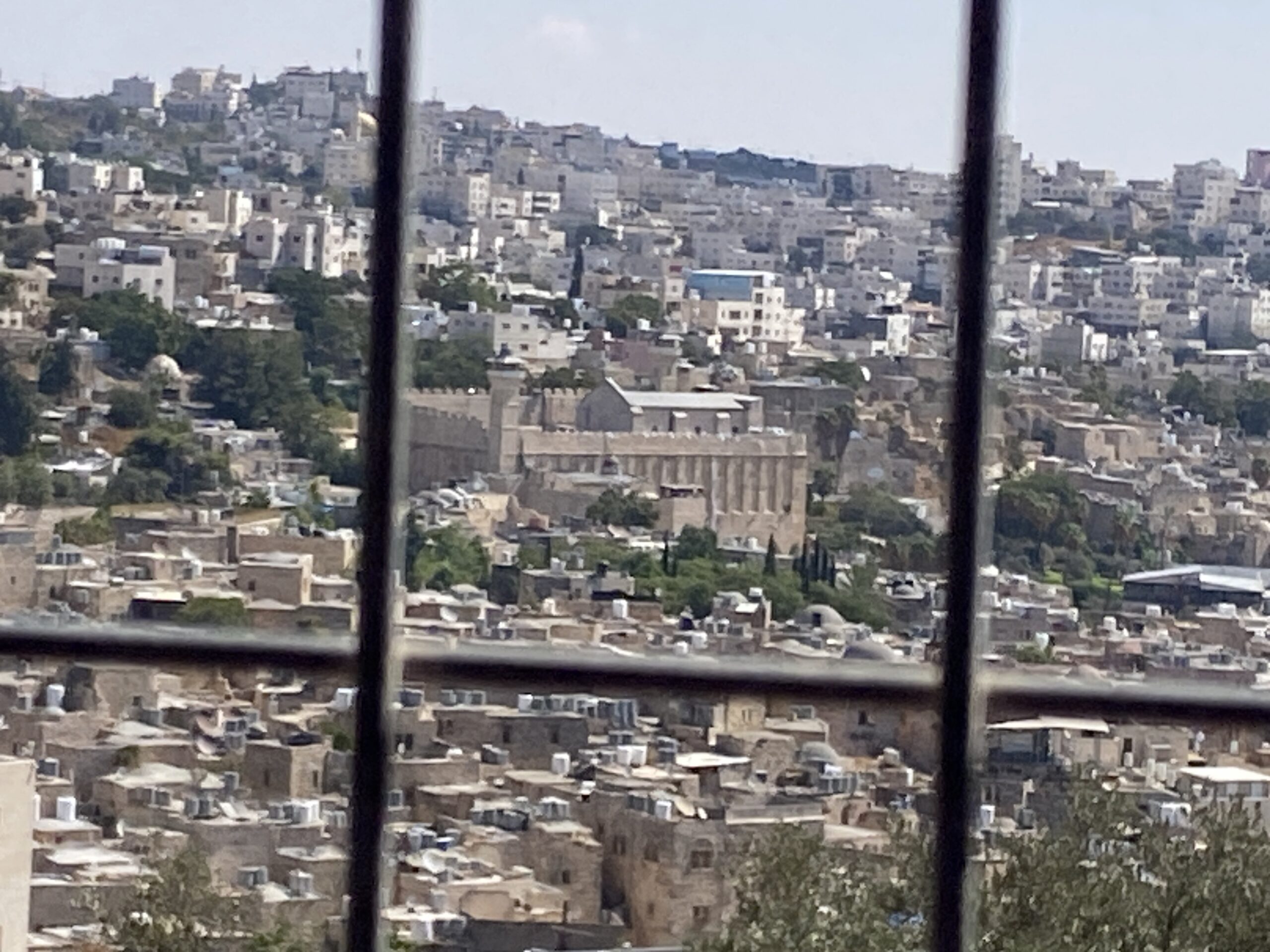 Yael ZoranSep-24-2026Hebron and the Cave of the Patriarchs from Beit Hashalom
-
