
Birin - destruction of houses, fields and a welll]]

We went to meet Abu Safi and to hear and see for ourselves some of the events of the last few days in the south of Mount Hebron. We went to Wadi Radim, which is located right at the foot of the buildings of the South Mount Hebron Regional Council.
Abu Safi and his family have lived there since time immemorial. He was born there and is 76 years old. For the past two years, he and his neighbour have been suffering from severe abuse by a new settler named Israel Kaplan.
He takes his flocks into the fields where the produce is grown and the sheep eat everything that grows. The day before we came, the settlers would not even let his daughter bring the sheep to the water hole to water them. Abu Safi has a very serious heart disease, recently, and is facing surgery. He can no longer walk around with his herds or work his fields or continue his attempts to negotiate with the settler. The latter is doing everything to make life there miserable for him and his neighbour so that they leave and he can take over the lands which in his view are state lands even though they belong to the local people with documents of ownership.
The neighbour who leased the lands from their Palestinian owners, has already given up and left for Yatta.
Abu Safi will not move, but his situation is very difficult. He says that when he called the Hebron police for help, they told him to come and file a complaint. They would not help him even when he talked about his mobility difficulties and asked them to come to him and evacuate the settlers. They refused. I tried to call an volunteer of old who visits him often and has a suitable car and time to help, and he said that he sent another person there and he can only come to visit him tomorrow. Abu Safi’s helplessness and our inability to help is really very discouraging.
Nasser and Bassel called us about the many demolitions taking place this morning in the area. This is mainly in the area of Birin.
We went there. The village is close to the Pni Hever settlement on road 356 and very close to the Mitzpeh Ziv, which was established about 20 years ago in memory of Yehuda and Yoav, two soldiers who were killed then by “friendly” fire.
Until now there was a site where people came to gather for prayer and observation. Recently they started preparing the place for construction. The people of Birin believe that this is the reason why they have been destroying them with great intensity in the last two years.
Farid, the head of the village, tells of a small village of 700 people. In the morning the Civil Administration came and destroyed land which had been cultivated and planted, the surrounding fences and a water well. Now the hundred children of the village study in someone’s private building until the 8th grade and then continue in Bani Naim, the Palestinian settlement closest to them. Someone tells us that also two houses have been demolished.
The anger and rage of the people is obvious. They ask what we can do to help them, and we can only express our sorrow and shame and tell them that we will continue to publish and ourselves resist the occupation as much as we can. From Farid’s yard we saw how close the outpost was on the hill next to them and that the first residential building has already been built. When we said we would go there to take a closer look, they warned us that the settlers would probably prevent us from getting closer.
We went anyway. According to the signs inviting you to the outpost you could think that there is something interesting there.
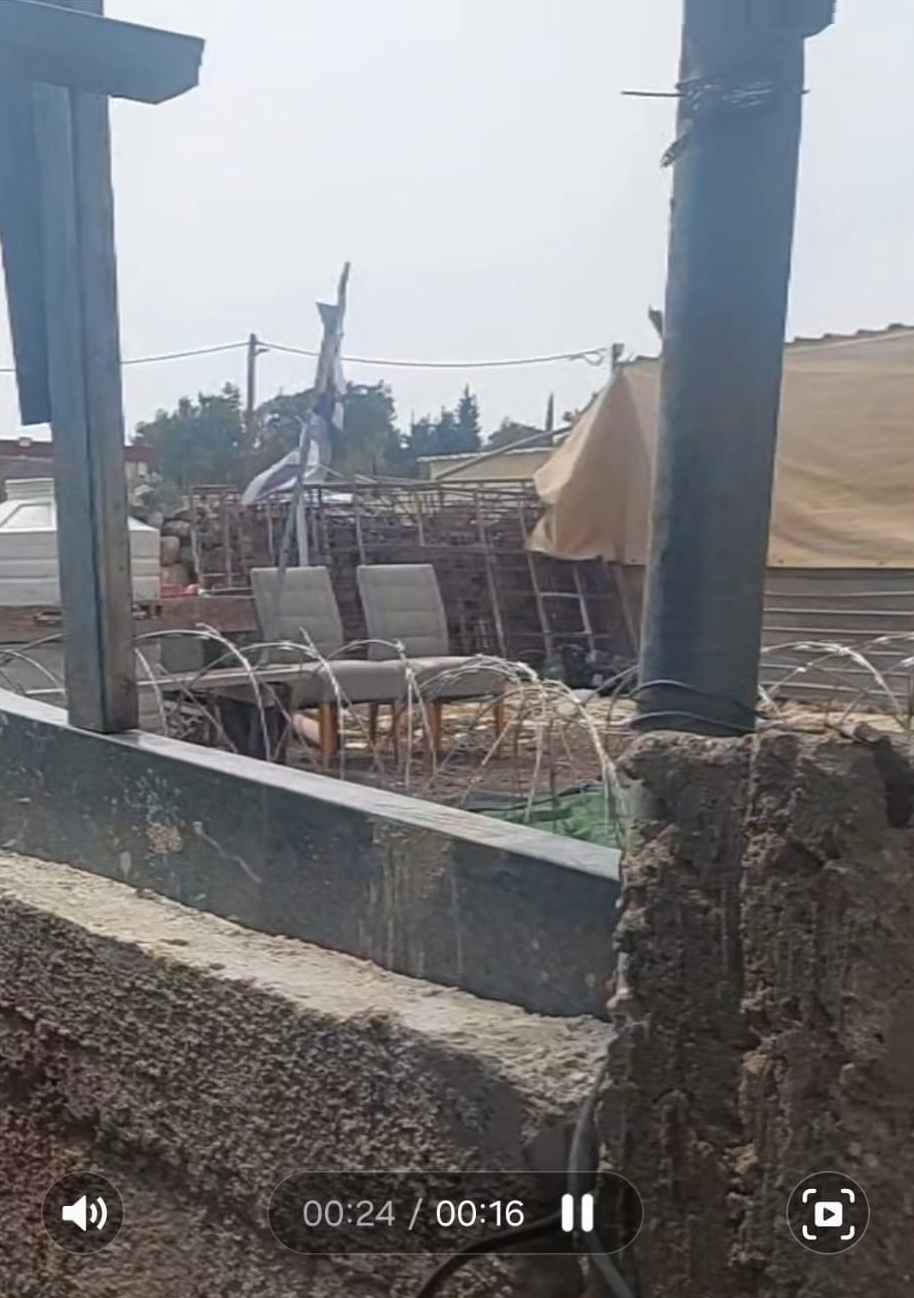
But the outpost looks very deserted despite all the signs and equipment which hint at gatherings for prayer there. We will continue to monitor the signs of change in what is happening.
South Hebron Hills
See all reports for this place-
South Hebron Hills
South Hebron Hills is a large area in the West Bank's southern part.
Yatta is a major city in this area: right in the border zone between the fertile region of Hebron and its surroundings and the desert of the Hebron Hills. Yatta has about 64,000 inhabitants.
The surrounding villages are called Masafer Yatta (Yatta's daughter villages). Their inhabitants subsist on livestock and agriculture. Agriculture is possible only in small plots, especially near streams. Most of the area consists of rocky terraces.Since the beginning of the 1980s, many settlements have been established on the agricultural land cultivated by the Palestinians in the South Hebron Hills region: Carmel, Maon, Susia, Masadot Yehuda, Othniel, and more. Since the settlements were established and Palestinians cultivation areas have been reduced; the residents of the South Hebron Hills have been suffering from harassment by the settlers. Attempts to evict and demolish houses have continued, along with withholding water and electricity. The military and police usually refrain from intervening in violent incidents between settlers and Palestinians do not enforce the law when it comes to the investigation of extensive violent Jewish settlers. The harassment in the South Hebron Hills includes attacking and attempting to burn residential tents, harassing dogs, harming herds, and preventing access to pastures.
There are several checkpoints in the South Hebron Hills, on Routes 317 and 60. In most of them, no military presence is apparent, but rather an array of pillboxes monitor the villages. Roadblocks are frequently set up according to the settlers and the army's needs. These are located at the Zif Junction, the Dura-al Fawwar crossing, and the Sheep Junction at the southern entrance to Hebron.
Updated April 2022
 Michal TsadikOct-12-2026Umm al-Khair - Concertina wire and fences
-
