
Central West Bank: Expansion of Outposts, Violence, and Harm to Residents in the Nablus Area
We entered via Route 5. We drove to Aqraba for a meeting Fathiya had coordinated with the mayor. Opposite the entrance to Aqraba, a new outpost named Oz Yehuda had recently been established. We met the mayor at the municipality. He recounted that they had requested permission to erect an entrance gate and a proper “Welcome” sign, but were denied approval because the area lies within Area C; the town itself is divided between Areas B and C.
The conversation focused primarily on the killing of Muhammad Khader Bani Jaber by the army during the night of September 7–8. According to the mayor, soldiers arrived at his home at 2:00 AM and called for him to come out. One version suggests he was a wanted man, though the reason was unclear. He was afraid to step outside; the soldiers fired tear gas, and as he emerged from the doorway, they shot him immediately, killing him. Muhammad was an only son, a young man who had married just 40 days before his death. His widow has returned to her family’s home in Majdal Bani Fadil, and his mother is being supported by her brother. The mayor also described the situation in Khirbet al-Tawil, on the outskirts of Aqraba: settlers had driven families from their homes and pitched tents among the houses. A Red Cross team and representatives from the Coordinator of Government Activities in the Territories (COGAT) arrived to assess the situation. He noted that the municipality recently hosted an appreciation dinner for about 50 people—half of them residents of Khirbet al-Tawil and the other half Israelis who assist them by maintaining a protective presence. The situation in Khirbet Yanun is also dire; after residents were driven out, the school in Upper Yanun was demolished. The mayor seeks to rebuild a school in Lower Yanun. Although the site is in Area B—where, in theory, no Israeli permit is required—settlers and the Civil Administration are obstructing the plan.
In response to our question, the mayor stated that the municipality lacks a mental health support unit and relies on external organizations. He recalled a successful meeting about two years ago with *Haaretz* journalist Gideon Levy; following an article Levy published about Aqraba, representatives from the US Embassy also visited. The large Palestinian flag flying at the town entrance, which had been torn by the wind, had not yet been replaced; the mayor explained that flags require frequent replacement, which poses a financial burden. We parted ways, hoping for an improvement in the situation after the elections in Israel.
On the way back from Aqraba, Fathiya spoke by phone with N., a resident of Khirbet al-Marajim, on the outskirts of Duma. He said that settlers continue to graze their cattle on the land facing the residents’ homes. The area has been declared a closed military zone, yet settlers enter it without hindrance. At that moment, soldiers arrived at the site, looking for volunteers from peace organizations. In light of what he said, we abandoned our plan to go there and drove toward Huwara instead.
We made a stop in Beita. The man Fathiya knows was unavailable, but he called later to say there were problems there too, and promised to send photos and explanations. We saw that the army had once again demolished the wholesale market in Beita; this was not the first time, and each time, operations simply shift to a different location.
We continued to the school on the outskirts of Huwara. Along the way, we saw bulldozers and pipes by the roadside, with “Mekorot” flags on the construction equipment. A Palestinian guard at the site said a new water line was being laid for Yitzhar.
We did not get very close to the school, which appeared empty. The Palestinian flag—which, during our previous visit, had flown from the structure and was visible from afar—had been moved to a flagpole at the front of the building. From the end of the road, we looked out at the outpost situated below Awarta; from a distance, it appeared to have expanded since our last visit. We could make out horses and the “Temple Flag” there.
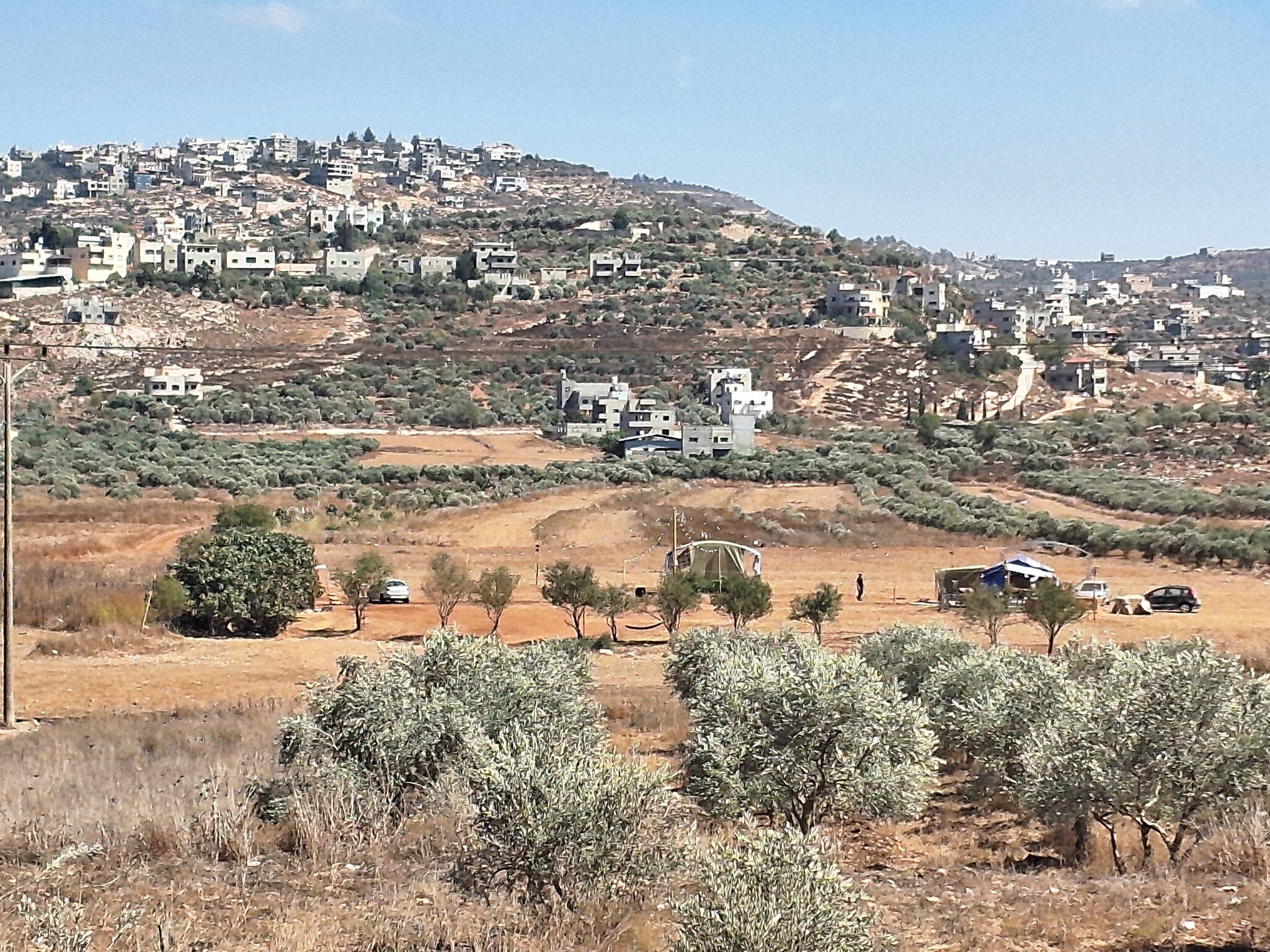
Inside Awarta, we met young men who recounted that the previous evening, two security jeeps from the Itamar settlement entered the village. One of them, S., recounted that he had gone out to exercise on the main road at 9:00 PM. According to him, the security personnel fired toward his feet to force him to stop; he was not hit, but bullets struck a vehicle parked nearby. After he stopped, they pounced on him, threw him to the ground, and stomped on him.
In a grocery store, we spoke with the shopkeeper, M., and a customer who was there. They related that settlers enter the village almost daily. On one night, men from the new outpost entered a home where the husband works night shifts and was absent. They forced the woman and children out of the house and stayed inside until morning, singing and dancing. They added that settlers also come to the maqam (shrine) to pray. (According to Google Maps, one side of Awarta contains the Tomb of Itamar son of Aaron, and the other side contains the Tomb of Eleazar son of Aaron). During the previous olive harvest season, they were prevented from harvesting, and M. shared that he was attacked with pepper spray when he attempted to harvest. Will the upcoming harvest be any better?…
On the way out of Awarta, we saw an area of burned olive trees and the shooting ranges set up there about a year ago. At the checkpoint on the road leading back from Nablus there were soldiers; in the direction toward Nablus there were none.
We drove through Burin to the Till Checkpoint (on the road leading to Nablus via the village of Till). The checkpoint was open and no soldiers were present. In both directions there are gates, and between them stands a stall selling vegetables, mostly onions and pumpkins. People at the site told us that the army considers the area a military zone where filming is prohibited, and that they monitor via cameras to see if anyone is filming. We filmed from inside the vehicle nonetheless.
Till Checkpoint is open, and next to it is a post staffed by soldiers when the checkpoint is manned and operational.
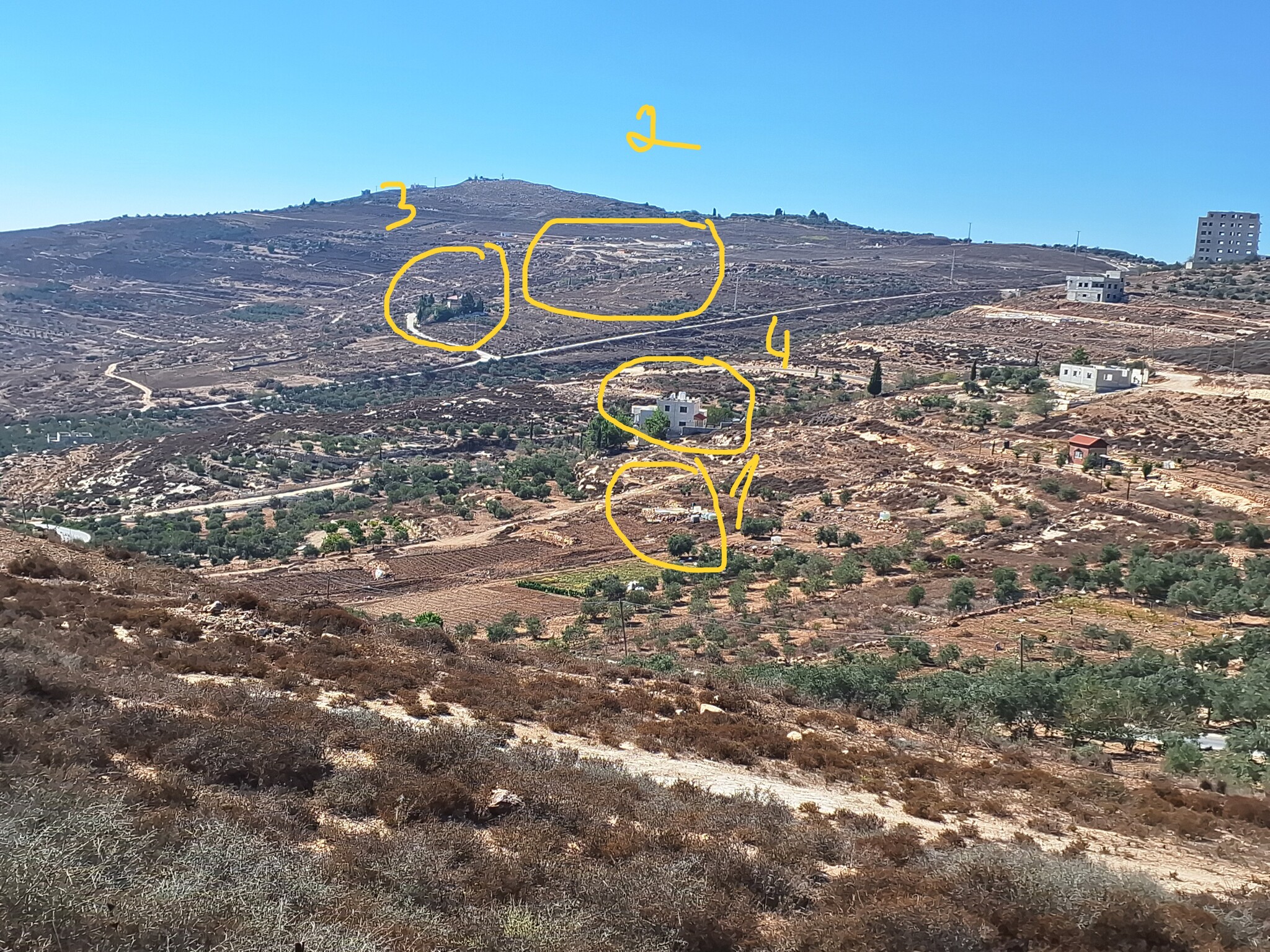
We drove down toward Madama. First, we stopped near a house we had visited in the past and photographed what we had then assumed was an outpost. Previously, we had promised the residents we would return to visit, but this time no one emerged from the house. We continued down into Madama and met a woman named Kh. Initially, she was apprehensive and startled when Ronny attempted to photograph her, but after Fathiya and Azzam, our driver, spoke with her and explained our peaceful intentions, she warmed up and invited us to the family home up the hill. She joined us in the car to show the way, while her young son ran up the footpath to open the entry gate for us.
We sat in the house’s courtyard (4), and Kh. showed us the surrounding area, explaining that what we had previously thought was an outpost (1) is actually land cultivated by Palestinians. In contrast, she pointed out a large outpost (2) adjacent to the home of her relatives, a house situated among the trees (3) whose residents are virtually besieged due to the settlers. Later, from Route 60, we could clearly see how close the outpost is to that house among the trees. (The numbers in parentheses refer to the markings in the photo)
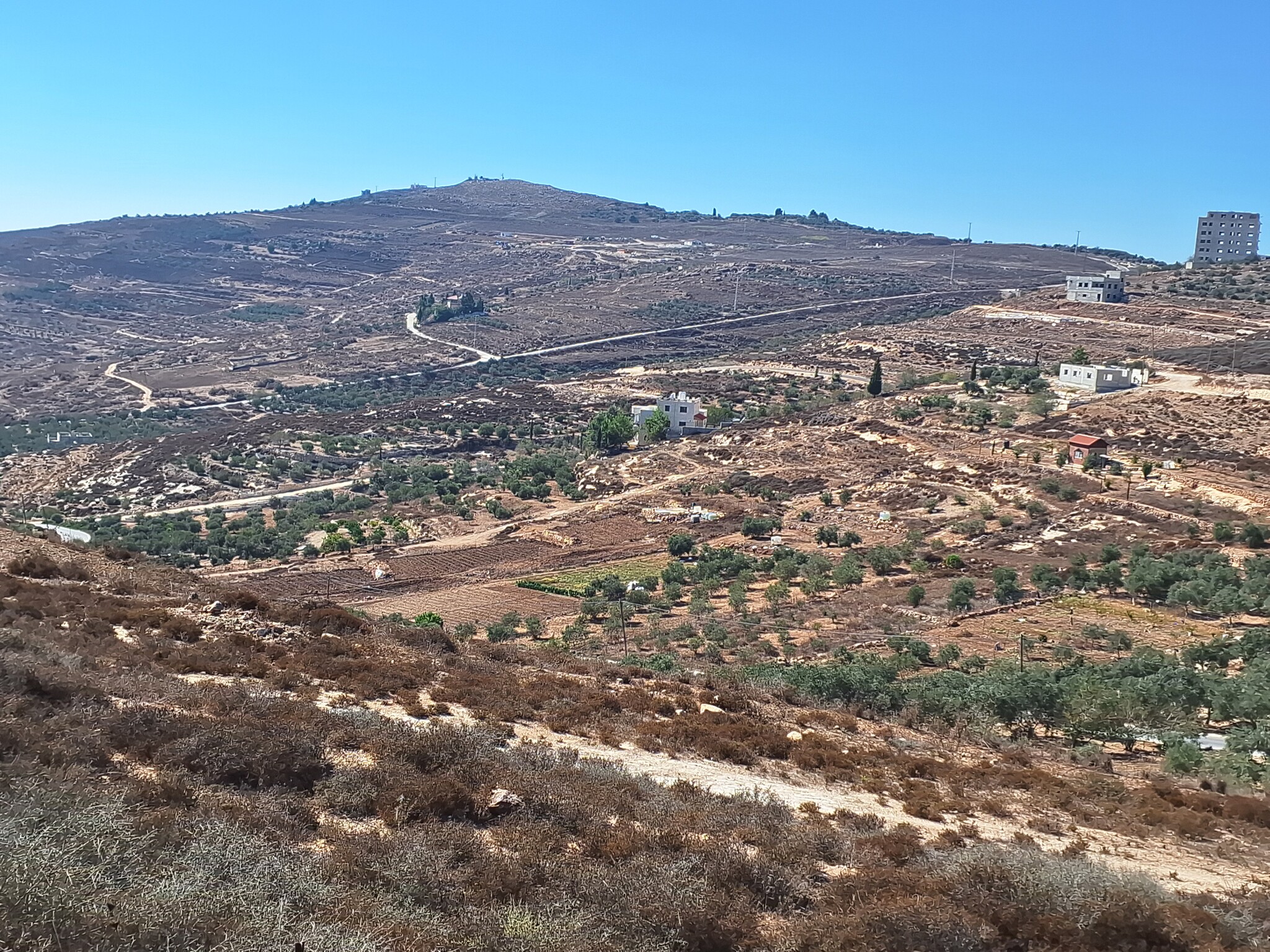
According to Kh., settlers arrive almost daily, enter home yards, come up to the steps, and sometimes attempt to step inside. They also send children to graze sheep right next to the house. The family began constructing a fence around the house but lacks the funds to complete it. In the olive groves, settlers entered a small structure housing a water reservoir and dumped out all the water.
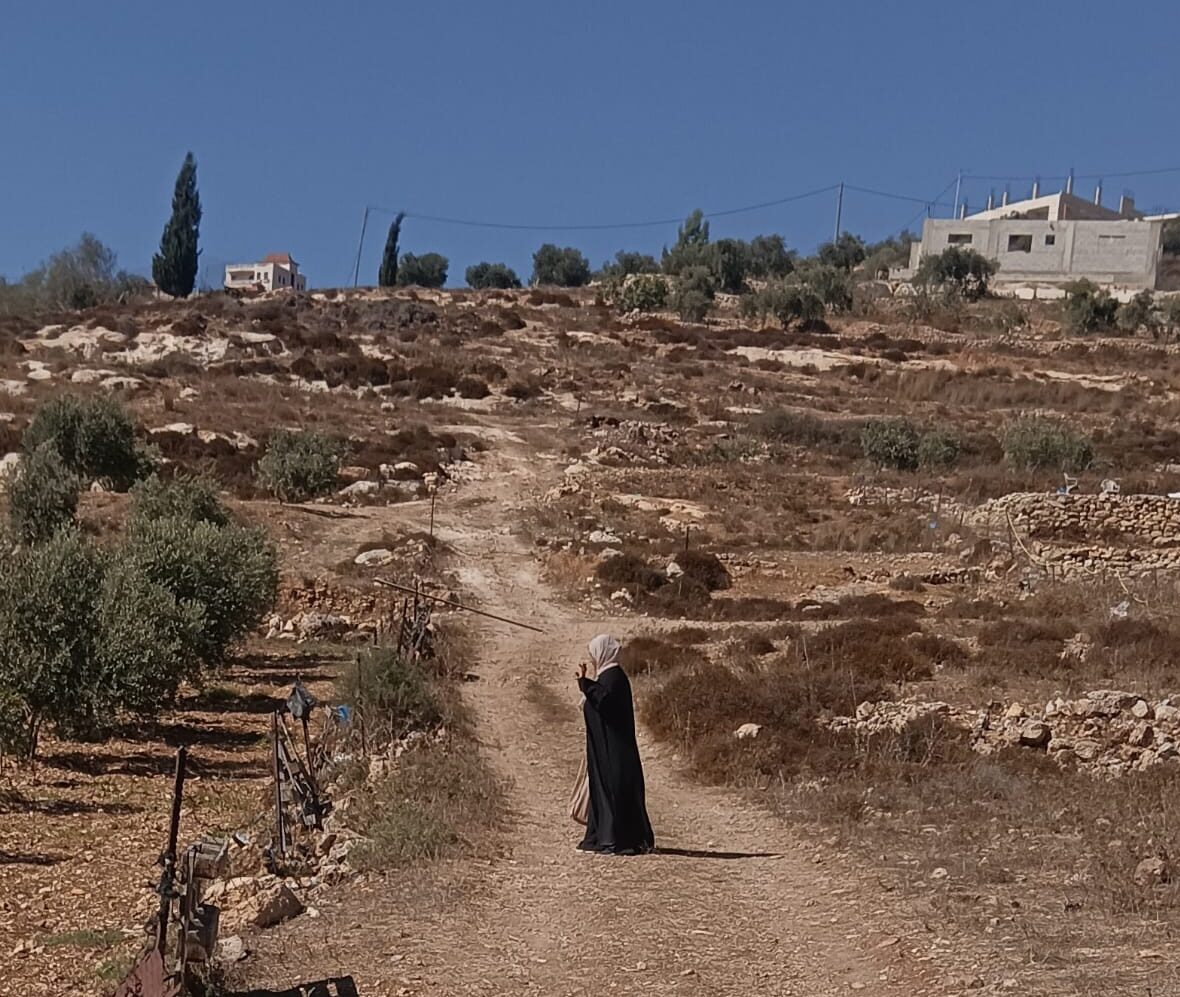
P., Kh.’s adult son, related that about two weeks ago settlers arrived at the house. He summoned the military for help, but instead, the settlers handcuffed him and handed him over to the soldiers. According to him, they bound his hands behind his back, laid him face-down on the ground, and detained him for about seven hours, during which he was also beaten. He is 18 years old, works with his father, and is saving money to get married.
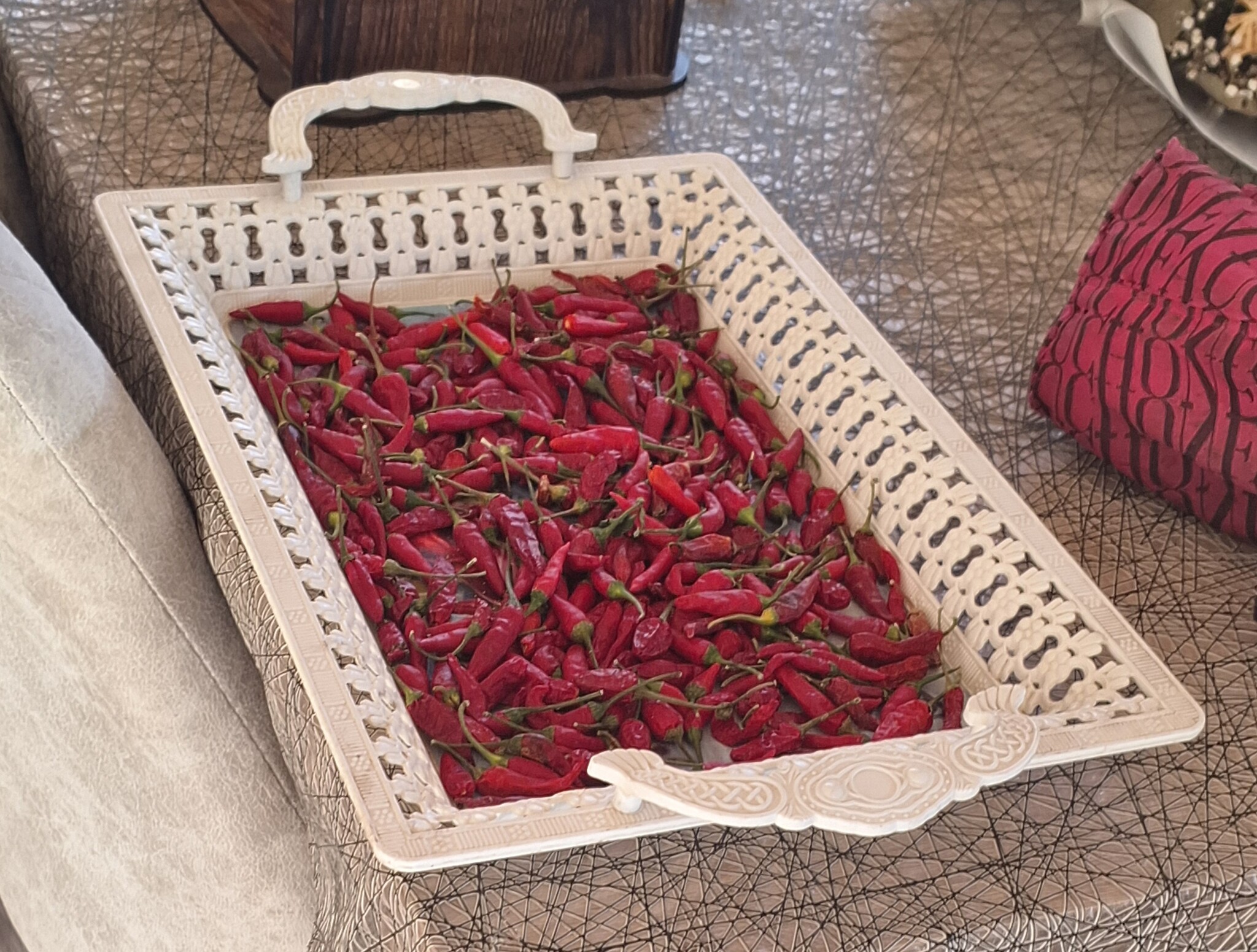
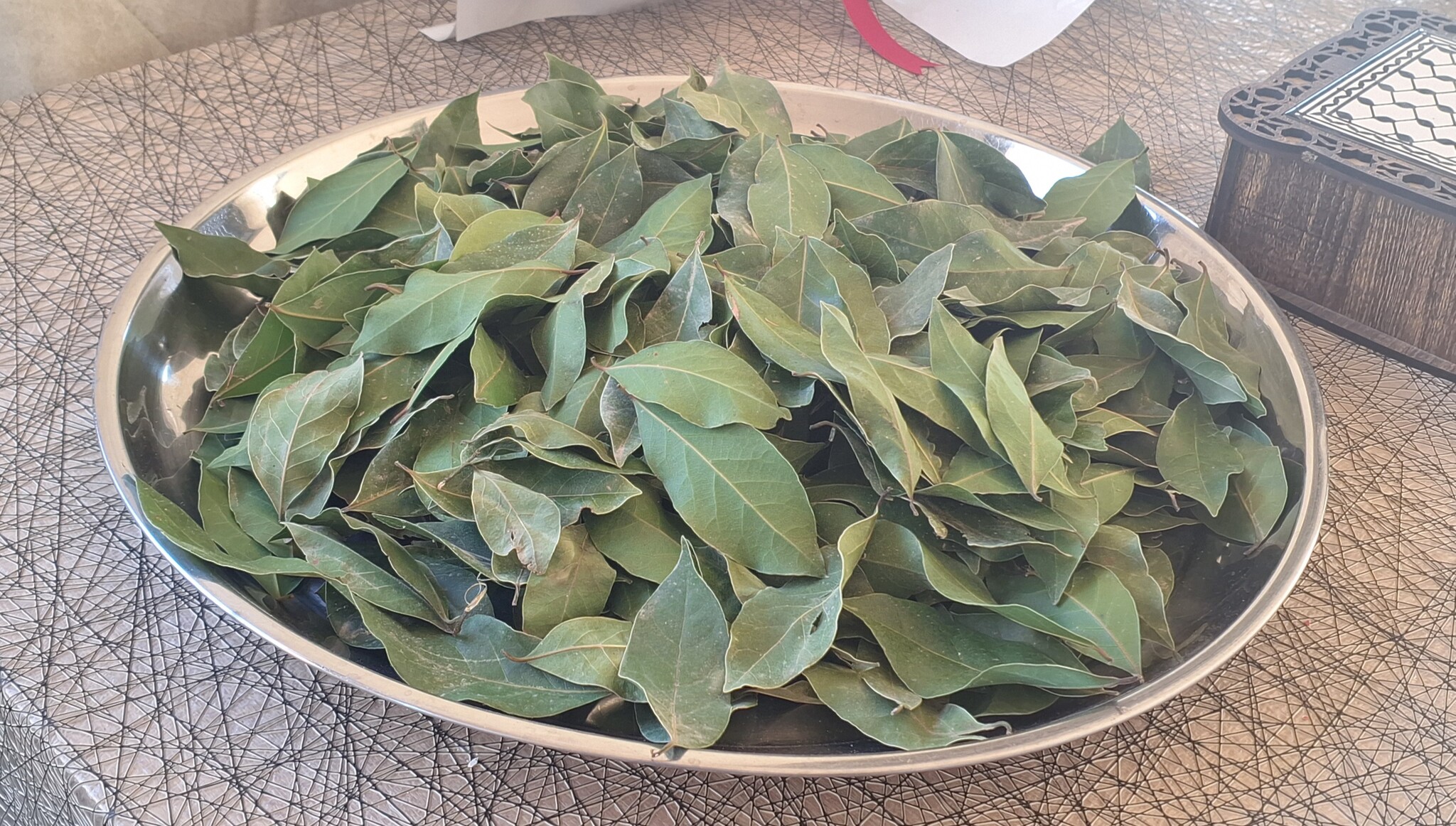
After drinking coffee and taking our leave, we drove down toward the center of Madama and from there to Burin, to visit our friend D. This time she was drying small hot peppers and bay leaves.
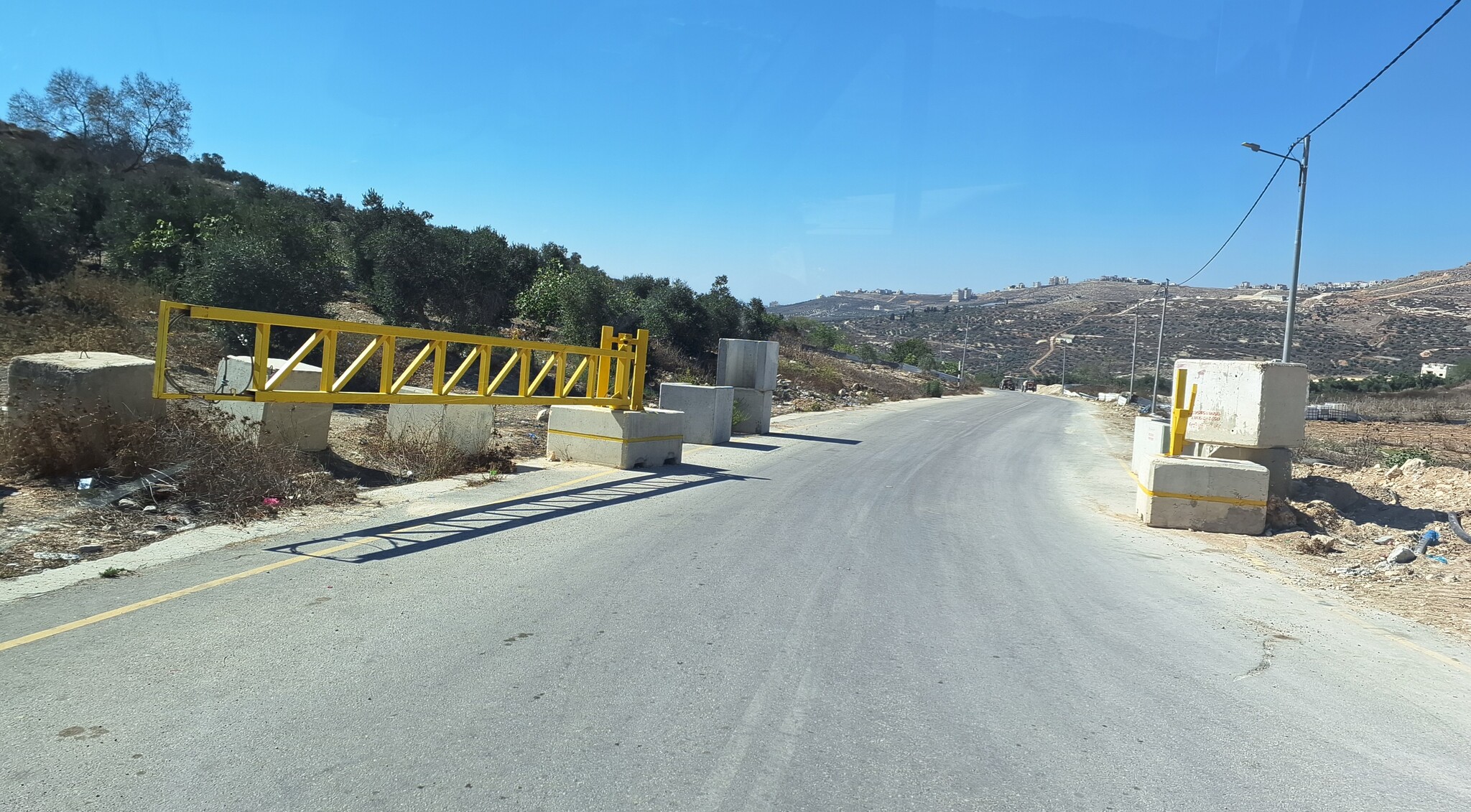
On the way back, at the Sarra junction, there was a major traffic jam and many soldiers. The yellow gate on the road coming from Nablus through Sarra toward Route 60 was closed. From the opposite direction, an ambulance arrived with sirens blaring—perhaps an accident had occurred.
Further along, via Route 55, the western entrance to Nabi Elyas remains, or is once again, closed.
Location Description
'Awarta
See all reports for this place-
Awarta, an internal checkpoint in the heart of the West Bank, is located east of the Hawara checkpoint, at the junction of Roads 555 (which was forbidden for Palestinian traffic in this area) and the entrance road to Nablus. It was one of the four checkpoints that surrounded Nablus until 2009. We used to watch it at Huwwara shifts because it was the only one where goods could be transferred to and from Nablus, using the back-to-back method. It was operated by the army, from 06:00 to 20:00. Until 2009.Ronit Dahan-RamatiSep-10-2026Awarta. Outpost below the town
-
Burin (Yitzhar)
See all reports for this place-
Burin (Yitzhar)
This is a Palestinian village in the Nablus governorate, a little south of Nablus, on the main road passing through the West Bank. The settlements: Yitzhar and Har Bracha, settled in locations that surrounded the village, placed fences so it is cut off the main road.
There are around 4000 inhabitants. Most of them are engaged in agriculture and pasture, although many graduates of the two secondary schools continue to study at the university. Academic positions are hardly available, they find work as builderd, or leave for the Gulf countries.
The village lands were appropriated several times for the establishment of Israeli settlements and military bases, and as a result, Burin's land and water resources dwindled. lSince 1982, more than 2,000 dunams of village land have been declared "state land" and then transferred to Har Bracha settlement.
Over the past few years and more so since 2017, the villagers have been terrorized by the residents of Yitzhar and Har Bracha, the Givat Ronen outpost and others. Despite the close proximity of soldiers to an IDF base close to one of the village's schools, residents are suffering from numerous stone-throwing events, vehicle and fire arson, also reported in the press.
In 2023, the prevention of the olive harvest in the village plot was more violent than ever. Soldiers and settlers walked with drawn weapons between the houses of the village and demanded that people stop harvesting in the village itself and in the private plots outside the village. The settlers from Yitzhar and Giv'at Roned raided the olive groves and stole crops. 300 olive trees belonging to the residents of Burin, near Yitzhar, were uprooted. The loss of livelihood from the olives causes long-term economic damage to the farmers' families, bringing them to the point of starvation.
(updated for November 2023)
-
Huwwara
See all reports for this place-
The Huwwara checkpoint is an internal checkpoint south of the city of Nablus, at the intersection of Roads 60 and 5077 (between the settlements of Bracha and Itamar). This checkpoint was one of the four permanent checkpoints that closed on Nablus (Beit Furik and Awarta checkpoints to the east and the Beit Iba checkpoint to the west). It was a pedestrian-only barrier. As MachsomWatch volunteers, we watched therre since 2001 two shifts a day - morning and noon, the thousands of Palestinians leaving Nablus and waiting for hours in queues to reach anywhere else in the West Bank, from the other side of the checkpoint the destination could only be reached by public transport. In early June 2009, as part of the easing of Palestinian traffic in the West Bank, the checkpoint was opened to vehicular traffic. The passage was free, with occasional military presence in the guard tower. Also, there were vehicle inspections from time to time. Since the massacre on 7.10.2023, the checkpoint has been closed to Palestinians.
On February 26, 2023, about 400 settlers attacked the town's residents for 5 hours and set fire to property, such as houses and cars. Disturbances occurred in response to a shooting of two Jewish residents of Har Bracha by a Palestinian Terrorist. The soldiers stationed in the town did not prevent the arson and rescued Palestinian families from their homes only after they were set on fire. No one was punished and Finance Minister Smotrich stated that "the State of Israel should wipe out Hawara." Left and center organizations organized solidarity demonstrations and support actions for the residents of Hawara.Hawara continued to be in the headlines in all the months that followed: more pogroms by the settlers, attacks by Palestinians and a massive presence of the army in the town. It amounted to a de facto curfew of commerce and life in the center of the city. On October 5, 2023, MK Zvi established a Sukkah in the center of Hawara and hundreds of settlers backed the army blocked the main road and held prayers in the heart of the town all night and the next day. On Saturday, October 7, 23 The "Swords of Iron" war began with an attack by Hamas on settlements surrounding Gaza in the face of a poor presence of the IDF. Much criticism has been made of the withdrawal of military forces from the area surrounding Gaza and their placement in the West Bank, and in the Hawara and Samaria region in particular, as a shield for the settlers who were taking over and rioting.
On November 12, 2023, the first section of the Hawara bypass road intended for Israeli traffic only was opened. In this way, the settlers can bypass the road that goes through the center of Hawara, which is the main artery for traffic from the Nablus area to Ramallah and the south of the West Bank. For the construction of the road, the Civil Administration expropriated 406 dunams of private land belonging to Palestinians from the nearby villages. The settlers are not satisfied with this at the moment, and demand to also travel through Hawara itself in order to demonstrate presence and control.(updated November 2023)
.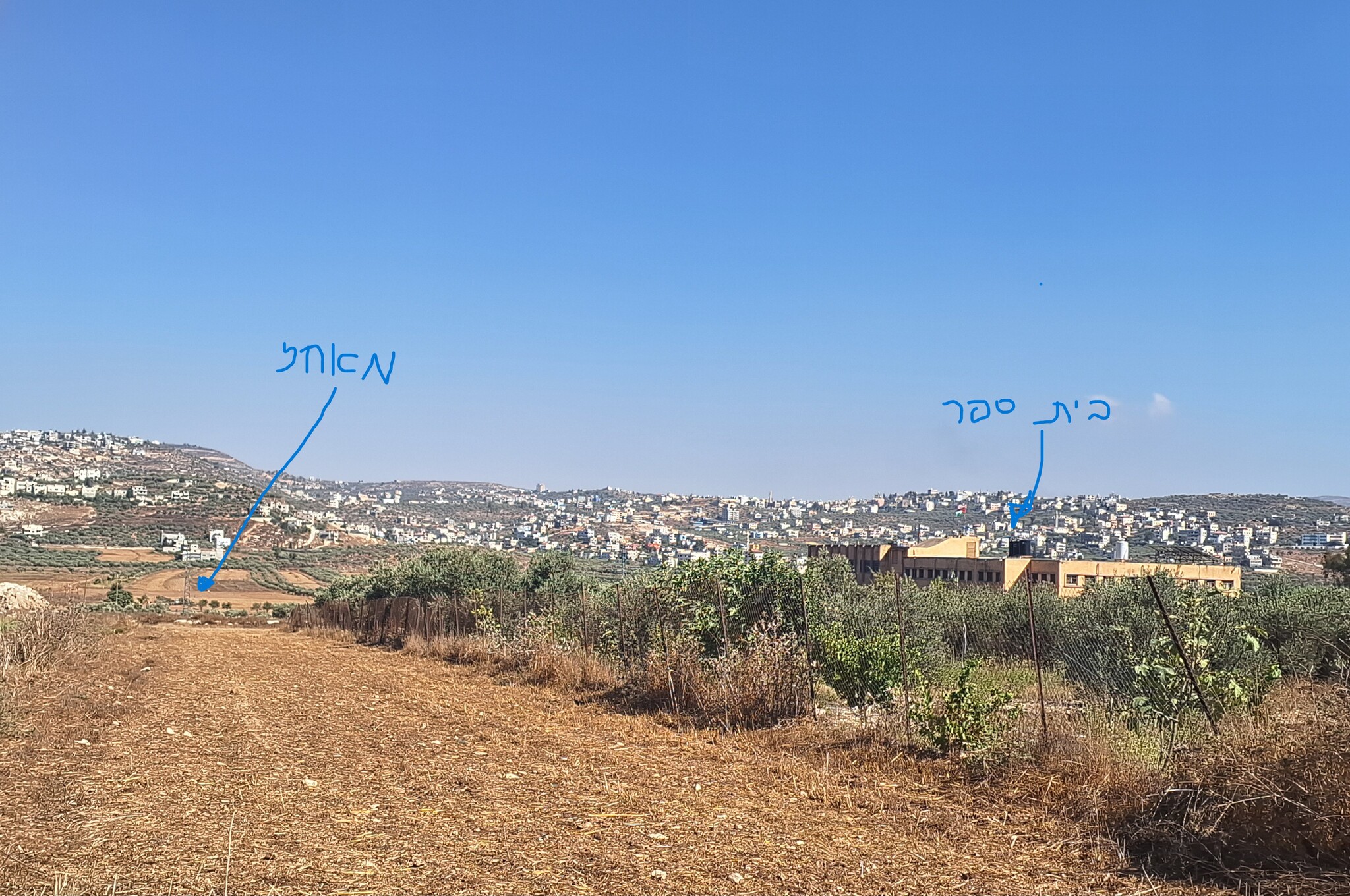 Ronit Dahan-RamatiAug-24-2026Huwara: The school on the outskirts of town and an outpost hidden among the trees
-
Madama
See all reports for this place-
Madama
This village is situated in the Nablus district, about 5 kilometers south of the city of Nablus, at an altitude of 517 meters above sea level. Madama was founded 400 years ago and its villagers originate from the Arabian Peninsula. It numbered 1,728 inhabitants in 2007. 62% of the village area is categorized as Area B, and 38% as Area C.
Over the years, hundreds of dunams have been robbed of the village for the purpose of building settler-colonies, army bases, and paving roads:139 dunams were sequestered to found settler-colony Yitzhar south of the village, and the land was also confiscated for paving road 60. The road and its buffer zone (75 meters on each side) lined by barbed wire fences separate the village’s farmlands to the north and the village farmers are denied access to tend them. The road also separates Madama and Burin, two villages with close neighborly ties, and now not able to access the road directly.
The settler-colony Yitzhar has become a daily threat to the village. The settler-colonists planted trees in fenced-in groves, steal crops, burn, uproot and vandalize Palestinians’ trees, and harm both holy sites and property. They also attack the Palestinian landowners in order to terrorize them and prevent them from accessing their lands.
For further information: http://vprofile.arij.org/nablus/pdfs/vprofile/Madama_vp_en.pdf
-
