
Deir Ballut, Huwwara, Yasuf, Za’tara (Tapuah)
An especially difficult day.
09:30 Departure from Rosh Ha'Ayin.
10:00 Arrival at Dir Ballut. We were supposed to begin a session with a group of women, as was agreed with them last week. The feeling is festive. To our surprise, a lad arrives from the council house and informs us that the women will not come. Without prior notification, without explanation. Nadim calls Nivin, the organizer. At first she is evasive. And bit by bit the truth is exposed: one of the council memebers opposes our activity and under his influence it was decided to cancel our activities.
How can such a step be explained? One reason which, as far as we are concerned, it is easier to digest is – "the conservative men don't want to expose the women to "modernity". A more difficult reason – "we don't need your favours". Be it as it may,the fact was that we were kicked out. Sad.
10:15 Departure for a tour.
As we had time on our hands, we decided to make it an expanded tour. We didn't imagine that we would find ourselves in the heart of a terrorist attack which would develop into Price Tag. On the way to the Tapuah junction we already saw more military vehicles that usual. At the junction itself. Near the bus station, there was a big gathering.
Policemen, soldiers, armed settlers. We approach and try to find out what has happened. It turned out that around 09:00 hrs a Palestinian fatally stabbed a settler from Yitzhar, snatched his weapons, and tried to get away. Soldiers shot at him and wounded him. He isn't around anymore, was evacuated by ambulance to the hospital.
A woman settler tells us assuredly that the assassin is from Yasuf, near Yitzhar. Later it transpires that he came from afar: from the village of Shwayka near Tul Karem (it may be hoped that at least for the moment Yasuf is saved from a retaliatory act…).
We tried to extract explanations: what led to the stabbing? After all it is not logical to assume that a person looking for revenge would choose such a long trail so far from his home (which makes his rescues in a hiding place more difficult) just in order to stab somebody? Just like that? What was the trigger that cause the violent outburst? Was there a prior acquaintanceship between them? What inflamed the atmosphere between the settler and the Palestinian prior to the stabbing?
We didn't get any answers to our querries. Will the investigators eventually try to find out whether the stabber had a motive? This remains to be seen.
While the military Zaka people (a religious organization of volunteers for finding and rescuing people injured in a disaster) perform their work, young people who fit according to their looks the description of the Youth of the Hills arrive from nowhere and the atmosphere becomes heated. One young man tries to shoo us away. "Who are you, are you the police?" we ask. And the answer, directed at Natalie is: "If you weren't a woman, I would crack your skull".
11:00 We leave. On the radio we hear the details of the event. Military jeeps patrol along the road. Every 100-200 meters there is a group of soldiers who block with spikes vehicles which drive in the direction of the Tapuah intersection. We, driving in the opposite direction. Pass without being checked.
All along the way, at the entries to each village, there are road blocks. Nobody can enter or leave. We arrive at Huwwara. Surprisingly the main road is lively. But in sporadic conversations with people it transpires that they are aware of the going-ons: "There is a mess". And indeed there is.
Ambulances pass with sirens, driving at high speed in both directions. And that's the reason: at the exit from Huwwara, at the roadside, there is a parked bus which drove girl pupils from their school. The front window is smashed. Wounded girls are transferred by ambulance for medical treatment. The price tag has begun its activities.
At the order of the border policemen we turn around and go in the opposite direction. Large groups of settlers, some of whom are armed, are seen along the road. How did they manage to pass through the police and army checkpoints??
12:30 Back to Rosh Ha'Ayin, to another reality, to another country. The news announce that the price tag activities which we witnessed are only the beginning.
Deir Ballut
See all reports for this place-
An internal checkpoint on Road 446 at the entrance to the village of Deir Ballut and near the settlements there, Alei Zahav and Peduel. Partially staffed, vehicles are inspected at random.
-
Huwwara
See all reports for this place-
The Huwwara checkpoint is an internal checkpoint south of the city of Nablus, at the intersection of Roads 60 and 5077 (between the settlements of Bracha and Itamar). This checkpoint was one of the four permanent checkpoints that closed on Nablus (Beit Furik and Awarta checkpoints to the east and the Beit Iba checkpoint to the west). It was a pedestrian-only barrier. As MachsomWatch volunteers, we watched therre since 2001 two shifts a day - morning and noon, the thousands of Palestinians leaving Nablus and waiting for hours in queues to reach anywhere else in the West Bank, from the other side of the checkpoint the destination could only be reached by public transport. In early June 2009, as part of the easing of Palestinian traffic in the West Bank, the checkpoint was opened to vehicular traffic. The passage was free, with occasional military presence in the guard tower. Also, there were vehicle inspections from time to time. Since the massacre on 7.10.2023, the checkpoint has been closed to Palestinians.
On February 26, 2023, about 400 settlers attacked the town's residents for 5 hours and set fire to property, such as houses and cars. Disturbances occurred in response to a shooting of two Jewish residents of Har Bracha by a Palestinian Terrorist. The soldiers stationed in the town did not prevent the arson and rescued Palestinian families from their homes only after they were set on fire. No one was punished and Finance Minister Smotrich stated that "the State of Israel should wipe out Hawara." Left and center organizations organized solidarity demonstrations and support actions for the residents of Hawara.Hawara continued to be in the headlines in all the months that followed: more pogroms by the settlers, attacks by Palestinians and a massive presence of the army in the town. It amounted to a de facto curfew of commerce and life in the center of the city. On October 5, 2023, MK Zvi established a Sukkah in the center of Hawara and hundreds of settlers backed the army blocked the main road and held prayers in the heart of the town all night and the next day. On Saturday, October 7, 23 The "Swords of Iron" war began with an attack by Hamas on settlements surrounding Gaza in the face of a poor presence of the IDF. Much criticism has been made of the withdrawal of military forces from the area surrounding Gaza and their placement in the West Bank, and in the Hawara and Samaria region in particular, as a shield for the settlers who were taking over and rioting.
On November 12, 2023, the first section of the Hawara bypass road intended for Israeli traffic only was opened. In this way, the settlers can bypass the road that goes through the center of Hawara, which is the main artery for traffic from the Nablus area to Ramallah and the south of the West Bank. For the construction of the road, the Civil Administration expropriated 406 dunams of private land belonging to Palestinians from the nearby villages. The settlers are not satisfied with this at the moment, and demand to also travel through Hawara itself in order to demonstrate presence and control.(updated November 2023)
.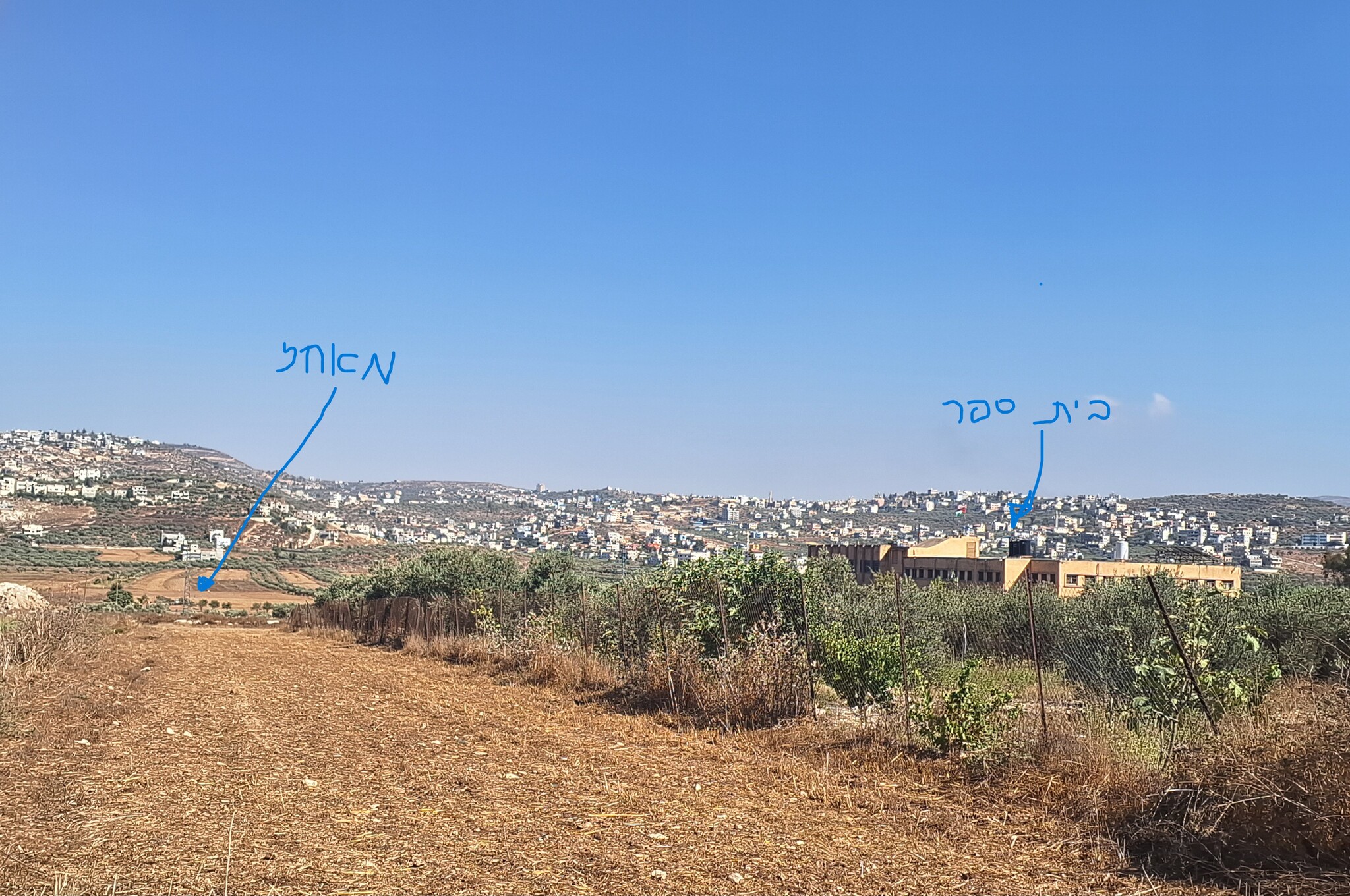 Ronit Dahan-RamatiAug-24-2026Huwara: The school on the outskirts of town and an outpost hidden among the trees
-
Yasuf
See all reports for this place-
Yasuf The village numbers 2,500 residents, and in the neighboring village of Iskaka about 1,500. Yasuf suffers from low water supply and intermittent flow - although the population has more than doubled since the Oslo Accords, the 12 cubic meters set in 1996, sometimes even less, are alternated between the two villages, summer and winter .Permits to complete the harvest are only given for a few days, and there are often roadblocks on the way to the groves and the settlers, mostly fr/om Tapuah, try to drive the harvesters away. Since 2006, the settlements have been expanded threefold from their original location, and the harassments are numerous - including vandalism of cars and spraying of hate-inscriptions on the mosque. The settlers from Kfar Tapuach took control of land belonging to the residents and planted their own trees, and the army does not allow the villagers to approach these plots.
-
Za'tara (Tapuah)
See all reports for this place-
Za'tara (Tapuah) Za'tara is an internal checkpoint in the heart of the West Bank, at the intersection of Road 60 and Road 505 (Trans-Samaria), east of the Tapuah settlement. This checkpoint is the "border" marked by the IDF between the north and south of the West Bank, in accordance with the policy of separation between the two parts of the West Bank that has been in place since December 2005. At the Za'tara checkpoint, there are separate routes for Israelis and Palestinians. In the route for Israelis, there are no inspections and the route for Palestinians inspects. The queue lengthens and shortens suits. The checkpoint is open 24 hours a day. The checkpoint is partially staffed and the people who pass through it are checked at random.
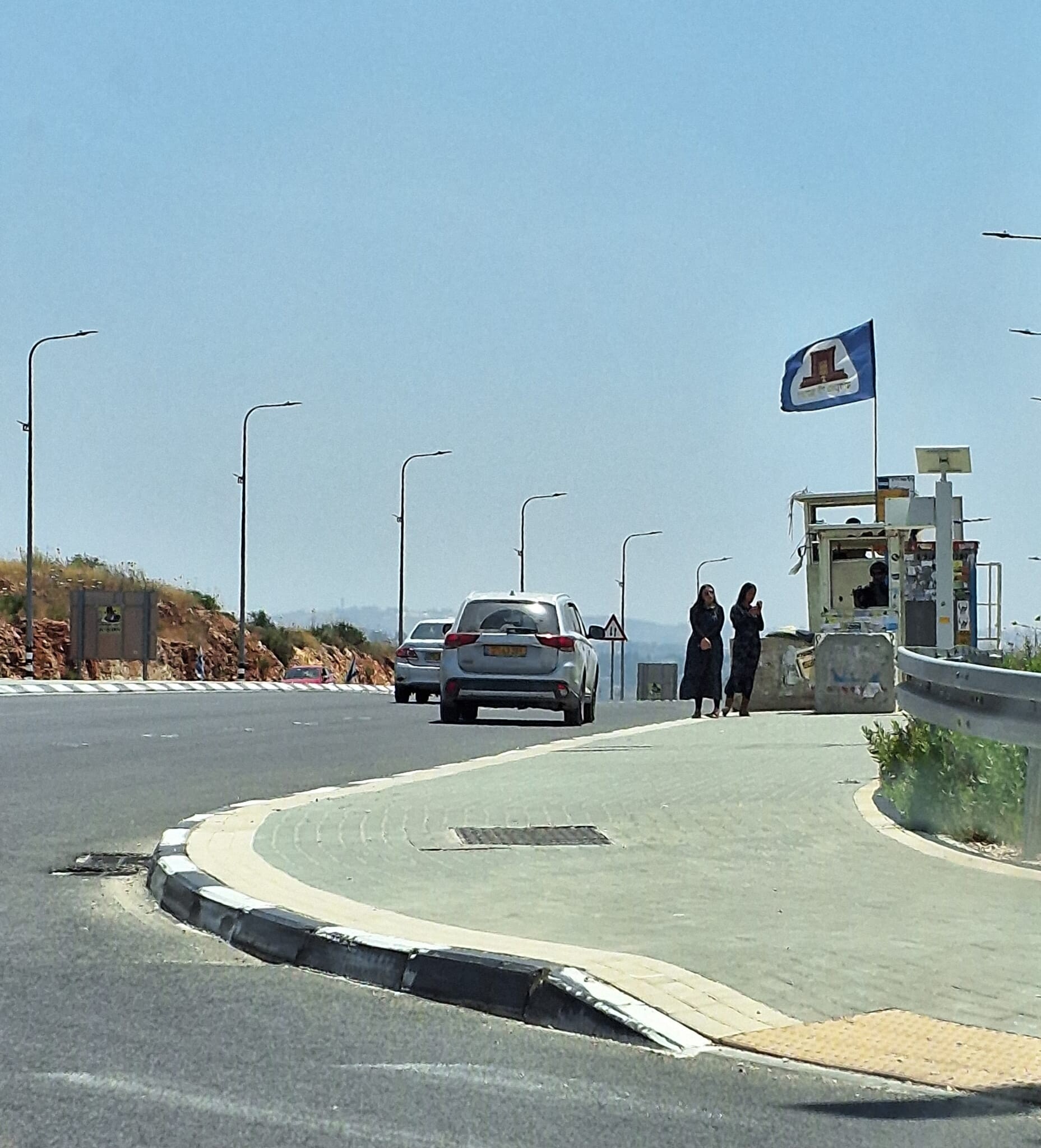 Ronit Dahan-RamatiJun-9-2026Za'atara (Tapuach Junction). The Temple Flag Above a Station
-
