
Deir Sharaf, Habla, Irtah (Sha’ar Efrayim), Jubara (Kafriat), Sun 4.3.12, Afternoon
Summary
One of the forgotten heroes of the endless conflict in these parts is Sari Nusseibeh, the “philosopher king” who has written about some of the roles he has played, or had cast upon him in “Once upon a Country.” We, with our monitoring at the checkpoints littered about what should be the nation state of Palestine, have noted, like Sari, that “humiliation” is the Occupation’s most powerful weapon. But there is another observation that also rings true to those of us who have gone to, and stood at, checkpoints, the understanding, no, the observation that, be it she or he, Israeli or Palestinian, each is “driven by fear and terror, totally unaware of the condition of the other…. the Jew seeks space to continue living, while the Arab defends his space to the death,” even when defense, as we most often observe, week in, week out, is rarely more than expressions of love for the land – another expression of steadfastness and perseverance – “sumoud” together with binding ties of home and belonging.
13:00 Habla
The weather continues to be terrible, and there is a profusion of rain and mud, wind and cold. Earlier, at our visit to the nursery, where a group of men were huddled around a fire made of avocado branches and other woods, we heard of two recent Seam Zone incidents: in the recent storm a soldier, a reservist, entered the schoolchildren’s bus at Habla and ordered the children to descend – in the pouring rain. He repeatedly addressed the young children as “chutzpanim” (cheeky). A Palestinian man who was escorting the children rebuked the soldier with the comment that he was the “chutzpan” and possibly had learnt the behavior in his own home. The woman military police there, seeing the young children standing in the rain, and hearing the altercation, eventually told the soldier to back off. Meanwhile, on a similar wintry weather day, typical of the ones we’ve been having lately, the shoe checking sensor at Gate 109 had been turned up to its full volume. The first pair of shoes checked through started a beep. All the Palestinians in line were ordered to remove their shoes and cross barefoot through the mud and rain.
Overall, a huge amount of disrespect is doled out to Palestinians, children, women and men alike on a day in day out basis. It stems, we’re told, not just from training in the army but “from the home.”
The checking of tractors, pony carts and humans is slow, the reservists taking their sweet time and making sure to check every animal or machine drawn vehicle.
14:00 Route 55
A new scene on the hill above Ramot Gilad: more white caravans, expanding the illegal outpost, telephone or electric wires, of course, included. And heedless to the rest of the world’s chorus of disapproval. More new caravans noted, also gleaming white, on the hill above Enav, the settlement on Route 57, by Anabta.
15:00 Deir Sharaf
Plenty of action here: Palestinians and Palestinian Israelis going in or out of Nablus in private cars, or regular and even tour buses. Others, wrapped in red and white checked kaffiyah, used as scarves to keep out the rain and cold, enjoy the freshly grilled meats at the rather gory roadside butcher shops,
16:00 Irtah (Sha’ar Efraim)
The guard insists on looking at our IDs, has never heard of MachsomWatch. A large crowd of returning Palestinian workers, many carrying panniers of strawberries, a few carrying sacks of oranges. At the torn down entryway, leading, eventually, homewards for those lucky Palestinians with work permits, there’s now a brand new turnstile, with the usual minimal space for getting through with anything being hand carried. We are immediately called by a gun toting guard and told that we are forbidden to be where we’re standing, or, rather, where we have been standing.
A group of men stop us, saying how bad it is at 4:00 in the morning when they are trying to get to work, and the line is long and unordered. Just yesterday, two men were beaten up and had to be taken to hospital. We gave the men the MachsomWatch card, telling them to call the MachsomWatch number. Frankly, with the guards we encountered today, anything is possible. It is clear that MachsomWatch is not known to the present shift of civilian guards.
Deir Sharaf checkpoint
See all reports for this place-
Deir Sharaf checkpoint is located west of Nablus and south of the settlement of Shavei Shomron, at the entrance to the village of Deir Sharaf on the road leading to Nablus. The checkpoint was activated in early March 2009 after the Beit Iba checkpoint was closed. Palestinians are allowed through the checkpoint , but not for Israelis. Unlike the checkpoints leading to Qalqilya and Tulkarm, crossing of Israeli Palestinians is only allowed on Saturdays.
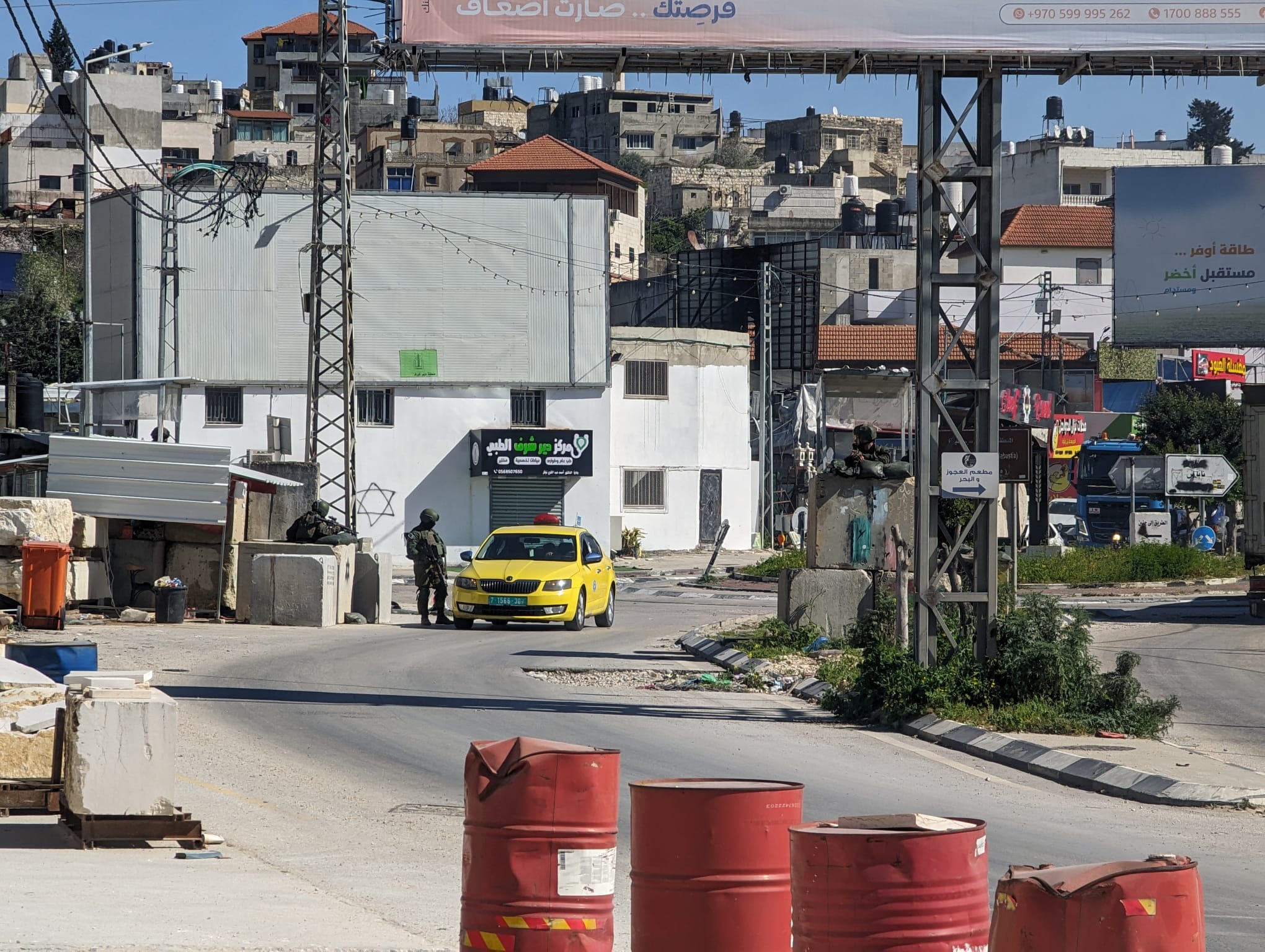 Nina SebaFeb-28-2024Deir Sharaf - the entrance to the village
-
Habla
See all reports for this place-
Habla CP (1393)
The Habla checkpoint (1393) was established on the lands of the residents of Qalqilya, on the short road that
connected it for centuries to the nearby town of Habla. The separation barrier intersects this road twice and cut off the residents of Qalqilya from their lands in the seam zone.(between the fence and the green line).
There is a passage under Road 55 that connects Qalqilya to the sabotage This agricultural barrier is used by the farmers and nursery owners established along Road 55 from the Green Line and on both sides of the kurkar road leading to the checkpoint.
This agricultural checkpoint serves the residents of Arab a-Ramadin al-Janoubi (detached from the West Bank), who pass through it to the West Bank and back to their homes. The opening hours (3 times a day) of this agricultural checkpoint are longer than usual, about an hour (recently shortened to 45 minutes), and are coordinated with the transportation hours of a-Ramadin children studying in the occupied in the West Bank.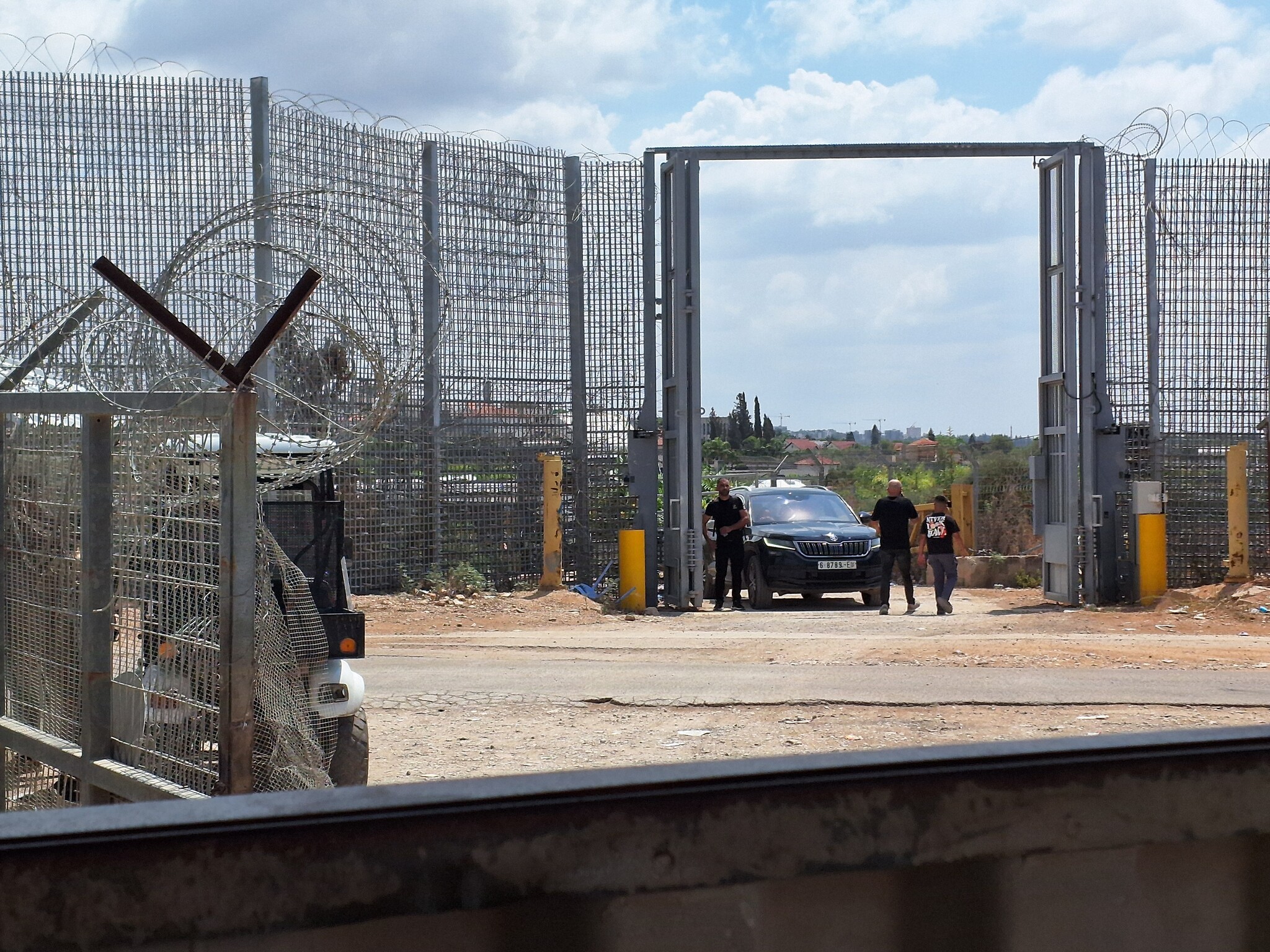 Ronit Dahan-RamatiAug-31-2026Habla. The gate is open
-
Irtah (Sha'ar Efrayim)
See all reports for this place-
The checkpoint is for Palestinians only. It is the main barrier to the passage of workers from the northern West Bank to Israel. Workers with a permit to work in Israel and also for trade (with appropriate permissions), medicine, and visiting prisoners. One can cross the checkpoint only on foot. The checkpoint is located north of Road 557 and south of Tulkarm. Operated by a civil security company, opening hours: between 4:00 and 19:00 on weekdays. As members of Machsom Watch, we began our shifts to this location in 2007. We arrived before it opened at 4 in the morning and report since, on the harsh conditions and the long and crowded queues of workers. The workers who pass by continue their journey by transportation to work throughout Israel. In the first period of its activity, about 3,000 and then 5,000 people passed through this checkpoint every day. Due to the small number of checking points and arbitrary delays for long periods of time in the "rooms", workers feared losing their transportation. Hence workers leave their homes at 2:30 at night to be among the first. Today, 15,000 pass and the transition is faster. Workers are still leaving their homes very early to get past the checkpoint at 7 p.m. In an adjacent compound, there is a terminal for the transfer of goods on a commercial scale, using the back-to-back method.
-
Jubara (Kafriat)
See all reports for this place-
The Jabra checkpoint was on Road 557, south of Tulkarm, on the side of the Figs Pass, which is located within the Palestinian Authority (a few kilometers east of the Green Line), and serves as an entry barrier from the territories to Israel. The checkpoint to the village of Jubara, which until 2013 was in the seam area, blocked and surrounded by a fence, was intended for the passage of the family members of the house next to the checkpoint, and also for the MachsomWatch volunteers (with special permission only), on their way to checkpoint 753. on the other side of the village. The soldiers supervising the "fig crossing" also supervised the crossing at this checkpoint, in our shifts we often waited a long time until the key was found and the gate opened. The checkpoint was abolished and became part of the separation fence that was moved west following the High Court.
-
