
Eliyahu Crossing, Eyal Crossing, Habla, Irtah (Sha’ar Efrayim), Tue 1.2.11, Morning
We have the privilege of getting up when we choose, leave home and return when we feel like doing so, drive where we wish. This isn’t true for the Palestinians who rise in the dark and cold before dawn, come to Israeli localities both to the east and to the west of the Green Line in order to build a state for the Jews, to work the land for the Jews, to clean their streets.
5:44 – Eyal
At this hour it’s no longer as crowded in the space outside the fenced and barricaded facility, but it’s cold and groups of men warm themselves at fires scattered around the area, waiting for their employers to pick them up for work.
We went to see the people on line coming from Qalqilya. We didn’t hang around there because we saw that although people keep arriving they’re moving quickly and without delay to the entrance (later one of those leaving the facility told us that there are people keeping order on the Palestinian side, and he’s one of them).
On our way back to the entrance three people came toward us, two security personnel and the facility’s manager. We “benefitted” from being yelled at and warned, in particular that we were “destroying the excellent cooperation we’ve had during the past year.” And if we again go to see what’s happening at the entry to the checkpoint they’ll call the police and “file a criminal complaint.”
People are kneeling for the morning prayer next to the fence near the revolving gate at the exit. The manager rebukes them for not praying under the canopy that he set up specially for them.
This is the first time we’ve seen an armed guard at the exit from the facility – that is, after people went through the entire inspection and were “certified.” Certification includes, for example, removing belts.
A man approached before we left asking us to help his son overturn the refusal to allow him to obtain a work permit in Israel. We gave him Sylvia’s phone number.
6:20
We left.
6:27 –
Zufin. We drove by but didn’t stop because there was nobody at the checkpoint other than police and soldiers. Apparently the rain that had been predicted kept the farmers home, as well as the Palestinian workers building Zufin.
6:31 –
Eliyahu crossing. People still arrive in dribs and drabs to cross for work in the settlements. They are orderly. There’s a revolving gate between the inspection room and those waiting (numbering about 30 at this hour). Three wait next to it until those in the inspection room have exited. They wait next to the revolving gate for about one minute.
6:40 –
Habla. People gather near the gate.
6:59 –
It’s opened. Five people at a time are allowed through.
7:06 –
The first five come out.
7:40 We left.
Eliyahu CP (109) / Crossing
See all reports for this place-
Eliyahu CP (109) / Crossing This checkpoint, also known as the Fruit Crossing, is one of the main checkpoints between Israel and the West Bank. It is located on Route 55 between Alfei Menashe and the turn to Qalqilya and Zufin, more than 4 km east of the Green Line, in the separation fence, which separates Qalqilya from its lands to the south, thus leaving Alfei Menashe West of the fence - the Seam Zone. This checkpoint, a few kilometers across the Green Line, is intended for "Israeli settlement in the West Bank and the population of the Seam Zone." It is managed by a civil company. Palestinians with a special permit for their lands in the seam area are also allowed to pass through it, on foot, and sometimes by car.
-
Eyal Checkpoint / Crossing
See all reports for this place-
Eyal Checkpoint is intended for pedestrians and Palestinians only. This is the main barrier for workers to cross from the center of the West Bank. Workers with a work permit to enter Israel can pass through it for trade, medicine, and visiting prisoners. The checkpoint was built on the Green Line north of Qalqilya in the separation barrier that surrounds the city. The checkpoint began operating in 2004 by the military. Opening hours on weekdays from 04:00 to 19:00. We started holding shifts there in 2007. We arrived at the checkpoint before it opened at 4 in the morning. We reported on the difficult conditions and the long and cramped queues of workers who must continue their journey by commuting to work throughout Israel. At the end of June 2009, the checkpoint was operated by a civil security company, The transit time has been gradually shortened, today it is faster, but the Palestinians still have to arrive very early to make it to the transportation. Usually, about 15,000 people pass through.
-
Habla
See all reports for this place-
Habla CP (1393)
The Habla checkpoint (1393) was established on the lands of the residents of Qalqilya, on the short road that
connected it for centuries to the nearby town of Habla. The separation barrier intersects this road twice and cut off the residents of Qalqilya from their lands in the seam zone.(between the fence and the green line).
There is a passage under Road 55 that connects Qalqilya to the sabotage This agricultural barrier is used by the farmers and nursery owners established along Road 55 from the Green Line and on both sides of the kurkar road leading to the checkpoint.
This agricultural checkpoint serves the residents of Arab a-Ramadin al-Janoubi (detached from the West Bank), who pass through it to the West Bank and back to their homes. The opening hours (3 times a day) of this agricultural checkpoint are longer than usual, about an hour (recently shortened to 45 minutes), and are coordinated with the transportation hours of a-Ramadin children studying in the occupied in the West Bank.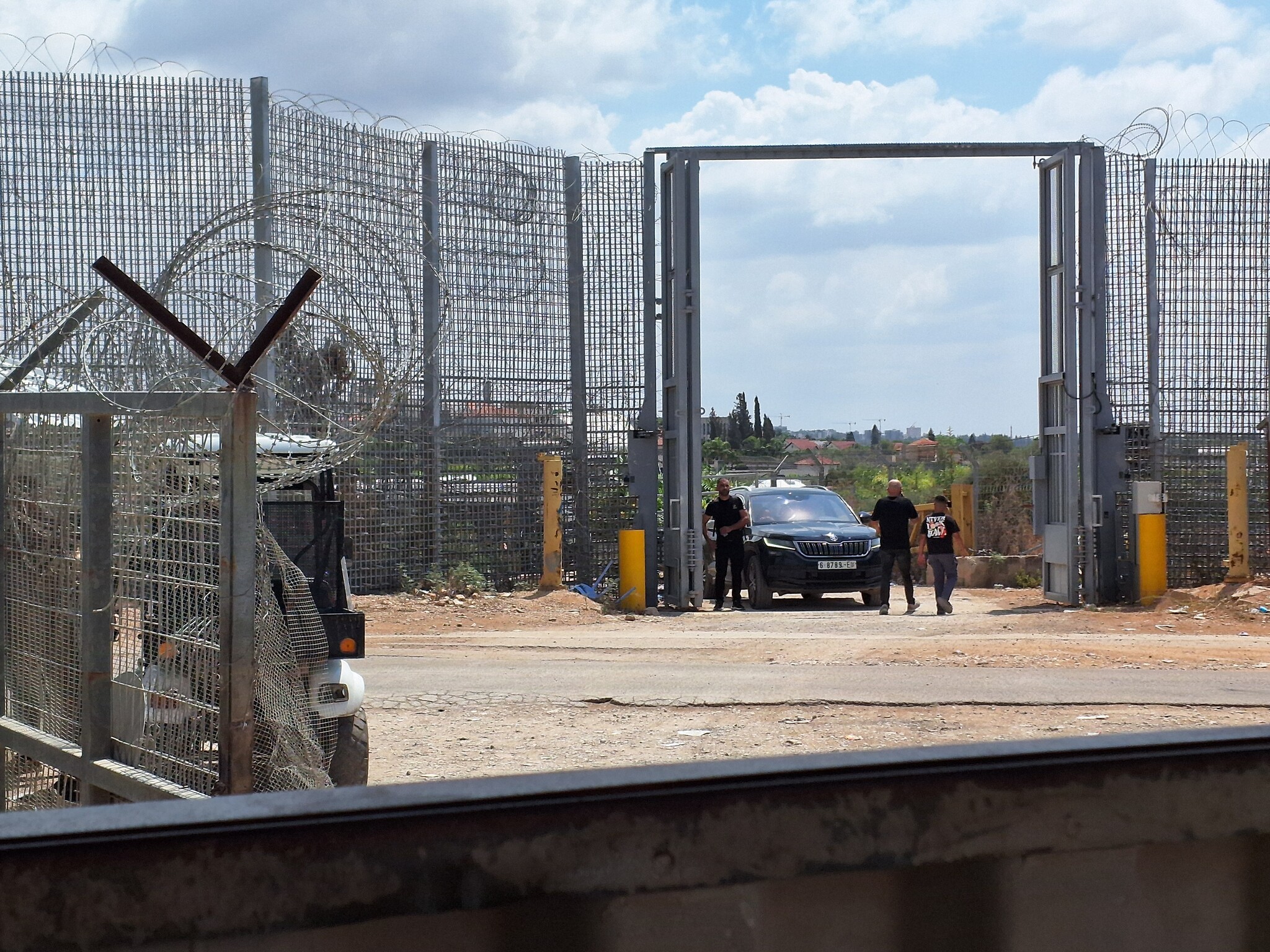 Ronit Dahan-RamatiAug-31-2026Habla. The gate is open
-
Irtah (Sha'ar Efrayim)
See all reports for this place-
The checkpoint is for Palestinians only. It is the main barrier to the passage of workers from the northern West Bank to Israel. Workers with a permit to work in Israel and also for trade (with appropriate permissions), medicine, and visiting prisoners. One can cross the checkpoint only on foot. The checkpoint is located north of Road 557 and south of Tulkarm. Operated by a civil security company, opening hours: between 4:00 and 19:00 on weekdays. As members of Machsom Watch, we began our shifts to this location in 2007. We arrived before it opened at 4 in the morning and report since, on the harsh conditions and the long and crowded queues of workers. The workers who pass by continue their journey by transportation to work throughout Israel. In the first period of its activity, about 3,000 and then 5,000 people passed through this checkpoint every day. Due to the small number of checking points and arbitrary delays for long periods of time in the "rooms", workers feared losing their transportation. Hence workers leave their homes at 2:30 at night to be among the first. Today, 15,000 pass and the transition is faster. Workers are still leaving their homes very early to get past the checkpoint at 7 p.m. In an adjacent compound, there is a terminal for the transfer of goods on a commercial scale, using the back-to-back method.
-
