
Eliyahu Crossing, Habla, Mon 3.1.11, Morning
06:35 Habla
The soldiers are already here; a light is on in the inspection booth; the gates open slowly.
06:43 The first five enter; three minutes later they exit and the next five enter. The crossing goes very quickly even though people aren’t waiting next to the revolving gate. Fifteen people went through in 10 minutes.
The buses arrive. In view of Yael’s depressing report on here meeting with the head of the DCO, I asked the drivers whether they or the head of the Bedouin village raised the problem of the afternoon buses with the DCO. The older, veteran driver didn’t remember. The other, new and more energetic, said that although we suggested last week he talk to the DCO, he didn’t do so because next week the school is on vacation for 10 days; he’ll do it after the vacation.
He doesn’t know whether the problem was addressed in the past. I remember speaking last year to Tedesa, the Crossings Officer, about the problem; he promised to take care of it…
07:20 Eliyahu gate (109)
Many laborers still waiting. We stopped by the side of the road and counted about 30 laborers waiting. During about 5 minutes we saw no one exit the inspection building. We were worried about getting a traffic ticket so we left.
We recommend that the morning shifts passing here park in the parking lot and from time to time check what’s going on there.
07:50 Jayyus agricultural gate (943)
The gate is locked; a notice posted in Arabic sends people to Falamya gate (927). The Ecumenicals who were there told us that yesterday afternoon the gate didn’t open either and people were sent to Falamya, a very long walk, in order to get out. We called Tedesa, who told us that the gate was closed for a day by order of the brigade because children threw rocks at the fence, tried to cut it and even lit a fire. He promised the gate would open tomorrow as usual.
I recommended that tomorrow morning’s shift check whether that happened.
We gave a ride to two youths who came on foot to the locked gate and had to go to Falamya.
08:10 Falamya gate (927)
Lots of activity at this gate. Pedestrians, carts, tractors and even a large truck going through.
A tractor transports za’atar seedings from the land beyond the fence, and there’s a lot of agricultural activity.
The soldiers also tell us the reason for the collective punishment and ask what we think about it. We explain our opinion about the fence and the denial of the Palestinians’ rights, and an interesting discussion develops.
08:30 We leave the gate and go up to Jayyous. We talk to a taxi driver who’s taking the Ecumenical volunteers about the situation and the serious unemployment.
He tells us about a project funded by the Spanish government – employing unemployed men in relief work in the village for NIS 60 per day. They work cleaning streets, landscape work in the park next to the municipality building and other such jobs. Organized by the municipality.
On our way home we stop as usual at the citrus stand near the turn to Qalqilya and talk to the owner. He’s from Nebi Elias, has an olive grove and citrus orchard on this side of the fence which he works to support his large family. But he also has a lot of land on the other side of the fence, beyond the Eliyahu gate, and he doesn’t have the strength to deal with the bureaucracy involved in obtaining the permits needed to go there. There are many people in the village with land in that area, and much land was taken from them to build the settlement of Zufim. He’s willing to talk about it systematically, and suggested we publicize the information we collect via Wikileaks…
Eliyahu CP (109) / Crossing
See all reports for this place-
Eliyahu CP (109) / Crossing This checkpoint, also known as the Fruit Crossing, is one of the main checkpoints between Israel and the West Bank. It is located on Route 55 between Alfei Menashe and the turn to Qalqilya and Zufin, more than 4 km east of the Green Line, in the separation fence, which separates Qalqilya from its lands to the south, thus leaving Alfei Menashe West of the fence - the Seam Zone. This checkpoint, a few kilometers across the Green Line, is intended for "Israeli settlement in the West Bank and the population of the Seam Zone." It is managed by a civil company. Palestinians with a special permit for their lands in the seam area are also allowed to pass through it, on foot, and sometimes by car.
-
Habla
See all reports for this place-
Habla CP (1393)
The Habla checkpoint (1393) was established on the lands of the residents of Qalqilya, on the short road that
connected it for centuries to the nearby town of Habla. The separation barrier intersects this road twice and cut off the residents of Qalqilya from their lands in the seam zone.(between the fence and the green line).
There is a passage under Road 55 that connects Qalqilya to the sabotage This agricultural barrier is used by the farmers and nursery owners established along Road 55 from the Green Line and on both sides of the kurkar road leading to the checkpoint.
This agricultural checkpoint serves the residents of Arab a-Ramadin al-Janoubi (detached from the West Bank), who pass through it to the West Bank and back to their homes. The opening hours (3 times a day) of this agricultural checkpoint are longer than usual, about an hour (recently shortened to 45 minutes), and are coordinated with the transportation hours of a-Ramadin children studying in the occupied in the West Bank.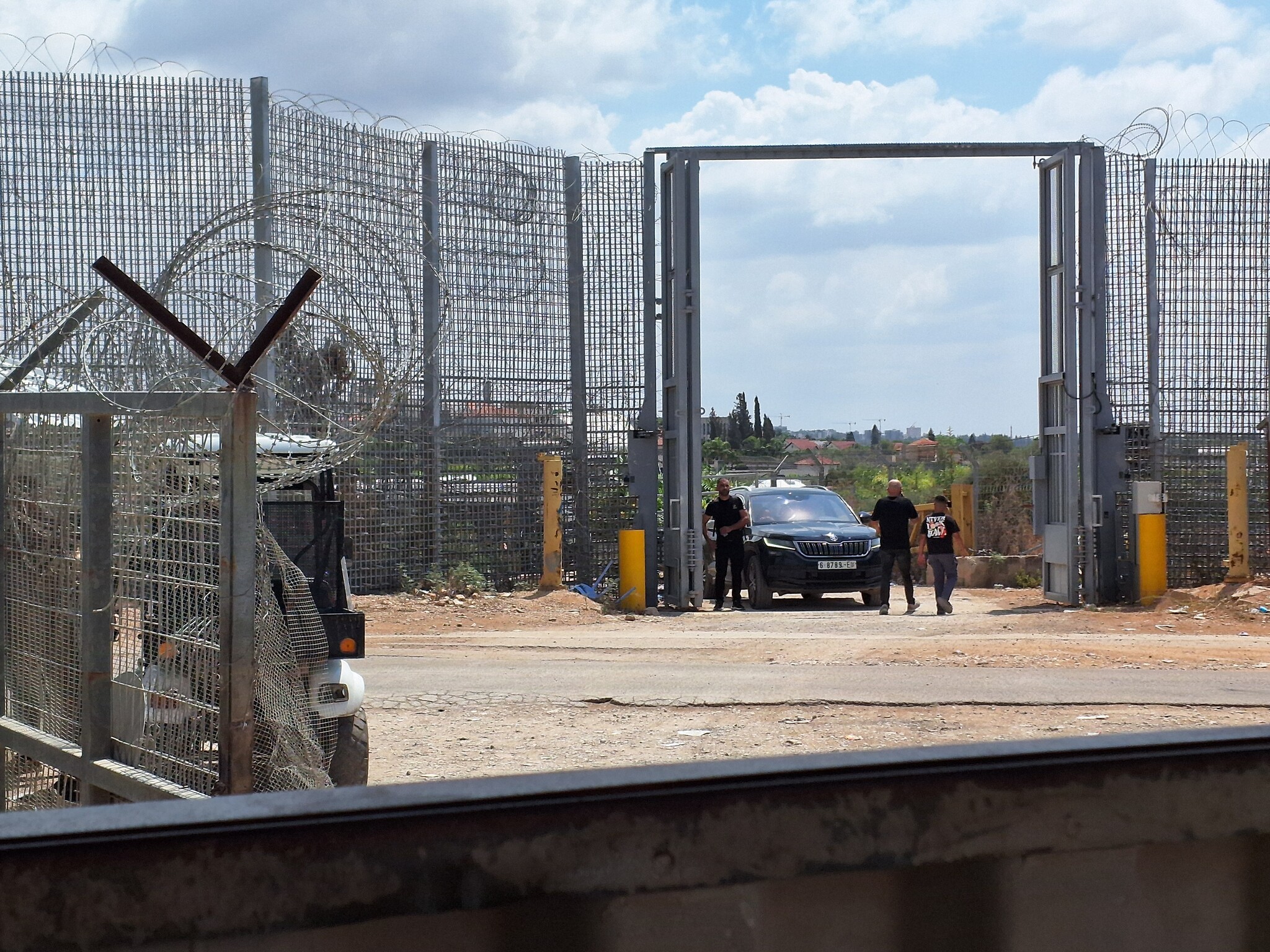 Ronit Dahan-RamatiAug-31-2026Habla. The gate is open
-
