
Eyal Crossing, ‘Anabta, Deir Sharaf, Huwwara, Irtah (Sha’ar Efrayim), Jubara (Kafriat), Ras ‘Atiya, Sun 21.2.10, Afternoon
Summary
There was a strange calmness to day's shift, leading to a sneaking suspicion that "transfer," that sanitized term for ethnic cleansing, is already taking place in the OPT. There were fewer Palestinian vehicles on the road today, fewer taxis, fewer private cars, and enormous numbers of lumbering Israeli trucks, as well as innumerable Israeli private cars. Another looming fact on the ground, which bolsters this sneaking suspicion, is the security barrier/wall which snakes around the inner portions of the Palestinian side of Green Line to bring settlements into the Israeli side of the wall. We have witnessed for a while how the wall impinges on Palestinian lands, prevents agricultural workers from access to their fields, violates the basic rights of mobility and work, and helps to upset the deep Palestinian rootedness in their land, making the very fact of transfer a fear that seems to be grounded in facts.
12:30 Near Alfe Menashe
Beware — all drivers on the roadway near the "building in process" at the Security Barrier to-be. The road has "developed," or the great engineers of the IDF have created a very steep gradient from the road being built and the one we travel on. A lot of equipment at work here, improving the Occupation, of course. There's brand new wire atop the brand new wall, still only half completed. But it will be: work here is never slow when there's an Occupation at work.
12:45 Ras Atiya
We seem to have stumbled on a performance of Eugene Ionesco's "The Chairs." There are, in fact, two white plastic chairs in the center of the checkpoint, on which sit two soldiers, casually and peacefully. Maybe they're indeed highlighting the loneliness and futility of human existence! To add to the mise en scene, another soldier stands, and a military policewoman completes the scene. Action? Not much today. A couple of young women show their IDs, two little boys meander across from the village, one dragging a big plastic bag with UNICEF on it. The Italian government-donated bus arrives, filled with passengers, and the driver tells us, "We'll see how it is today." The soldiers get up from their chairs, but there's no checking, and the bus proceeds on into the village.
Two of three young men who've crossed the Separation barrier earlier in our monitoring stop by our car as we are about to leave. One, from Ad Daba, close by, speaks a street Hebrew well, which he learned while in prison. Life is made so difficult by the soldiers, he complains, although not today, and D. goes back and forth several times each day to make life difficult for them. In other words, he, too, is part of the theater of the absurd!
13:45 Huwwara
On the settlement looming over the checkpoint, Har Bracha, building cranes are at work, but here at the checkpoint, yellow springtime weeds camouflage the turnstiles and the sophisticated checkpoint shed that made up the horror that was Huwwara; debris lies all over the place of other Occupation buildings demolished. But the military lookout tower is still there and manned, added to which there are two soldiers, one of them a Border Policeman, at the entrance to the now empty parking lot and another group of soldiers checking vehicles coming out of the city of Nablus but no checking going in.
14:00 Gilad Ranch
Purple lupins at the entrance to this illegal outpost on Route 60 are outdone by the buildings that have been erected there: "in your face" colors of striking purple, bright blue and other paler shades. A wooden house (Swedish style) completes the blatant wrongdoing. But who's to care or control? This is Judea and Samaria, no?
14:30 Deir Sharaf
Another "illegality," the creation of a roadway up to the settlement of Shavei Shomron when the original one is perfectly good. But the new one, still unused, still unfinished, has taken up yet more Palestinian land, uprooted yet more olive trees which form the livelihood of many in this part of the world.
14:50 Anabta
A lot of traffic flowing in both directions, the red stop light is, as always, turned on, but has no meaning. A soldier stands desultorily at the side, nowhere near the checking booths which remain unused. He is joined by another who soon makes his way back into the military lookout tower.
15:10 Irtah
Few Palestinians returning from work, and we can see nobody working at any of the positions inside.
15:35 Eyal
Many more people returning from work here, and they pass quickly into the building and out again, with no delay.
15:50 Zufin
A huge mass of concrete building going on here in the settlement above the old Qalqilya checkpoint, and a house with five or six bedrooms is available — or maybe it's already sold?
'Anabta CP
See all reports for this place-
'Anabta CP
The checkpoint is located south of the village of 'Anabta, at the intersection of Road 60 (leading to Nablus at the entrance to Area A), with Road (57, 557, 5576) facing west towards the Einav settlement and the checkpoint at the exit from the West Bank - Figs checkpoint. Until 2010 we used to watch the intersection and report the long columns created due to a slow inspection of the vehicles in both directions.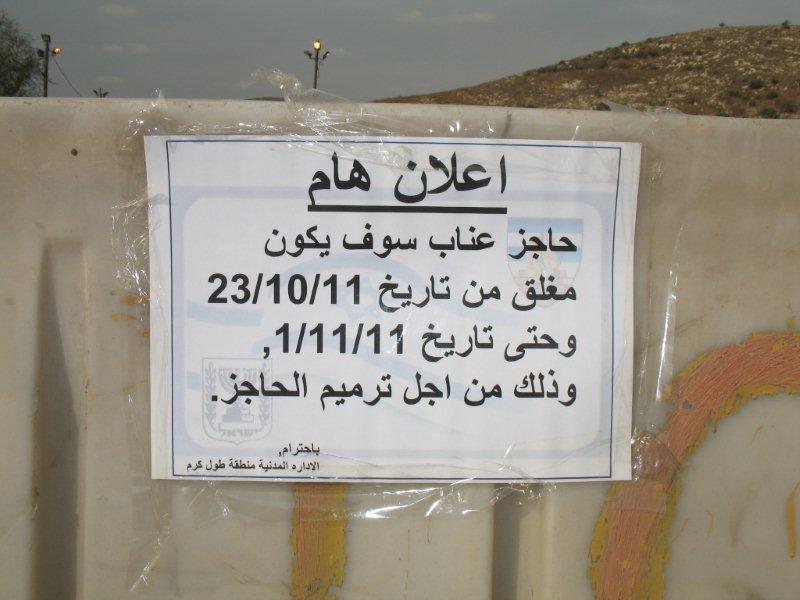 Oct-28-2011Anabta checkpoint 24.10.11
-
Deir Sharaf checkpoint
See all reports for this place-
Deir Sharaf checkpoint is located west of Nablus and south of the settlement of Shavei Shomron, at the entrance to the village of Deir Sharaf on the road leading to Nablus. The checkpoint was activated in early March 2009 after the Beit Iba checkpoint was closed. Palestinians are allowed through the checkpoint , but not for Israelis. Unlike the checkpoints leading to Qalqilya and Tulkarm, crossing of Israeli Palestinians is only allowed on Saturdays.
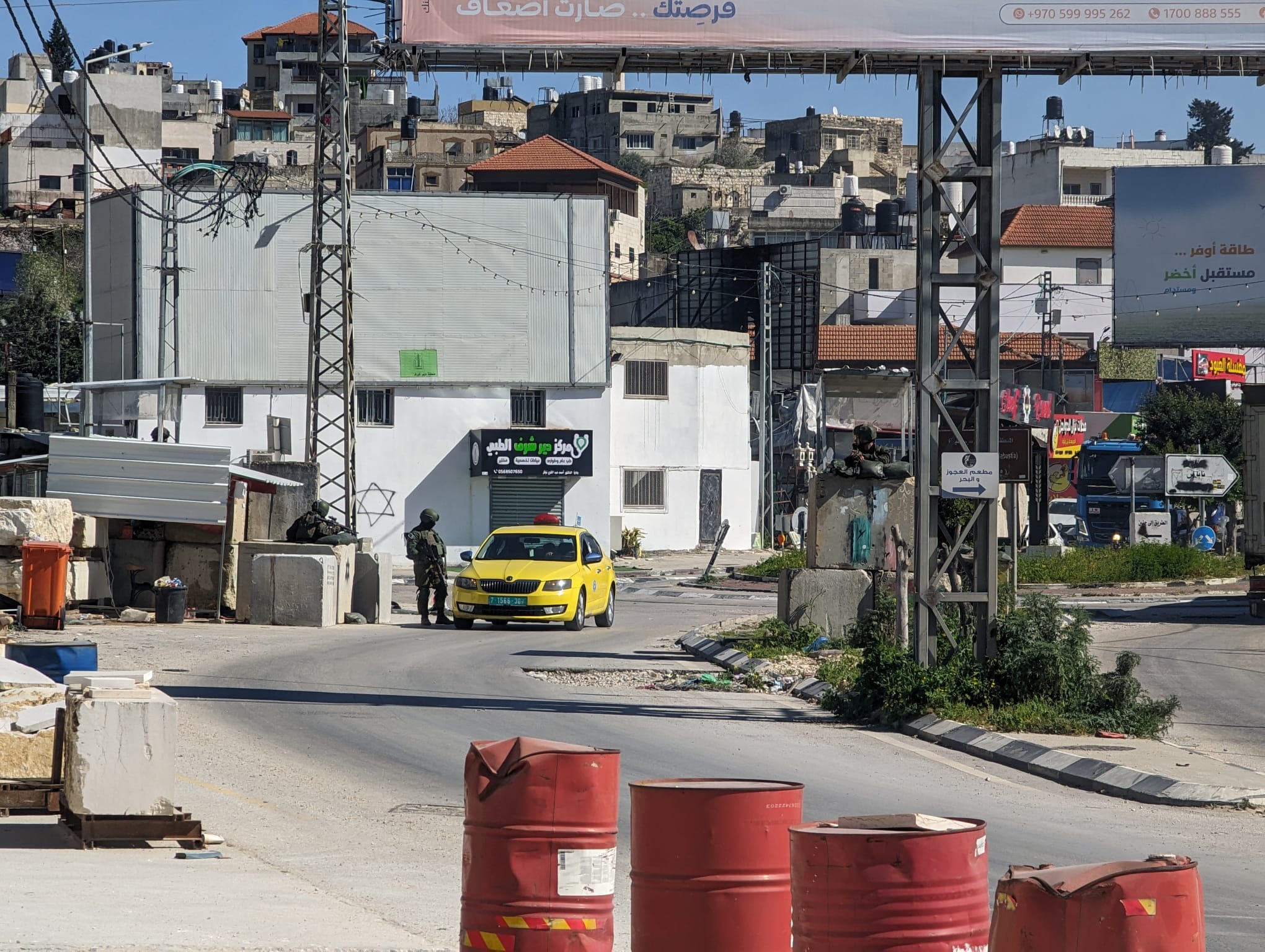 Nina SebaFeb-28-2024Deir Sharaf - the entrance to the village
-
Eyal Checkpoint / Crossing
See all reports for this place-
Eyal Checkpoint is intended for pedestrians and Palestinians only. This is the main barrier for workers to cross from the center of the West Bank. Workers with a work permit to enter Israel can pass through it for trade, medicine, and visiting prisoners. The checkpoint was built on the Green Line north of Qalqilya in the separation barrier that surrounds the city. The checkpoint began operating in 2004 by the military. Opening hours on weekdays from 04:00 to 19:00. We started holding shifts there in 2007. We arrived at the checkpoint before it opened at 4 in the morning. We reported on the difficult conditions and the long and cramped queues of workers who must continue their journey by commuting to work throughout Israel. At the end of June 2009, the checkpoint was operated by a civil security company, The transit time has been gradually shortened, today it is faster, but the Palestinians still have to arrive very early to make it to the transportation. Usually, about 15,000 people pass through.
-
Huwwara
See all reports for this place-
The Huwwara checkpoint is an internal checkpoint south of the city of Nablus, at the intersection of Roads 60 and 5077 (between the settlements of Bracha and Itamar). This checkpoint was one of the four permanent checkpoints that closed on Nablus (Beit Furik and Awarta checkpoints to the east and the Beit Iba checkpoint to the west). It was a pedestrian-only barrier. As MachsomWatch volunteers, we watched therre since 2001 two shifts a day - morning and noon, the thousands of Palestinians leaving Nablus and waiting for hours in queues to reach anywhere else in the West Bank, from the other side of the checkpoint the destination could only be reached by public transport. In early June 2009, as part of the easing of Palestinian traffic in the West Bank, the checkpoint was opened to vehicular traffic. The passage was free, with occasional military presence in the guard tower. Also, there were vehicle inspections from time to time. Since the massacre on 7.10.2023, the checkpoint has been closed to Palestinians.
On February 26, 2023, about 400 settlers attacked the town's residents for 5 hours and set fire to property, such as houses and cars. Disturbances occurred in response to a shooting of two Jewish residents of Har Bracha by a Palestinian Terrorist. The soldiers stationed in the town did not prevent the arson and rescued Palestinian families from their homes only after they were set on fire. No one was punished and Finance Minister Smotrich stated that "the State of Israel should wipe out Hawara." Left and center organizations organized solidarity demonstrations and support actions for the residents of Hawara.Hawara continued to be in the headlines in all the months that followed: more pogroms by the settlers, attacks by Palestinians and a massive presence of the army in the town. It amounted to a de facto curfew of commerce and life in the center of the city. On October 5, 2023, MK Zvi established a Sukkah in the center of Hawara and hundreds of settlers backed the army blocked the main road and held prayers in the heart of the town all night and the next day. On Saturday, October 7, 23 The "Swords of Iron" war began with an attack by Hamas on settlements surrounding Gaza in the face of a poor presence of the IDF. Much criticism has been made of the withdrawal of military forces from the area surrounding Gaza and their placement in the West Bank, and in the Hawara and Samaria region in particular, as a shield for the settlers who were taking over and rioting.
On November 12, 2023, the first section of the Hawara bypass road intended for Israeli traffic only was opened. In this way, the settlers can bypass the road that goes through the center of Hawara, which is the main artery for traffic from the Nablus area to Ramallah and the south of the West Bank. For the construction of the road, the Civil Administration expropriated 406 dunams of private land belonging to Palestinians from the nearby villages. The settlers are not satisfied with this at the moment, and demand to also travel through Hawara itself in order to demonstrate presence and control.(updated November 2023)
.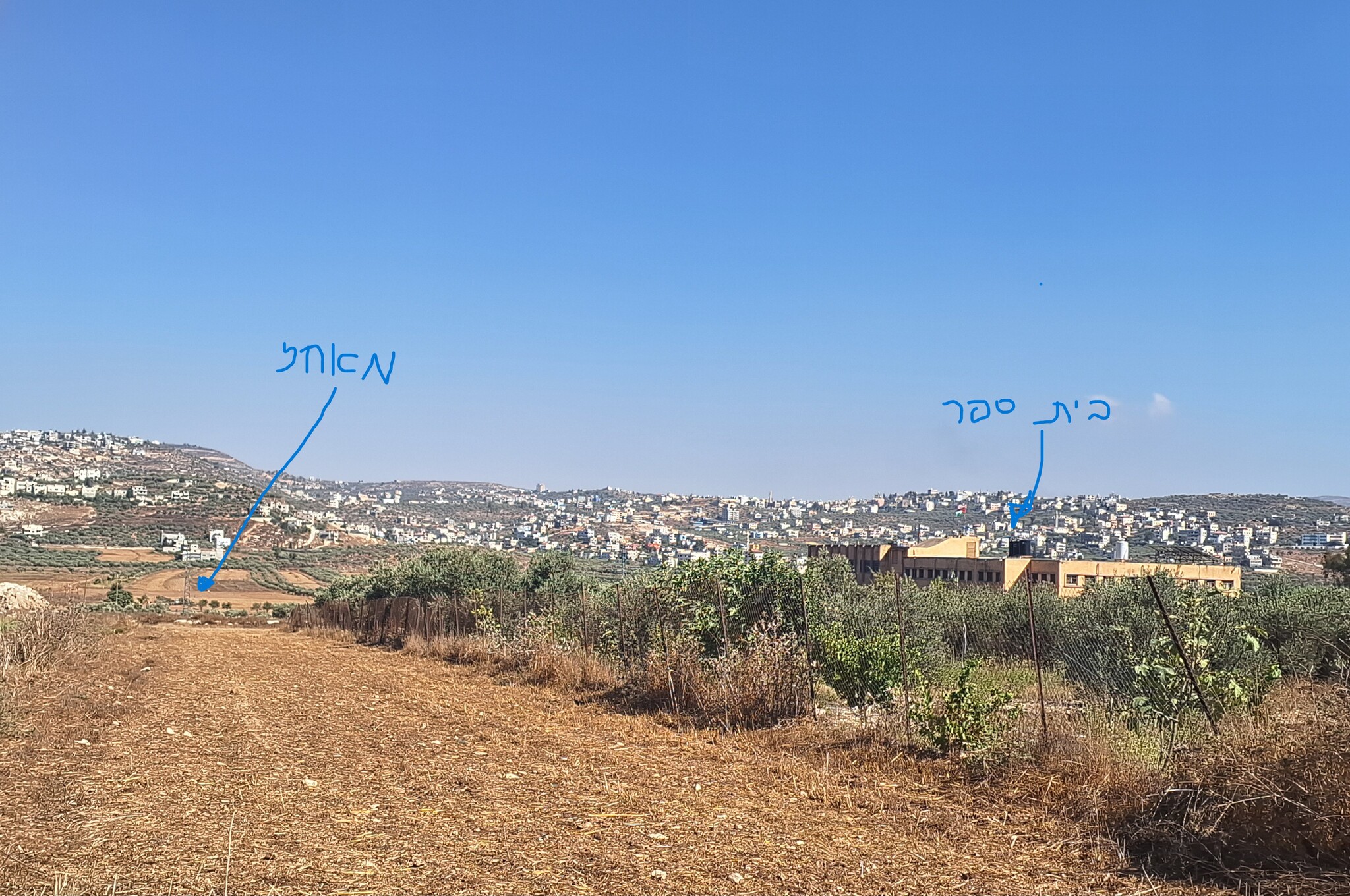 Ronit Dahan-RamatiAug-24-2026Huwara: The school on the outskirts of town and an outpost hidden among the trees
-
Irtah (Sha'ar Efrayim)
See all reports for this place-
The checkpoint is for Palestinians only. It is the main barrier to the passage of workers from the northern West Bank to Israel. Workers with a permit to work in Israel and also for trade (with appropriate permissions), medicine, and visiting prisoners. One can cross the checkpoint only on foot. The checkpoint is located north of Road 557 and south of Tulkarm. Operated by a civil security company, opening hours: between 4:00 and 19:00 on weekdays. As members of Machsom Watch, we began our shifts to this location in 2007. We arrived before it opened at 4 in the morning and report since, on the harsh conditions and the long and crowded queues of workers. The workers who pass by continue their journey by transportation to work throughout Israel. In the first period of its activity, about 3,000 and then 5,000 people passed through this checkpoint every day. Due to the small number of checking points and arbitrary delays for long periods of time in the "rooms", workers feared losing their transportation. Hence workers leave their homes at 2:30 at night to be among the first. Today, 15,000 pass and the transition is faster. Workers are still leaving their homes very early to get past the checkpoint at 7 p.m. In an adjacent compound, there is a terminal for the transfer of goods on a commercial scale, using the back-to-back method.
-
Jubara (Kafriat)
See all reports for this place-
The Jabra checkpoint was on Road 557, south of Tulkarm, on the side of the Figs Pass, which is located within the Palestinian Authority (a few kilometers east of the Green Line), and serves as an entry barrier from the territories to Israel. The checkpoint to the village of Jubara, which until 2013 was in the seam area, blocked and surrounded by a fence, was intended for the passage of the family members of the house next to the checkpoint, and also for the MachsomWatch volunteers (with special permission only), on their way to checkpoint 753. on the other side of the village. The soldiers supervising the "fig crossing" also supervised the crossing at this checkpoint, in our shifts we often waited a long time until the key was found and the gate opened. The checkpoint was abolished and became part of the separation fence that was moved west following the High Court.
-
Ras 'Atiya
See all reports for this place-
The checkpoint is presently on the Separation Barrier roadway, manned and open 12 hours a day, from 6:30 to 18:30. West of it is the large Seam Line village whose school is attended by children from the nearby villages east of the Barrier and many of whose inhabitants have permits to work in Israel. How long this checkpoint will remain in place is unknown, since construction of the Separation Wall, just by the settlement of Alfe Menashe, east of the present Separation Barrier, is endless, as is the creation of a new road and, obviously, a new checkpoint.
-
