
Eyal Crossing, ‘Anabta, Sun 12.7.09, Morning
We approached the laborers who came out. Two complaints were heard again and again:
- More restrictions on what they’re allowed to take through. Tools – In the past they’d normally bring them in; with the privatization, complete prohibition on tools. Food – Not clear what’s allowed and what’s prohibited. A laborer complains that small bottle of oil was confiscated, another reports that sausages were taken, a third leaving for a week had to leave 1 kg of sugar behind, a fourth had the dry ice in his cooler taken. The repeated complaint is that the confiscations are arbitrary and there are no clear regulations.
- The dangerous scanning room – Almost everyone coming out complained about it; they’re worried and upset. There’s a rumor, apparently backed up by a physician, that the full-body scanner they go through is dangerous to their health, and daily exposure to it has a cumulative damaging effect.
We asked to speak to the shift director in order to investigate the complaints. After a while the crossing’s security officer came over to us. He said that more than 4000 people went through this morning, with no delays or special problems, even though there are only two inspection sleeves here. By 7 AM all the laborers had gone through. He feels their operation has improved during the two weeks they’ve been in charge of the crossing. We presented the complaints about tools, and he confirmed that they’re forbidden for security reasons. Regarding food, he said that signs were posted saying that only one day’s food was allowed, including for those with permits for a week. Uncooked meat is prohibited by the Ministry of Health. Dry ice is prohibited because its contents can’t be inspected. All the rest is subject to the inspector’s judgment. There aren’t exact amounts. In answer to the question why people with a weekly permit can’t bring food for a week that was cooked at home (cheaper, tastier, more familiar) we didn’t get an answer. The suggestion of the laborers, that exact quantities be posted so they can plan ahead and not have food confiscated, was rejected: “I’m not willing to announce how many pitas they can bring. What doesn’t look like a wholesale quantity goes through.” We didn’t have the impression that was the case.
Regarding the dangerous scanning room, the security officer completely rejected the complaint. He says that the quantity of radiation is less than that of a cellular phone. We stressed that the laborers are worried, and that objective data about the installation should be published. Naomi K. suggested that experts representing them and Israel inspect the installation and publish their findings. There was no response other than that there’s someone inciting and spreading the rumors.
When we left we saw the mass of laborers waiting near the dry faucet. They said the only water source in the area has been dry for a few days. They also showed us the terrible filth in the bathrooms, which makes them unusable. We asked the soldier at the entrance to the crossing to transmit the complaint to those in charge.
8:00 Anabta – The widening of the road to two lanes has been completed, and the checkpoint is back where it was before. Free passage in both directions.
Beit Iba. There’s no checkpoint.
'Anabta CP
See all reports for this place-
'Anabta CP
The checkpoint is located south of the village of 'Anabta, at the intersection of Road 60 (leading to Nablus at the entrance to Area A), with Road (57, 557, 5576) facing west towards the Einav settlement and the checkpoint at the exit from the West Bank - Figs checkpoint. Until 2010 we used to watch the intersection and report the long columns created due to a slow inspection of the vehicles in both directions.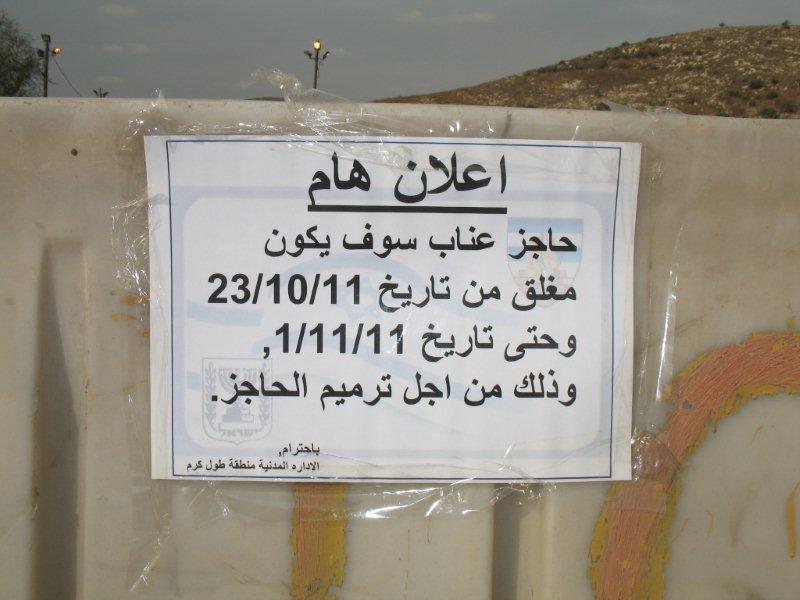 Oct-28-2011Anabta checkpoint 24.10.11
-
Eyal Checkpoint / Crossing
See all reports for this place-
Eyal Checkpoint is intended for pedestrians and Palestinians only. This is the main barrier for workers to cross from the center of the West Bank. Workers with a work permit to enter Israel can pass through it for trade, medicine, and visiting prisoners. The checkpoint was built on the Green Line north of Qalqilya in the separation barrier that surrounds the city. The checkpoint began operating in 2004 by the military. Opening hours on weekdays from 04:00 to 19:00. We started holding shifts there in 2007. We arrived at the checkpoint before it opened at 4 in the morning. We reported on the difficult conditions and the long and cramped queues of workers who must continue their journey by commuting to work throughout Israel. At the end of June 2009, the checkpoint was operated by a civil security company, The transit time has been gradually shortened, today it is faster, but the Palestinians still have to arrive very early to make it to the transportation. Usually, about 15,000 people pass through.
-
