
Eyal Crossing, Eliyahu Crossing, Habla, Irtah (Sha’ar Efrayim), Thu 24.12.09, Afternoon
Translation: Galia S.
Qalqiliya
14:25 – One soldier stands in a post on the left side of the road shoulders, watching those who enter the city. In both directions vehicles pass without inspection.
Eliyahu Passage
14:35 – Residents of the villages around Alfei Menashe (Ras at Tira, Dab'a, Wadi Rasha and a few Bedouin encampments) are allowed to pass here by car. The vehicles are checked in a special lane destined for Palestinians (this is an entry checkpoint into Israel). The driver leaves his vehicle next to the checkpoint and passes on foot. The passengers of the vehicle, in case there are any, are to get out where the pedestrian lane starts, a narrow fenced lane about half a kilometer long. We talked with two drivers and both of them said that leaving the women and children to walk alone along the lane in the evening or when it rains was very unpleasant. We have also heard from both drivers, residents of Ras at-Tira, about restrictions on food (a more detailed description we hear from the village headman we meet later).
14:55 – Two soldiers stand guard over a construction site on the road leading to Ras at Tira. A wall and a new road that will lead to Alfei Menashe are under construction. The lands belong to Ras at Tira residents, including the olive trees which probably will soon be cut down.
Ras at Tira (1351)
15:05 – The checkpoint is open from 06:30 to 18:30, which means that in the evening and the night hours no traffic is allowed. Vehicles and pedestrians pass. Passengers get out of the vehicles before the checkpoint, pass in the pedestrian lane while the driver proceeds alone toward the checkpoint and picks them up on the other side. Those who pass through the checkpoint show ID cards and the trunks of their vehicles are checked. There isn't much traffic and there are no lines here. Still, the checkpoint is never empty for more than a few minutes.
Two young men, Dab'a residents, tell us that soldiers beat them and members of their family. The grandmother of one of them needed medical care. We take down a telephone number and pass the information to "Yesh Din" [Organization of volunteers for human rights].
We meet up with the Ras at Tira village headman who tells us about the life of the residents in the seam-line zone, an area which Israel intends to annex, preferably without its Palestinian residents, for which all means are justified.
Last Wednesday the permits to bring in food into the villages were canceled. The situation today is that the residents need to coordinate all their grocery shopping with the village headman who has to coordinate it with the DCO [District Coordination Office of the IDF Civil Administration that handles passage permits]. It is not just the inconvenience, there are also restrictions. A family is allowed one chicken that doesn't exceed the weight of 2 kilograms and one carton of eggs (one of the drivers we meet at Eliyahu Passage says that with 7 kids they are 9 in the family and it just isn't enough). The village headman tells us about a shortage of gas containers, for cooking and heating. The DCO doesn't give permission to buy gas cylinders. Two days ago a vet was not allowed to cross the checkpoint with medication that according to the DCO, was not coordinated in advance.
Two thousand people live in the four villages. (The village headman keeps in touch with Tami and Dalia.)
Habla (1392)
15:45 – The gate is opened intermittently: 06:45–07:45, 11:15–12:15, and 16:45-17:45. The inspection includes going through the magnetometer. From what the six men who are waiting in line say, we understand that the opening of the gate is often delayed. One of them collects the ID cards and puts them in the order of arrival. So far he has already collected 26 documents. It turns out that there are people who plan their daily life according to the times the gate opens – they get here, secure a good place in the line and go back to work. Riva has given one of the men her phone number in case the opening of the gate is delayed. Fortunately, we haven't heard from him.
Eyal
16:05 – There is no line and the passage is quick. We decide to go on to Irtah and come back later.
Irtah (Efrayim Passage)
16:40 – When we arrive, we see along line of about 150 men (counting is impossible, so this is a rough estimate) waiting by the turnstile (pictures attached). The turnstile doesn't move. When the checkpoint opens at 16:50, the inspection is brief and it take minutes to cross the checkpoint. We have seen how bicycles are transferred through the turnstile. Two men are needed, one of whom maneuvers the bicycle while the other take care of the turnstile (picture attached).
Eyal
17:30 – The traffic at the checkpoint is quick and without delays.
Eliyahu CP (109) / Crossing
See all reports for this place-
Eliyahu CP (109) / Crossing This checkpoint, also known as the Fruit Crossing, is one of the main checkpoints between Israel and the West Bank. It is located on Route 55 between Alfei Menashe and the turn to Qalqilya and Zufin, more than 4 km east of the Green Line, in the separation fence, which separates Qalqilya from its lands to the south, thus leaving Alfei Menashe West of the fence - the Seam Zone. This checkpoint, a few kilometers across the Green Line, is intended for "Israeli settlement in the West Bank and the population of the Seam Zone." It is managed by a civil company. Palestinians with a special permit for their lands in the seam area are also allowed to pass through it, on foot, and sometimes by car.
-
Eyal Checkpoint / Crossing
See all reports for this place-
Eyal Checkpoint is intended for pedestrians and Palestinians only. This is the main barrier for workers to cross from the center of the West Bank. Workers with a work permit to enter Israel can pass through it for trade, medicine, and visiting prisoners. The checkpoint was built on the Green Line north of Qalqilya in the separation barrier that surrounds the city. The checkpoint began operating in 2004 by the military. Opening hours on weekdays from 04:00 to 19:00. We started holding shifts there in 2007. We arrived at the checkpoint before it opened at 4 in the morning. We reported on the difficult conditions and the long and cramped queues of workers who must continue their journey by commuting to work throughout Israel. At the end of June 2009, the checkpoint was operated by a civil security company, The transit time has been gradually shortened, today it is faster, but the Palestinians still have to arrive very early to make it to the transportation. Usually, about 15,000 people pass through.
-
Habla
See all reports for this place-
Habla CP (1393)
The Habla checkpoint (1393) was established on the lands of the residents of Qalqilya, on the short road that
connected it for centuries to the nearby town of Habla. The separation barrier intersects this road twice and cut off the residents of Qalqilya from their lands in the seam zone.(between the fence and the green line).
There is a passage under Road 55 that connects Qalqilya to the sabotage This agricultural barrier is used by the farmers and nursery owners established along Road 55 from the Green Line and on both sides of the kurkar road leading to the checkpoint.
This agricultural checkpoint serves the residents of Arab a-Ramadin al-Janoubi (detached from the West Bank), who pass through it to the West Bank and back to their homes. The opening hours (3 times a day) of this agricultural checkpoint are longer than usual, about an hour (recently shortened to 45 minutes), and are coordinated with the transportation hours of a-Ramadin children studying in the occupied in the West Bank.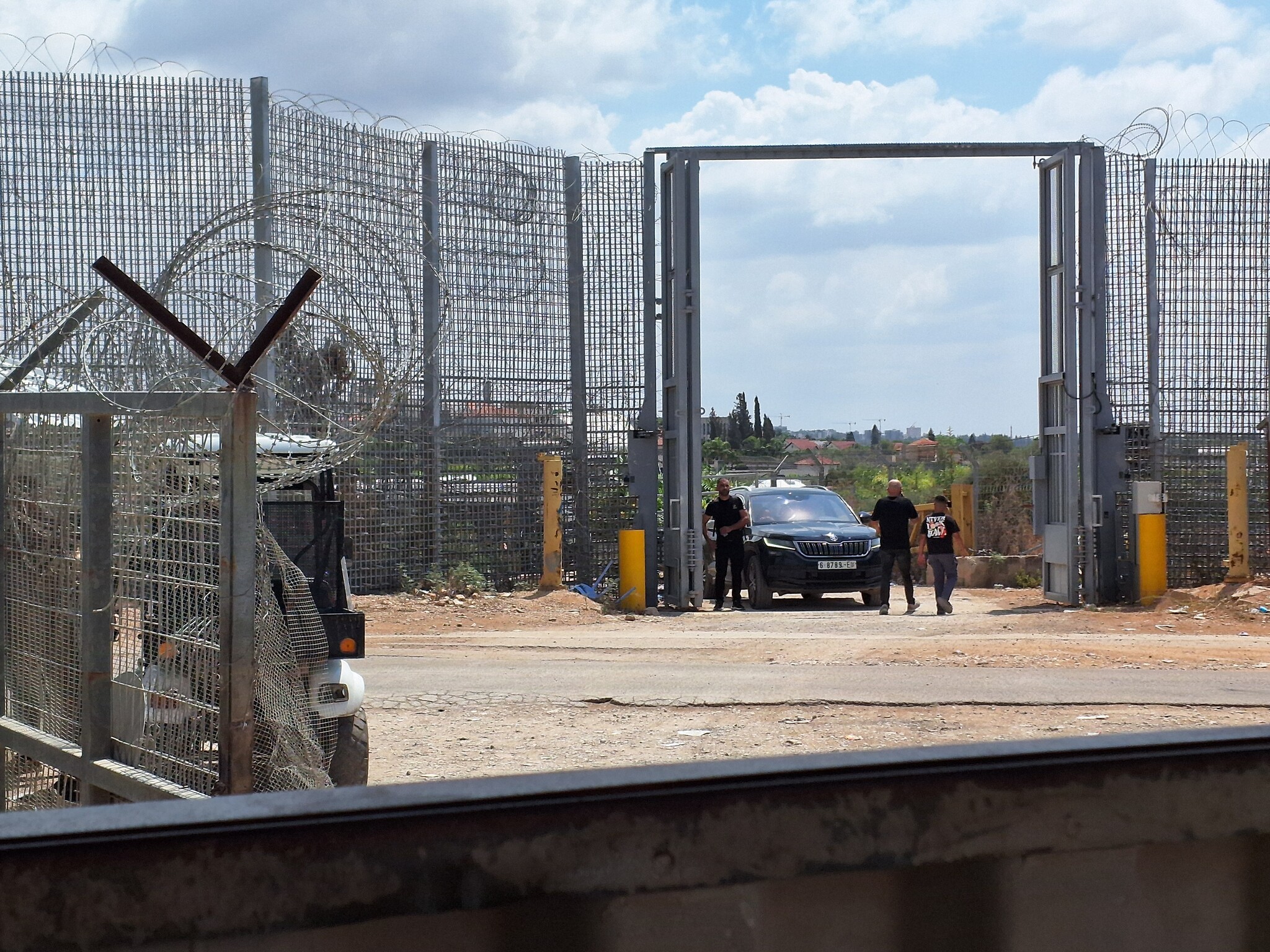 Ronit Dahan-RamatiAug-31-2026Habla. The gate is open
-
Irtah (Sha'ar Efrayim)
See all reports for this place-
The checkpoint is for Palestinians only. It is the main barrier to the passage of workers from the northern West Bank to Israel. Workers with a permit to work in Israel and also for trade (with appropriate permissions), medicine, and visiting prisoners. One can cross the checkpoint only on foot. The checkpoint is located north of Road 557 and south of Tulkarm. Operated by a civil security company, opening hours: between 4:00 and 19:00 on weekdays. As members of Machsom Watch, we began our shifts to this location in 2007. We arrived before it opened at 4 in the morning and report since, on the harsh conditions and the long and crowded queues of workers. The workers who pass by continue their journey by transportation to work throughout Israel. In the first period of its activity, about 3,000 and then 5,000 people passed through this checkpoint every day. Due to the small number of checking points and arbitrary delays for long periods of time in the "rooms", workers feared losing their transportation. Hence workers leave their homes at 2:30 at night to be among the first. Today, 15,000 pass and the transition is faster. Workers are still leaving their homes very early to get past the checkpoint at 7 p.m. In an adjacent compound, there is a terminal for the transfer of goods on a commercial scale, using the back-to-back method.
-
