
Eyal Crossing, Eliyahu Crossing, Habla, Tue 21.9.10, Afternoon

13:40
Habla. The gates are shut. About 12 people are waiting in the shade of the caravan, three carts hitched to horses, and on the other side two buses of schoolchildren (one of boys, the second of girls) two trucks, and pedestrians. The sun blazes and the soldiers are nowhere to be seen.
We call the DCO – no reply.
13:55
A hummer arrives. 5 men and women soldiers descent, laughing and jubilant. Why were you late we ask, "there was a mess…" they reply and laugh.
14:00
The gate nearest to us is opened. A soldier says: "hi everybody, the show begin" but they are in no hurry to open the other gates. We ask what the matter is and the soldiers answer that we disturb them and that we should retreat.
Very slowly the 3 gates are opened. The papers of the bus driver are being checked. The first 5 Palestinians pass on to the checking station. Karin calls the EAPPI representative on the other side of the CP. What she has to say is that this is the soldiers' last day at the CP and that this probably is the reason for the arrogance and disregard, they are there because our morning shift reported on problems.
14:10
The first cart owner passes to the village and five Palestinians enter the checking station, in the direction of the village. A Palestinian who waits in the caravan says to us: "do you see that they do to us? Why?" (indeed, why?!). A tractor passes, another five people and a truck. The two buses, with the children are still waiting inside the buses, in the terrible heat. Three grown up children are made to leave the bus. The luggage compartment too is checked. On our side is the representative of the Bedouin village, the only one who remained on this side of the fence. Since the new separation fence at the Alfey Menashe enclave has been completed, his children are forced to undergo this drilling every day on their way to school and back to their homes.
14:25
Finally one bus pass, after a waiting time of about an hour. The bus driver tells us that the children who were made to leave the car, have authorizations only for gate no. 109 (Eliyahu CP). He stops to wait for the second bus' the small children who haven't left the bus for a whole hour, use this stop in order to freshen up and to drink water from a pipe in the field. The second bus (the one with the girls) passes aswell and stops.
14:32
The buses leave.
15:00
Eliyahu passage – the traffic flows.
On the way to the agricultural gate of H' Assla: we turn right from road no. 55 before Azzun, take a hitch-hiker to Izbat Tabib and ask about the problems in the village, where there is a little agriculture and a few hers. He tell us that they don't get building permits. He directs us to the house of Bian the head of the local council. In the courtyard of his house Bian tell us also about the shops that have been demolished, on which we have reported in our report of the 1st of September 2010. (Opposite Izbat Tabib a few shops near the road with a ruined front. The tenant of the shops tells us that the owner of the place, a rich collaborator, sent at night, without a demolition injunction, criminals to destroy the place. Since 21 years he manages shops for car appliances, toys and building material, and supports his expanded family (about 40 people) and now he remains penny-less, after the first payment to the lawyer and the court). He asks us to join him and go to the place, to listen to all the details and to help them. According to him friends and even "internationals" guard the place at night. But as I have already been there and have reported on the matter we decide that it is senseless to go there again.
He also complains about soldiers who enter the village, during the day and at night and create havoc…they stop children and grown-ups. Another burning issue is the fact that they don't obtain any building permits, for private house and the school. They began building an annex to the school and received an order to stop the work. Only three years ago the school was opened, and it has 7 classes only. There are 300 people in the village. He opens a door which leads to a room attached to his house which serves as kindergarten for 7 children. In the room there are 7 small tables but no toys.
15:25
We continue to Hirbat Asla, in order to reach the agricultural gate one has to turn right at the entrance to the village, and thus at each junction and intersection. At the end of the paved road there is a dirt road (its beginning is defective) 400 meters in length which leads to it. A pleasant captain tells us that the gate is opened for a quarter of an hour from 15:30 to 15:45 and about 3-4 people only pass through it. Today a shepherd with his sheep flock passed.
16:00
We turned to Eyal. At the Eliyahu Passage we are asked to show identity cars.
16:40
Eyal Passage – Northern Kalkilya. The last day before the long closure. Many transportation means bring many Palestinians, but all pass without delays.
16:45
Tzofim CP – the gate is open. Only 2 cars pass.
17:00
We return to road 55 in the direction of El-Punduk and then southwards to Emanuel.
On leaving the village of Hares a young man approaches us and tells us that two months ago soldiers stopped him on the charge of throwing stones (probably somebody informed on him) he was imprisoned in the Megiddo prison, was hit on the head and on other parts of his body, and he was hospitalized in the Belinson hospital. He adds that he has met Dalia and told her his story. We gave him a visiting card of MW with a phone number of a person who talks Arabic, in the hope that he'll get help in getting back the work permit he at in Barkan.
17:50
Samaria Gate. At the exit the traffic flow, but at the entrance there is a very long convoy of cars.
Eliyahu CP (109) / Crossing
See all reports for this place-
Eliyahu CP (109) / Crossing This checkpoint, also known as the Fruit Crossing, is one of the main checkpoints between Israel and the West Bank. It is located on Route 55 between Alfei Menashe and the turn to Qalqilya and Zufin, more than 4 km east of the Green Line, in the separation fence, which separates Qalqilya from its lands to the south, thus leaving Alfei Menashe West of the fence - the Seam Zone. This checkpoint, a few kilometers across the Green Line, is intended for "Israeli settlement in the West Bank and the population of the Seam Zone." It is managed by a civil company. Palestinians with a special permit for their lands in the seam area are also allowed to pass through it, on foot, and sometimes by car.
-
Eyal Checkpoint / Crossing
See all reports for this place-
Eyal Checkpoint is intended for pedestrians and Palestinians only. This is the main barrier for workers to cross from the center of the West Bank. Workers with a work permit to enter Israel can pass through it for trade, medicine, and visiting prisoners. The checkpoint was built on the Green Line north of Qalqilya in the separation barrier that surrounds the city. The checkpoint began operating in 2004 by the military. Opening hours on weekdays from 04:00 to 19:00. We started holding shifts there in 2007. We arrived at the checkpoint before it opened at 4 in the morning. We reported on the difficult conditions and the long and cramped queues of workers who must continue their journey by commuting to work throughout Israel. At the end of June 2009, the checkpoint was operated by a civil security company, The transit time has been gradually shortened, today it is faster, but the Palestinians still have to arrive very early to make it to the transportation. Usually, about 15,000 people pass through.
-
Habla
See all reports for this place-
Habla CP (1393)
The Habla checkpoint (1393) was established on the lands of the residents of Qalqilya, on the short road that
connected it for centuries to the nearby town of Habla. The separation barrier intersects this road twice and cut off the residents of Qalqilya from their lands in the seam zone.(between the fence and the green line).
There is a passage under Road 55 that connects Qalqilya to the sabotage This agricultural barrier is used by the farmers and nursery owners established along Road 55 from the Green Line and on both sides of the kurkar road leading to the checkpoint.
This agricultural checkpoint serves the residents of Arab a-Ramadin al-Janoubi (detached from the West Bank), who pass through it to the West Bank and back to their homes. The opening hours (3 times a day) of this agricultural checkpoint are longer than usual, about an hour (recently shortened to 45 minutes), and are coordinated with the transportation hours of a-Ramadin children studying in the occupied in the West Bank.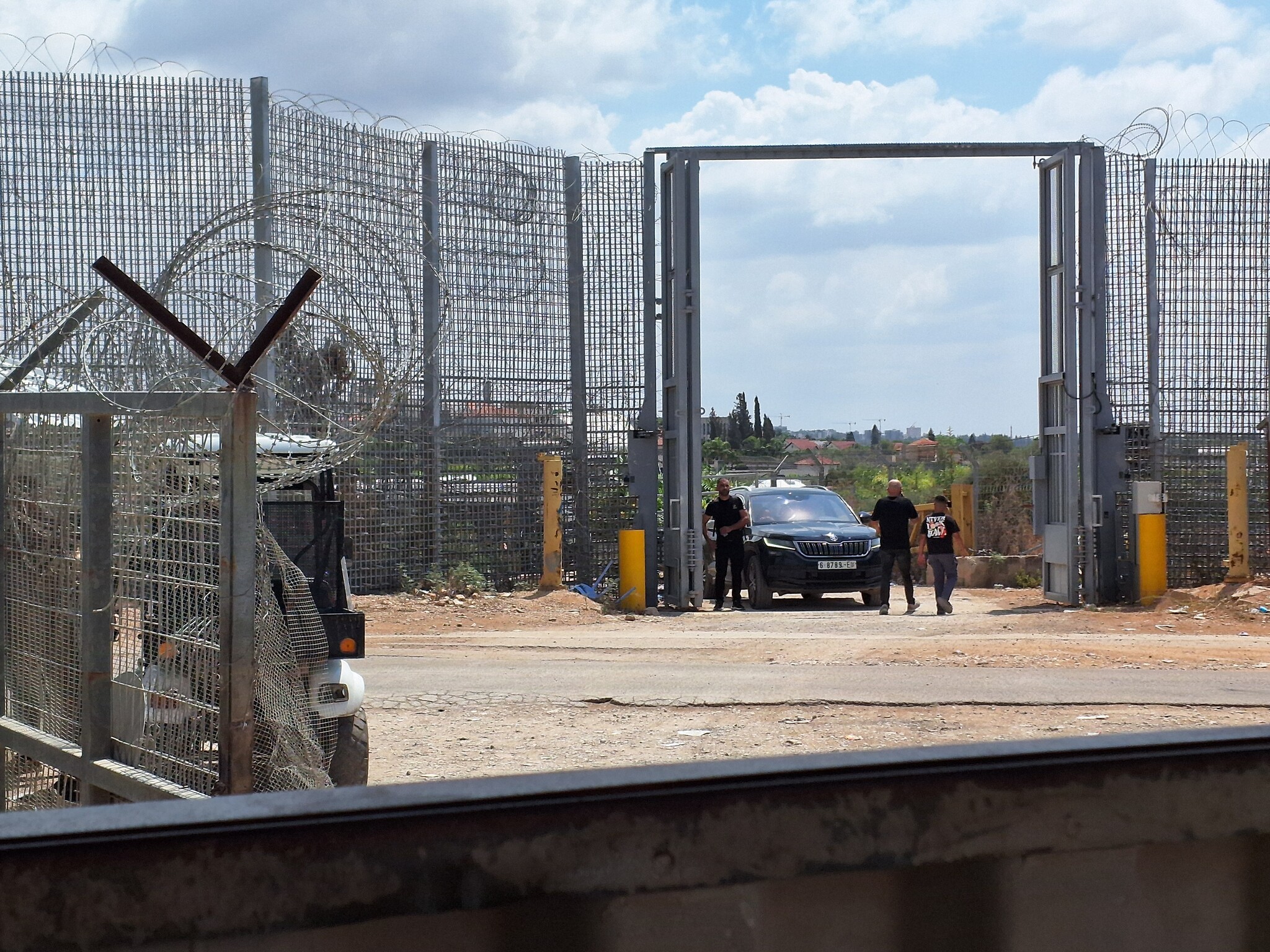 Ronit Dahan-RamatiAug-31-2026Habla. The gate is open
-
