
Eyal Crossing, Habla, Irtah (Sha’ar Efrayim)
Irtah, Eyal Habla. Tuesday 4.3.14, early morning
Observers: Tzvia S., Annalien, Rachel A. (reporting)
Guests: A cinema man and film producer from The Netherlands
04:00 — We took two cars. Annalien joined the shift with the guests, who followed our car. The CP opened on time. Passage was heavy but moving. Because of the cameras more people approached us to tell of their problems.
We told them that we were about to meet the CP commanders, and asked what messages they wished us to convey. We heard details of their long hard daily routine, and the ridiculous wages paid at its end. Most of them are employed by a contractor who gets most of their wages, leaving them with a pitiful remainder. Their day begins at 02:30 when they leave home, returning at 17:30.
They have a lot of self-directed anger at their failure to organize the entry area, and their inability to control the pressure and the pushing. "This is not the enemy's fault", said one complainant. "It is our own problem".
Another said: "You're wasting your time, nothing will come of your talking".
Someone else said "When you're here, passage is smoother".
05:45 Eyal
Many laborers waiting for their employers. We went around the CP on foot towards the laborers' entrance and got their unhampered, till a point where the loudspeaker announced that we in a closed military area and had to clear out. There is a new wing at the CP which will enable passage of more workers. It is not active yet.
06:15: We drove north for the filming. We saw the extensive construction in the village, which is steadily expanding. From our observation point one can see afar (but there was a haze).
07:15 Habla
The CP was open for workers wishing to enter the area of the seamline. Workers enter five at a time. Cars pass occasionally, as do donkeys and carts, and a bus of schoolgirls.
When Omar passes he invites us to coffee, and so we sit at his place with another nursery owner and hear of their water and electricity troubles, of the economic hardship in Qalqiliya, the deep unemployment and the lack of development. It is difficult to face Israel with all these problems, and more.
Around 09:00 we started on our way home.
Eyal Checkpoint / Crossing
See all reports for this place-
Eyal Checkpoint is intended for pedestrians and Palestinians only. This is the main barrier for workers to cross from the center of the West Bank. Workers with a work permit to enter Israel can pass through it for trade, medicine, and visiting prisoners. The checkpoint was built on the Green Line north of Qalqilya in the separation barrier that surrounds the city. The checkpoint began operating in 2004 by the military. Opening hours on weekdays from 04:00 to 19:00. We started holding shifts there in 2007. We arrived at the checkpoint before it opened at 4 in the morning. We reported on the difficult conditions and the long and cramped queues of workers who must continue their journey by commuting to work throughout Israel. At the end of June 2009, the checkpoint was operated by a civil security company, The transit time has been gradually shortened, today it is faster, but the Palestinians still have to arrive very early to make it to the transportation. Usually, about 15,000 people pass through.
-
Habla
See all reports for this place-
Habla CP (1393)
The Habla checkpoint (1393) was established on the lands of the residents of Qalqilya, on the short road that
connected it for centuries to the nearby town of Habla. The separation barrier intersects this road twice and cut off the residents of Qalqilya from their lands in the seam zone.(between the fence and the green line).
There is a passage under Road 55 that connects Qalqilya to the sabotage This agricultural barrier is used by the farmers and nursery owners established along Road 55 from the Green Line and on both sides of the kurkar road leading to the checkpoint.
This agricultural checkpoint serves the residents of Arab a-Ramadin al-Janoubi (detached from the West Bank), who pass through it to the West Bank and back to their homes. The opening hours (3 times a day) of this agricultural checkpoint are longer than usual, about an hour (recently shortened to 45 minutes), and are coordinated with the transportation hours of a-Ramadin children studying in the occupied in the West Bank.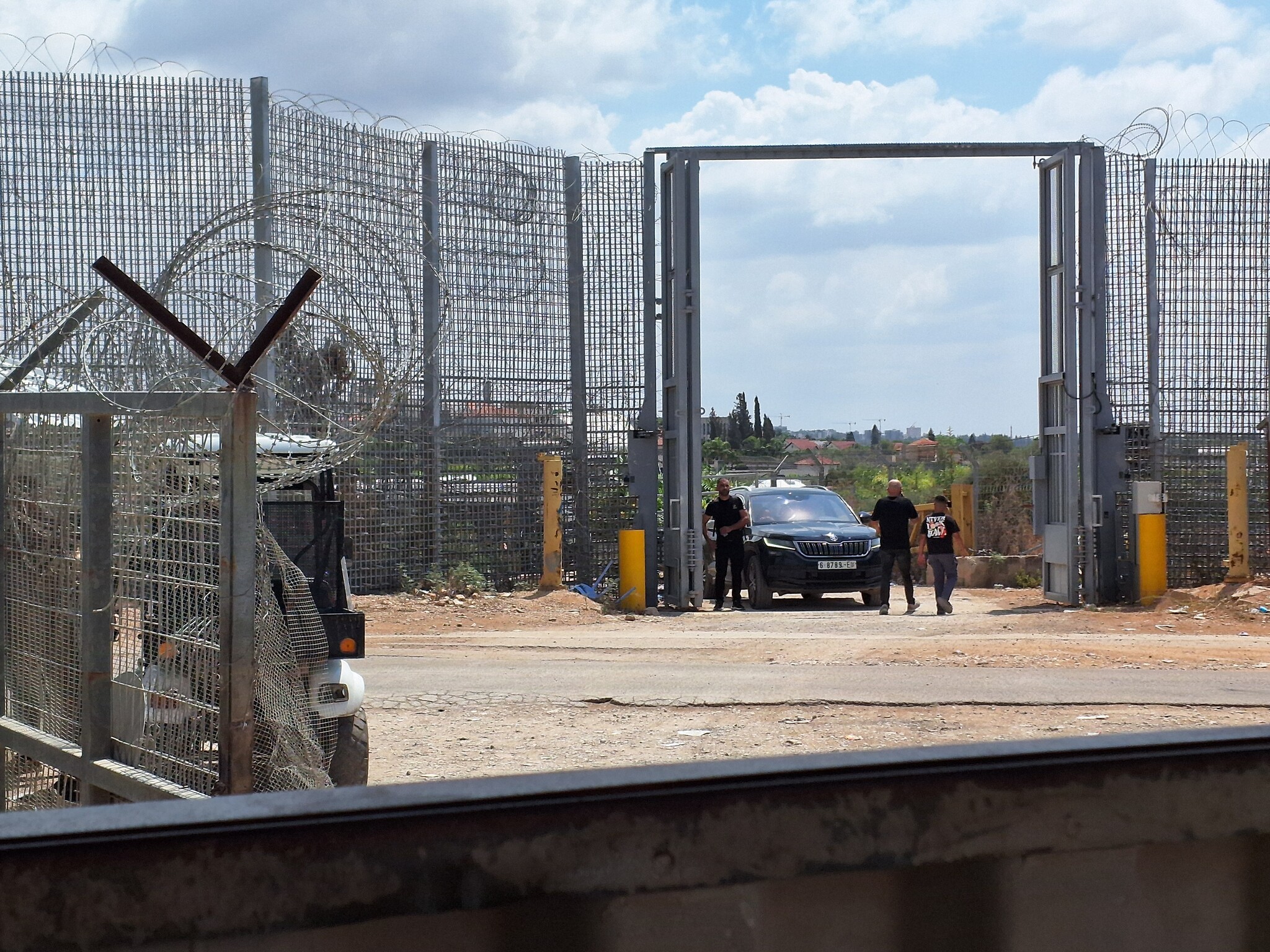 Ronit Dahan-RamatiAug-31-2026Habla. The gate is open
-
Irtah (Sha'ar Efrayim)
See all reports for this place-
The checkpoint is for Palestinians only. It is the main barrier to the passage of workers from the northern West Bank to Israel. Workers with a permit to work in Israel and also for trade (with appropriate permissions), medicine, and visiting prisoners. One can cross the checkpoint only on foot. The checkpoint is located north of Road 557 and south of Tulkarm. Operated by a civil security company, opening hours: between 4:00 and 19:00 on weekdays. As members of Machsom Watch, we began our shifts to this location in 2007. We arrived before it opened at 4 in the morning and report since, on the harsh conditions and the long and crowded queues of workers. The workers who pass by continue their journey by transportation to work throughout Israel. In the first period of its activity, about 3,000 and then 5,000 people passed through this checkpoint every day. Due to the small number of checking points and arbitrary delays for long periods of time in the "rooms", workers feared losing their transportation. Hence workers leave their homes at 2:30 at night to be among the first. Today, 15,000 pass and the transition is faster. Workers are still leaving their homes very early to get past the checkpoint at 7 p.m. In an adjacent compound, there is a terminal for the transfer of goods on a commercial scale, using the back-to-back method.
-
