
Eyal Crossing, Irtah (Sha’ar Efrayim), Qalqiliya, Thu 26.8.10, Afternoon
Translator: Charles K.
16:30 Sha’ar Efrayim crossing
People entered freely, with no delays and without showing IDs. Most complaints were about the morning, particularly on Friday when inspection is more rigorous and the wait is longer. People told us that what bothers them about waiting in the morning is the uncertainty.
16:50 Eliyahu crossing
People cross freely, laborers automatically show their IDs and cross. They appear exhausted from word and fasting. While we were standing in the entrance after having gone through the revolving gate the shift manager approached us claiming we were photographing in a security area – though we had no cameras. But he was polite and smiling, explained that the Eyal crossing treats the laborers patiently, and is much better than the Efrayim crossing. It wasn’t clear exactly what he was referring to, but he emphasized that he follows instructions; he’s not the one who decides.
17:25 The entrance to Qalqiliya
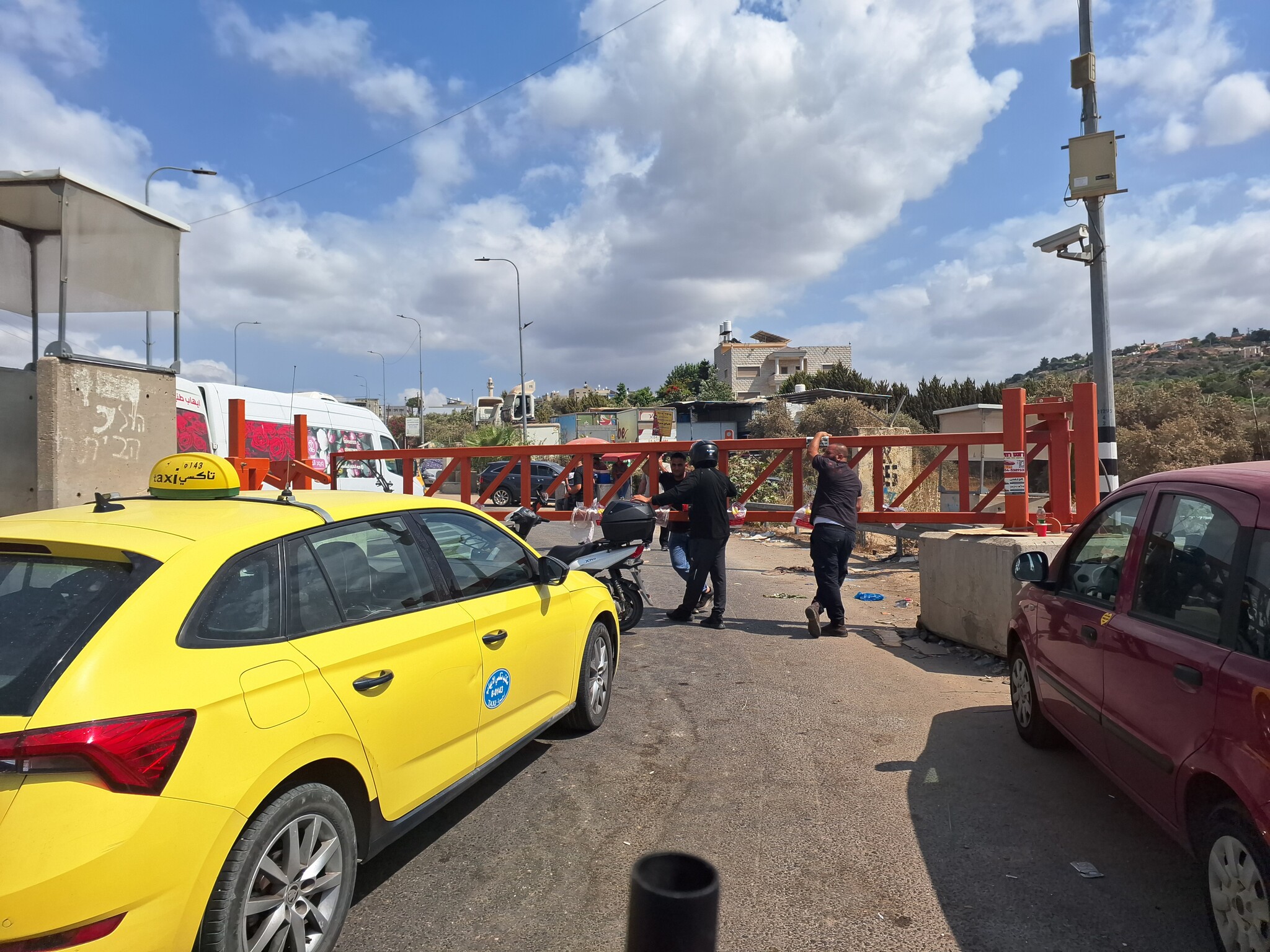
On our way to the Habla agricultural gate we saw a traffic jam of taxis on both sides of the entrance to Qalqilya. We stopped and walked over to watc. The soldiers had stretched spiky barriers across the road and inspected the cars entering the city. People with Israeli IDs weren’t allowed to enter, and had to turn around and go back. Some were waiting, and told us they live in Qalqilya but still weren’t allowed to enter since they have Israeli IDs. We were told that there are thousands of people with Israeli IDs living in Qalqilya. The soldiers refused to provide any information about what was happening. Later we learned the story: that there’d been an alert involving an Israeli car heading for Qalqilya. I have to admit that I was relieved to learn that there had been a reason for holding people up in the heat at the end of the Ramadan fast – that it wasn’t done for no reason.
We didn’t make it to Habla because there had been a fatal car crash nearby and we were held up for a long time in a line of cars until the road had been reopened.
Eyal Checkpoint / Crossing
See all reports for this place-
Eyal Checkpoint is intended for pedestrians and Palestinians only. This is the main barrier for workers to cross from the center of the West Bank. Workers with a work permit to enter Israel can pass through it for trade, medicine, and visiting prisoners. The checkpoint was built on the Green Line north of Qalqilya in the separation barrier that surrounds the city. The checkpoint began operating in 2004 by the military. Opening hours on weekdays from 04:00 to 19:00. We started holding shifts there in 2007. We arrived at the checkpoint before it opened at 4 in the morning. We reported on the difficult conditions and the long and cramped queues of workers who must continue their journey by commuting to work throughout Israel. At the end of June 2009, the checkpoint was operated by a civil security company, The transit time has been gradually shortened, today it is faster, but the Palestinians still have to arrive very early to make it to the transportation. Usually, about 15,000 people pass through.
-
Irtah (Sha'ar Efrayim)
See all reports for this place-
The checkpoint is for Palestinians only. It is the main barrier to the passage of workers from the northern West Bank to Israel. Workers with a permit to work in Israel and also for trade (with appropriate permissions), medicine, and visiting prisoners. One can cross the checkpoint only on foot. The checkpoint is located north of Road 557 and south of Tulkarm. Operated by a civil security company, opening hours: between 4:00 and 19:00 on weekdays. As members of Machsom Watch, we began our shifts to this location in 2007. We arrived before it opened at 4 in the morning and report since, on the harsh conditions and the long and crowded queues of workers. The workers who pass by continue their journey by transportation to work throughout Israel. In the first period of its activity, about 3,000 and then 5,000 people passed through this checkpoint every day. Due to the small number of checking points and arbitrary delays for long periods of time in the "rooms", workers feared losing their transportation. Hence workers leave their homes at 2:30 at night to be among the first. Today, 15,000 pass and the transition is faster. Workers are still leaving their homes very early to get past the checkpoint at 7 p.m. In an adjacent compound, there is a terminal for the transfer of goods on a commercial scale, using the back-to-back method.
-
Qalqiliya checkpoint
See all reports for this place-
Qalqilya is surrounded on all sides by the separation barrier. The only exit from the city is in the east of the city on the road that leaves the city in an easterly direction. This is where the checkpoint was located. When the checkpoint was active until 2009 our shifts watched long queues of cars being inspected at the only exit from the city to the West Bank. The checkpoint was canceled, but there is a military presence at the entrance to the city.
 Ronit Dahan-RamatiAug-31-2026Nabi Elias. The gate is closed
-
