
Givat Zeev, Hizma, Jaba (Lil), Qalandiya, Mon 26.7.10, Afternoon
15:30, Givat Ze'ev: The CP was practically abandoned in the afternoon heat. We drove by and continued on to Qalandiya.
15:45, Qalandiya: When we arrived in the parking lot we saw many policemen and soldiers, accompanied by civilian security personnel, walking around and examining the area. A security guard whom we asked explained that they were preparing deployment for the Ramadan. Inside, the northern shed was almost empty. The guard on duty in the booth in the shed was fast asleep, head lolling on his shoulder, feet on the table opposite.
The three passageways that were operating were moderately full, with about 20 people each in lines 3 and 4, which were allotted to blue ID bearers (Israeli's and Jerusalem residents). Only a handful of people were waiting in line number 2 which was for bearers of Palestinian ID cards.
A young woman who had reached the checking area in passageway 4 kept setting off the alarm of the magnetometer when she went through. People waiting outside shouted to her to take off her shoes but she became increasingly upset and began shouting at the soldiers and banging on the partition. The female soldier on duty in passageway 4 also lost her cool and began shouting angrily into the PA system at the young woman. The following is a partial transcription of what we heard (we couldn't write fast enough to get it all down): "Uskot (shut up)! Don't do that with your papers! You're making me angry – don't! Don't say another word! That's it – you're not going through! Shut your mouth! Put down your papers! Calm down!" At this point the shouting stopped and the young woman was ushered into the examination room. (About half an hour later a man in the shed phoned Natanya – it was her father. Evidently someone had seen what was happening and had informed him. As Natanya was speaking to him, the girl called her father and told him that she had been ordered to strip (although Natanya understood from him that she had not complied) and later had been released without having to sign anything.
All the while the lines kept getting longer and longer and, although the people generally waited quietly, it was evident that there was much pent up anger waiting to explode. It was like watching a volcano on the verge of eruption.
Suddenly there was shouting in passageway one. A woman who had waited for over an hour in one of the other passageways had gone to try her luck there and, not being allowed in, something snapped. She stood in front of the closed circuit surveillance camera and spat at it. Then she started shouting that anyone who could treat people as Israel was treating the Palestinians deserved what Hitler had done. This went on for quite a while. Later the woman walked around shouting at passersby and particularly at Natanya and myself, all the time invoking Hitler as future punishment for Israel's behavior.
Natanya went over to passageway one, reserved for people with green PA-ID cards. At this time passageway one was completely empty while 50 people crowded into each of the other lines. There were 4 soldiers sitting in the "aquarium" in the checking area, 2 men and 2 women. Natanya suggested that blue-ID holders be allowed to use this Passageway too, but one of the women soldiers shouted at her through the PA system that the area was not for blue IDs and then sat back with her friends, all of them looking mockingly at Natanya and laughing. This is not intended as a personal statement but as a classic example of how the soldiers seem to forget that they are dealing with human beings and view the whole situation as an amusement. I doubt that they would find it so were they waiting in two different lines for over an hour in such a crowd and in that heat.
All of a sudden a middle aged man, a doctor, emerged from line 4, young daughter in tow, hands full of packages and holding his belt. I asked him what had happened and he said his daughter had not been allowed through. It emerged that the doctor had returned the previous day from Saudi Arabia, picking up his daughter en route. She had been in Amman Jordan over the past two years. The problem was that she was over 17 but did not have the required ID papers. Of course she did have a valid passport and visa. He had tried to explain to the soldiers that the girl had left Jerusalem two years ago, when she was too young to need ID papers, and had only returned the previous day so obviously had not managed to receive them. The soldiers would not let her through. I tried to contact the DCO representative, but he never arrived. I tried my luck with Police Officer Shaul even though, knowing his attitude towards Palestinians, I doubted he would be helpful. He wasn't. He told the doctor to go stay the night in Ramallah and apply at the DCO office in the morning.
The doctor said he would try to get through a different CP and left. A few minutes later he returned – he had forgotten his cellphone in the X-ray machine. Natanya asked a man at the head of line 4 to look for the phone when he got into the checking area, but he never found it. At this point, the man looking for the phone was himself detained. Natanya asked some young women to give him her phone number but they said they were afraid to do so as they themselves might then be detained. One said she would ask him to come back to speak with me but this might make things worse for him.
Continuing to talk with the doctor, I learned that he had undergone open-heart surgery in Jerusalem 12 years ago. On recovery he decided that it was too stressful for him to live in Jerusalem under the Occupation and so had found a job in Saudi Arabia, where he has lived for the past 12 years (leaving his family in Jerusalem). Then he told me that he had experienced more stress in the past 24 hours in Jerusalem than he would have in a year in Saudi Arabia. He and his daughter went off without the phone. (I phoned the doctor's wife later on and found that he had made it home with his daughter and with no further problems.)
The situation continued to be volatile – crowded and hot with long lines inside the CP and outside in the northern shed. We periodically phoned Headquarters and H.B. to report on what was happening and ask them to intervene. Nothing seemed to make a difference. Things remained bad.
We left Qalandiya at 17:30. The passageways were full and there were close to 100 people waiting in the northern shed. From the car we called Headquarters one last time.
17:30: We returned to Jerusalem via Lil/Jabba and Hizmeh CPs. Traffic was jammed all the way to Jerusalem, but there were no queues at the CPs.
Hizma
See all reports for this place-
Hizma
A checkpoint at the north-eastern entrance to the Jerusalem area which was annexed in 1967, at Pisgat Zeev. The passage is allowed to bearers of blue IDs only. Open 24 hours a day.
-
Jaba' (Lil)
See all reports for this place-
Jaba' (Lil) In fact, the Jaba checkpoint is east of the Qalandiya checkpoint. Its declared purpose is the prevention of Israeli citizens from entering Area A. A road checkpoint for vehicles, located on Road 65, borders the southern fence of Kfar Jaba, about three kilometers east of the Qalandiya checkpoint, on the road leading to the settlement of Adam on Road 60. Archaeological excavations within the village found the remains of a cloth house from the First Temple period. The events that led to the construction of the checkpoint are precisely here: on the day of the abduction of Gilad Shalit and before the outbreak of the Second Lebanon War, a 17-year-old man from one of the settlements was abducted by a Palestinian cell. His body was found several days later at the entrances to Ramallah. A military investigation revealed that his abductors had taken him along this route. The checkpoint was set up to prevent future kidnappings and to warn settlers from traveling to Ramallah and entering Area A (which is forbidden for Israelis). The checkpoint that operates around the clock. Usually only vehicles traveling in the direction of Ramallah are inspected. (November 2016): Every morning, when the settlers en masse travel to Jerusalem on Route 60 and every afternoon they return from Jerusalem on Route 60, the army initiates a traffic jam at the entrance to the Jaba checkpoint and stops the movement of Palestinians traveling toward Route 60. (February 2020): In the last two years the checkpoint has not always been manned. Sometimes the soldiers come and just stand, sometimes they come and stop and check those who enter the village, sometimes they patrol the alleys of the village, sometimes they fire stun grenades and gas and sometimes they invade houses and stop young people, say those passing through the Hazma checkpoint. (Updated February 2020)
-
Qalandiya Checkpoint / Atarot Pass (Jerusalem)
See all reports for this place-
Click here to watch a video from Qalandiya checkpoint up to mid 2019 Three kilometers south of Ramallah, in the heart of Palestinian population. Integrates into "Jerusalem Envelope" as part of Wall that separates between northern suburbs that were annexed to Jerusalem in 1967: Kafr Aqab, Semiramis and Qalandiya, and the villages of Ar-Ram and Bir Nabala, also north of Jerusalem, and the city itself. Some residents of Kafr Aqab, Semiramis and Qalandiya have Jerusalem ID cards. A terminal operated by Israel Police has functioned since early 2006. As of August 2006, northbound pedestrians are not checked. Southbound Palestinians must carry Jerusalem IDs; holders of Palestinian Authority IDs cannot pass without special permits. Vehicular traffic from Ramallah to other West Bank areas runs to the north of Qalandiya. In February 2019, the new facility of the checkpoint was inaugurated aiming to make it like a "border crossing". The bars and barbed wire fences were replaced with walls of perforated metal panels. The check is now performed at multiple stations for face recognition and the transfer of an e-card. The rate of passage has improved and its density has generally decreased, but lack of manpower and malfunctions cause periods of stress. The development and paving of the roads has not yet been completed, the traffic of cars and pedestrians is dangerous, and t the entire vicinity of the checkpoint is filthy. In 2020 a huge pedestrian bridge was built over the vehicle crossing with severe mobility restrictions (steep stairs, long and winding route). The pedestrian access from public transport to the checkpoint from the north (Ramallah direction) is unclear, and there have been cases of people, especially people with disabilities, who accidentally reached the vehicle crossing and were shot by the soldiers at the checkpoint. In the summer of 2021, work began on a new, sunken entrance road from Qalandiya that will lead directly to Road 443 towards Jerusalem and Tel Aviv. At the same time, the runways of the old Atarot airport were demolished and infrastructure was prepared for a large bus terminal. (updated October 2021)
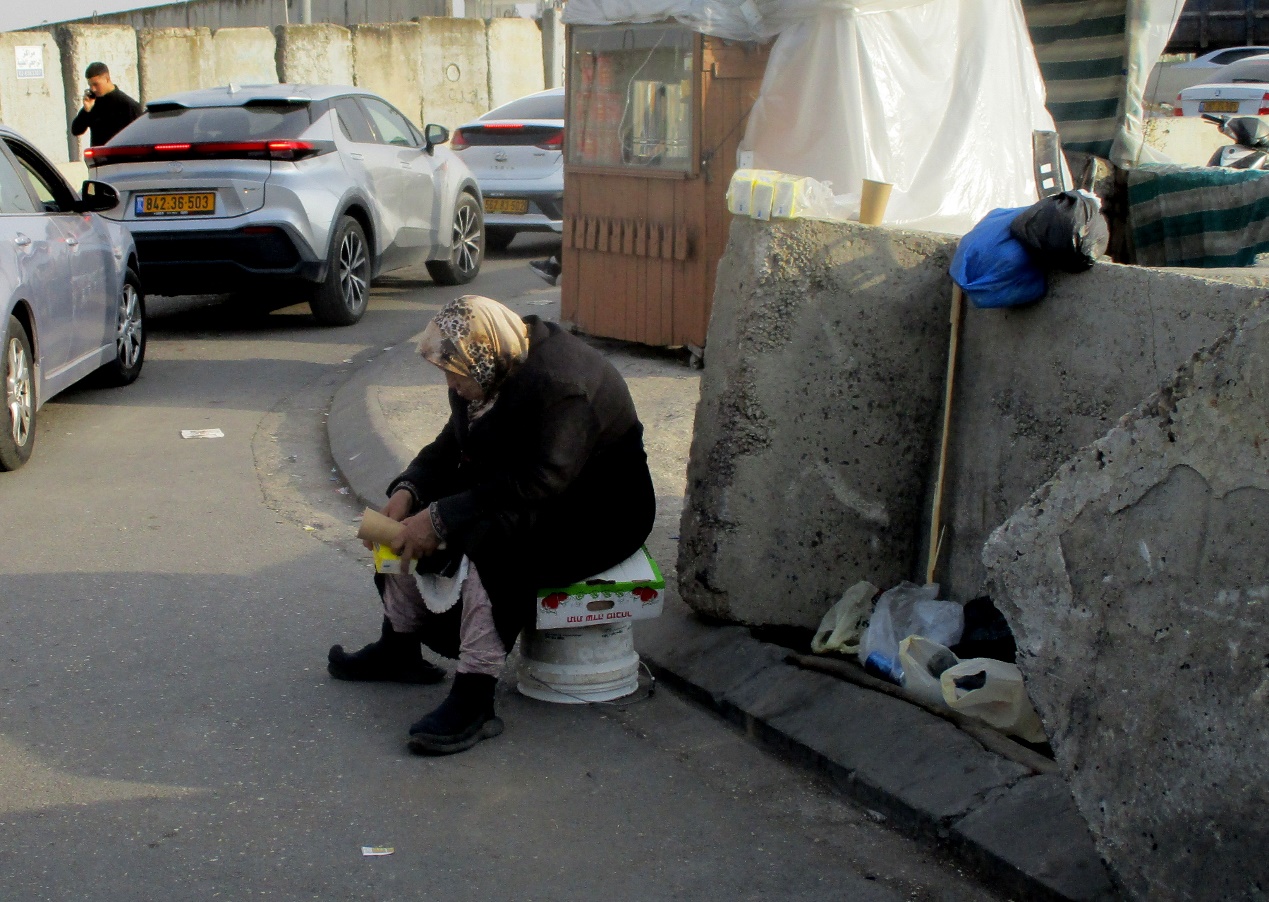 Tamar FleishmanOct-11-2026Qalandiya. Female Beggar
-
Zif Junction
See all reports for this place-
Zif Junction located on the crossroads that directs towards Road 356 to Yata. Yata is the district city of the southern Hebron Mountains. Usually, this junction is open to traffic. The nearby pillbox is unmanned. But the army and police are present occasionally, sometimes setting up a checkpoint and sometimes detaining residents from the big city. Often, the Israeli policemen inspect vehicles and distribute driving reports to Palestinian vehicles. s
-
