
Hamra (Beqaot), Tayasir, Tue 17.9.13, Afternoon
Translator: Charles K.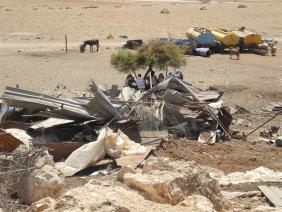
Alon Road/Highway 578
12:556 We reached the havoc wreaked by the army on the 11 Bisharat families who’ve lived for years in this wadi, north of the road up to the Hemdat settlement and the Kfir brigade training base. The buildings of the Umm-Zuka military base are visible higher up and to the north.
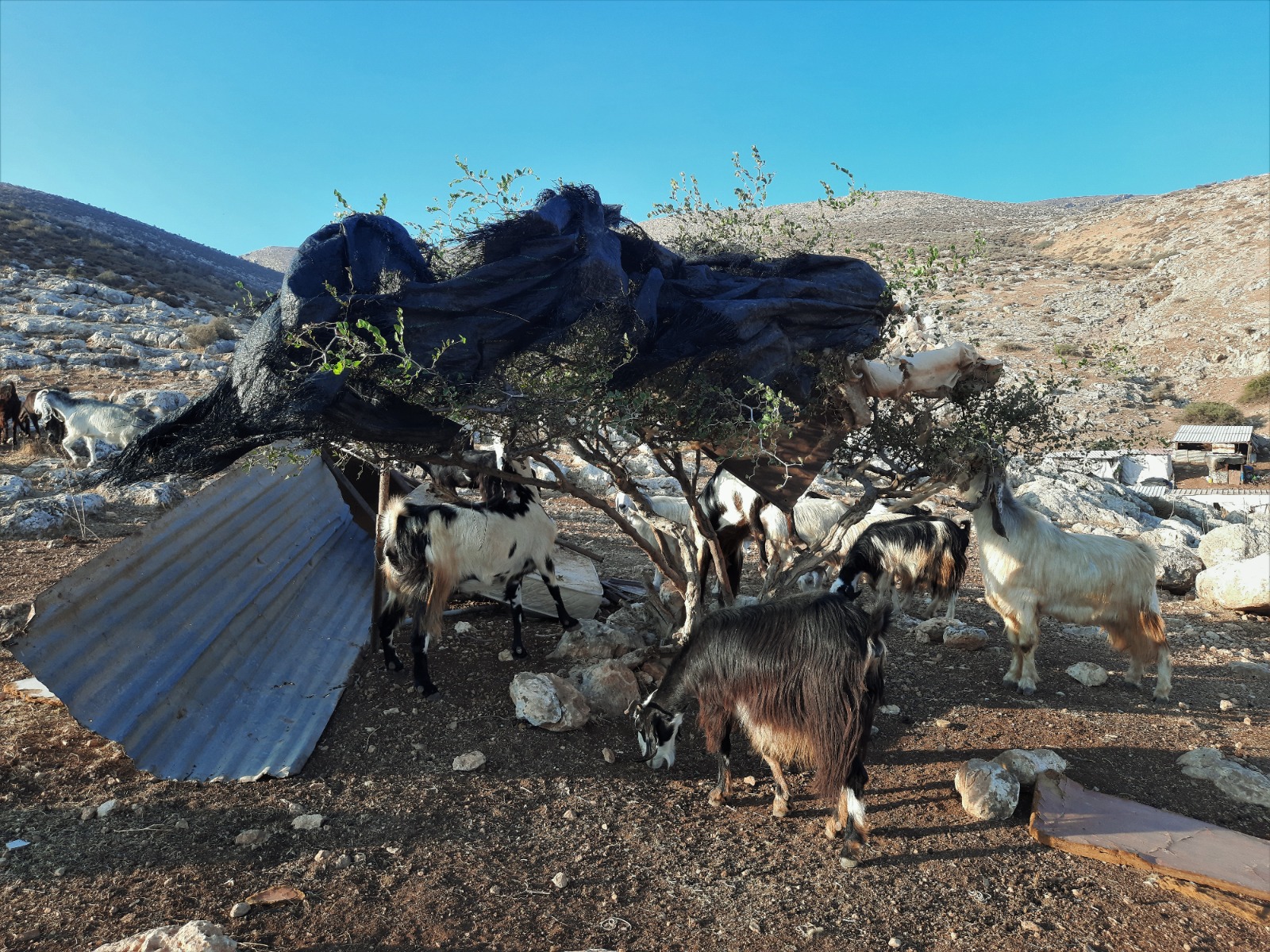
We met A., B. and Y., brothers, and another brother who lives some distance away. There were also four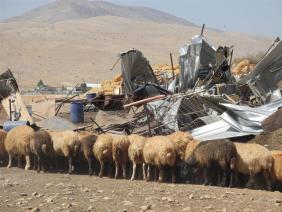 EAPPI volunteers (from Hebron and from Yanun), and a driver/translator. The scene was hard to describe. Crushed piles of corrugated metal and fencing. The water troughs for the sheep were arranged in rows, in contrast to the jumble of destruction. The sheep had no shade; some goats hid under the water tanker. The flock fled and scattered while the destruction was going on. It was hard to gather them. No sheep were harmed. We asked about the chickens; they’re hiding under the rubble. There’s a large, crushed water tank. “We asked to move it before they demolished everything, the soldiers said “no way,” and crushed it.” The food? Gone! The soldiers agreed not to destroy the food for the sheep; the sacks of
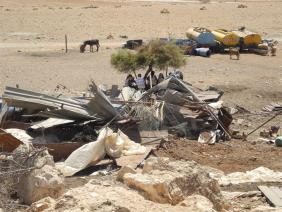 hay also remained. The women and children are with relatives in Tamun. The children are transported to school. Yesterday at 3 in the afternoon soldiers saw B. in the area and chased him away. They fired a grenade and said, “You’re not allowed to be here!”
Y: “We have houses in Tamun, but we live here [with the sheep and cattle], work here, and want to die here.”
They say it’s the first time the entire village has been demolished. In the past one or two homes were destroyed, water tanks were emptied, but this time – all our property, which we’d worked to building during the past few years, was destroyed in one morning. Three large bulldozers arrived on Monday, September 16, 2013, at 5:30 in the morning along with forces from the army and the Border Police and began the demolition. The army stopped relatives on the road who came with food and to help. We left the brothers water we’d bought and drove on.
13:35 We left
The earthen berm (to prevent Bedouin from crossing) along the road has been repaired and made higher.
13:45 Hamra checkpoint
A line of about 12 cars waiting to cross to the west (the West Bank). They’re not moving. Two trailer-trucks, vans with laborers or pupils and private cars. It’s hot!!! An army jeep parked near the emplacement on the road flying an MP banner.
The line began moving at 13:50, the cars sent to the middle lane while those coming from the west had to wait. The line of waiting cars alternately lengthened and shortened. At 14:10 the congestion eased.
A soldier (from the Home Front Command search and rescue teams) called us from the emplacement on the road, told us to come stand with him in the shade, where we’ll also be safer. He didn’t know anything about us, nor that he’s forbidden to talk to us, or that we’re not allowed to stand in the checkpoint area. Suddenly the commander appeared who probably taught him a thing or two about how to behave with people like us. We left. Is that how it is with replacements manning the checkpoints on holidays?
On our way to the car we met a young man from the Hamra settlement, who was paying a laborer. The laborer didn’t talk to us but the young man (about 26 years old) was curious. In brief: he told us about the wonderful cooperation and social relations between the settlers and the residents of the Jordan Valley, on the mission he and his family are carrying out by living in the Jordan Valley, serving as a living shield for the state of Israel. His family raises herbs and dates. They’re wealthy, treat their 140 workers fairly. “If we leave, they won’t be able to make a living.” He claimed (somewhat impolitely) that we still had a thing or two to learn about occupation, colonialism, etc.
14:40 We left.
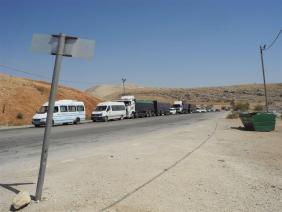
15:05 Tayasir checkpoint
Something we haven’t seen for a long time: a van parked by the roadside, passengers outside in a line being inspected. The soldier calls out names and returns ID cards. To the driver. Then the passengers in other passing vans underwent that (humiliating) inspection. And also passengers in private cars. The driver got out, opened doors…it looked to me as if the commander was training his soldiers in “checkpoint procedures.”
Other soldiers were busy moving poles and sheeting for a reusable sukkah into the area of the guard tower. We promised the commander not to bother anyone.
15:25 We left.
The road up to Tayasir is getting ready for a military event. A tank on a transporter and another transporter with a dummy tank (with no cannon). Jeeps that came through the Tayasir checkpoint parked opposite Hamam el Malih, north of the road.
15:45 Bezeq checkpoint
After she learned we’d been to Hamra and Tayasir, the woman stationed at the checkpoint was unsure whether to allow us through. After consulting her colleagues she opened the gate.
.
Hamra (Beqaot)
See all reports for this place-
One of the Jordan Rift Valley checkpoints that prevent direct transit between the West Bank and the Jordan Valley, in addition to Tayasir Checkpoint. Located next to Hamra settlement, on Route 57 and the Allon Road.
Read about the peple of the Jordan Valley and the quiet transfer happening there.
 Shahar ShilohNov-3-2021Ein Shibli: grazing begins close to home
-
Tayasir CP
See all reports for this place-
Located on road 5799, It is one of the checkpoints control the passage between the northern West Bank and the Jordan Valley. For a long time, it stood empty and open, with only a sign next to it warning against entering Area A. It was adjacent to an old military camp - now everything is neglected. How much money was invested here, and how much brainwashing was done to the soldiers of Netzah Yehuda and Kfir.
Today, it is very difficult to pass there. Many delays. Often, teachers from Tubas are not allowed to pass into the Valley to villages like Ein al-Bida where the local schools are located, and there are no classes. There are additional days when the checkpoint is closed. In general, there is a wait there of about two to four hours to go towards the Valley and also to return. Many times the Palestinians are forced to use the Hamra checkpoint, which also leads into Tubas and the West Bank, but there is also a huge queue there and a long wait.
Following a deadly attack on soldiers at the nearby base in February 2025, the checkpoint was completely closed for the time being. (Updated March 2025)
-
