
Hamra, Ma’ale Efrayim, Tayasir, Thu 19.8.10, Afternoon
Charles K.
It’s the hottest day in many years. The temperature is about 48 degrees celcius. We suffered greatly, but our suffering was nothing compared to that of the Palestinians forced to trudge along while fasting. We saw people drenching kaffiyas and handkerchiefs in water and wrapping the wet rags around their burning bald heads, perspiring faces, eyes dimmed from the heat…
11:15 – Gitit (Ma’aleh Efraim)
The checkpoint isn’t manned, but is swarming with settlers wandering around in the soldiers’ booth, going down to the road to talk with their fellows who stop in the middle of the checkpoint and block the road. Lords of the land!
Hamra checkpoint
Soldiers doing compulsory service have replaced the reservists who’ve completed their stint, and with them the unnecessary struggle over our presence at the checkpoint. A few weeks ago we received a letter from a reservist who told us the soldiers have orders saying that “when the Watch bitches show up, close the checkpoint if they bother you.” Shutting the checkpoint and preventing Palestinians from crossing is illegal (not to mention how inhuman it is, because it harms Palestinians who aren’t a party to the all-out war the army is waging to prevent us from observing the checkpoint).
The commander demands that we move back to the junction, we refuse and remain where we usually stand. He orders his soldiers to close the checkpoint and prevent the Palestinians from crossing; they suffer greatly as a result. We ask our lawyer to send a fax about it (as well as the closing of the checkpoint a week earlier) to the legal advisor, and also call S., the DCO officer. He argues with us (“Why didn’t they close the checkpoint before you arrived?”), but orders the soldiers to open it. It was closed no longer than 10 minutes, but the suffering of people forced to wait for their rides in the inhuman heat and sun, without water, just because the soldiers wanted to get rid of us, is indescribable.
The crossing procedure hasn’t been eased for Ramadan, and cars entering the Jordan Valley are rigorously inspected, including opening the trunk and rummaging around intrusively. The Palestinians have to get out of their cars about fifty meters before the checkpoint, just as they must do the rest of the year, wait to be called by the soldiers and then go wait for the car at the junction. The canopy that was erected and filmed for the news reports as an example of “improving conditions at the checkpoints” still serves only to shade the soldiers’ water container; the Palestinians are forbidden to shelter there.
12:25 – Three officers with the rank of captain arrive and one approaches us to chase us away from the junction. Again we make it clear to him, politely but firmly, that we won’t move from where we’re standing, that we’re observing quietly, not interfering with the operation of the checkpoint and standing pretty far away from the soldiers. We tell him to call the police if he has a problem with our being here.
12:40 – We leave.
13:15 Tayasir checkpoint
Here, too, one of the soldiers tries to chase us away, but the checkpoint commander tells him that so long as we don’t interfere with the checkpoint’s operation he doesn’t have any problem with us being there.
Light traffic in the oppressive heat. A taxi crossing into the Jordan Valley is detained a long time for inspection. A young man and woman cross on foot at the same time because they’re forbidden to go through in a vehicle. The man tries to explain to the soldier that he should allow his wife to get their baby from the taxi; she left it there with the air conditioning on, but now the taxi is being inspected and the motor is off and she’s worried about the baby. The soldier doesn’t understand what he’s talking about, and a dialogue of the deaf begins, with gestures, and finally the soldier allows the mother to get the baby. Immediately afterwards, the taxi is released.
A very old woman, about 80, remains in another taxis, holding a screaming baby. The woman is worried about violating the occupier’s rules by remaining in the taxi; she’s forced to get out and cross through the checkpoint on foot, and in her anxiety she presents her ID card to every soldier she sees. The checkpoint commander approaches and interrogates her – where is she from, where is she going, etc. The woman looks at him in alarm – not only can’t she understand him, she can barely hear what he’s saying over the baby’s screams. The soldier, who could be her great-grandson, finally lets her go…
Here, too, the soldiers are those doing compulsory service. Most of the time the crossing operates reasonably well, considering that it’s interfering with the normal lives of people in their own land, in 48 degree heat.
14:10 – We left.
We were invited to El Pharsiya, to a meeting of the owners of homes that had been demolished in the two demolitions carried out during the past month (on 19.7 and 5.8), who were left homeless, along with others who’d received demolition orders but whose homes/tents hadn’t yet been destroyed, along with lawyers, Palestinian Authority officials and representatives of aid organizations. It was clear to everyone that Israel has opened a campaign to annex the Jordan Valley and is therefore systematically demolishing the homes of the Palestinians and trying to expel the local inhabitants, some of whom have lived here more than 50 years.
Hamra (Beqaot)
See all reports for this place-
One of the Jordan Rift Valley checkpoints that prevent direct transit between the West Bank and the Jordan Valley, in addition to Tayasir Checkpoint. Located next to Hamra settlement, on Route 57 and the Allon Road.
Read about the peple of the Jordan Valley and the quiet transfer happening there.
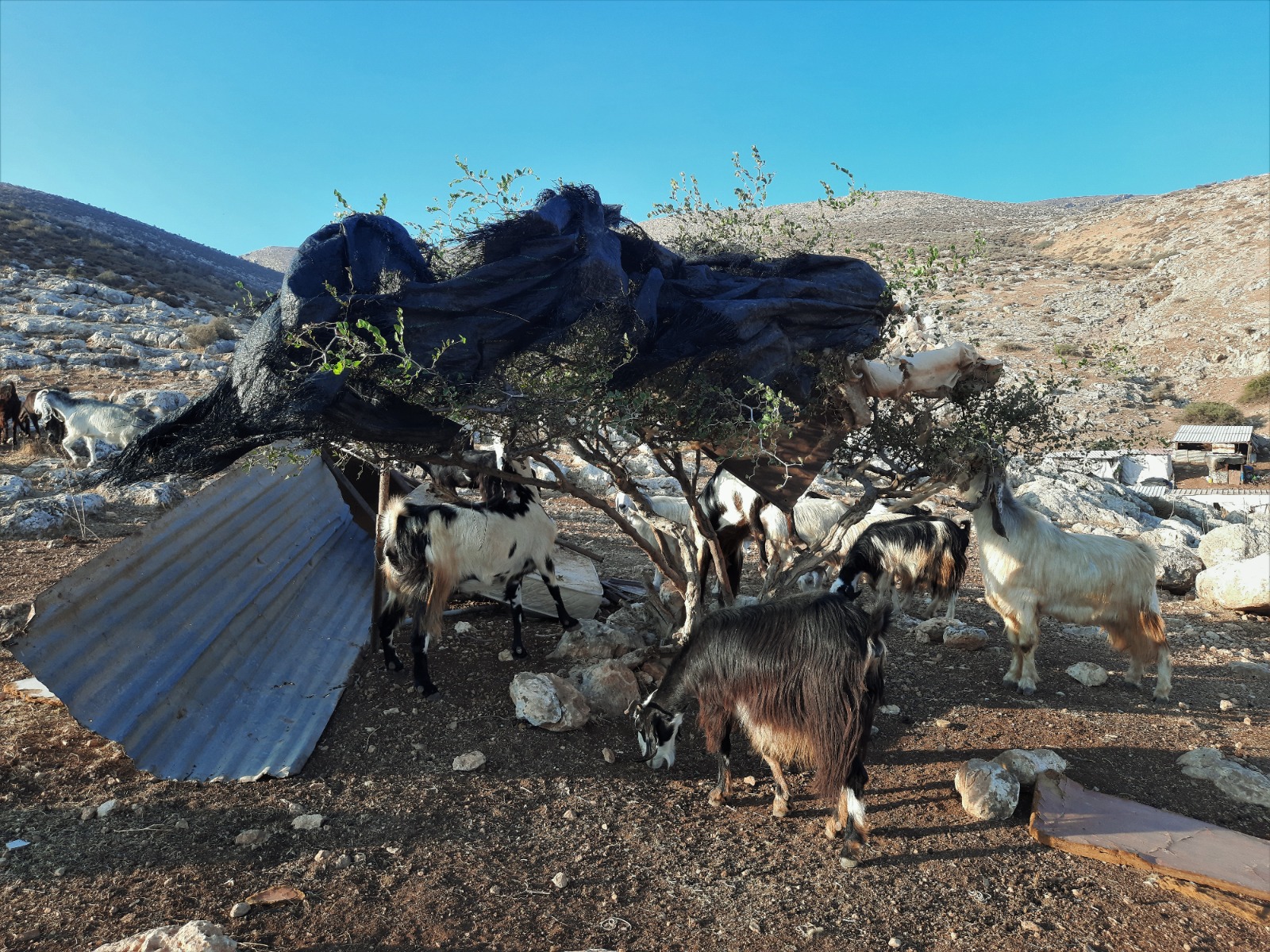 Shahar ShilohNov-3-2021Ein Shibli: grazing begins close to home
-
Ma'ale Efrayim
See all reports for this place-
Ma'ale Efrayim On the road connecting Route 90 (the Jordan Valley road) to the Allon Road.
-
Tayasir CP
See all reports for this place-
Located on road 5799, It is one of the checkpoints control the passage between the northern West Bank and the Jordan Valley. For a long time, it stood empty and open, with only a sign next to it warning against entering Area A. It was adjacent to an old military camp - now everything is neglected. How much money was invested here, and how much brainwashing was done to the soldiers of Netzah Yehuda and Kfir.
Today, it is very difficult to pass there. Many delays. Often, teachers from Tubas are not allowed to pass into the Valley to villages like Ein al-Bida where the local schools are located, and there are no classes. There are additional days when the checkpoint is closed. In general, there is a wait there of about two to four hours to go towards the Valley and also to return. Many times the Palestinians are forced to use the Hamra checkpoint, which also leads into Tubas and the West Bank, but there is also a huge queue there and a long wait.
Following a deadly attack on soldiers at the nearby base in February 2025, the checkpoint was completely closed for the time being. (Updated March 2025)
-
