
Hamra, Ma’ale Efrayim, Tayasir, Thu 29.7.10, Afternoon

Translator: Charles K.
The scope of the expulsion and demolition orders given to the Palestinians in the past month is slowly becoming apparent. Almost every family has received them, which indicates that the government of Israel is determined to expel the Palestinians from the Jordan Valley, as some of our leaders said recently (and not only recently).
We arranged to meet the senior official from the US State Department in Bardala, in the northern Jordan Valley, and this time she brought along the person in charge of political and military matters. Together we met Pathi from Jordan Valley Solidarity and the chairman of the Bardala local council. We saw a lovely encampment, clean and very well organized, located on the outskirts of the village, that has been there for approximately 15 years. The residents of the village received an expulsion order because they were said to be living in a closed area (not necessarily a military area), and were notified that if they don't leave on their own their homes will be demolished, their livestock confiscated and they will have to pay the cost of their own expulsion.
Prior to our meeting I sent the official material and photographs describing how the entire northern Jordan Valley – more specifically, every place in the Jordan Valley where Palestinians live – has been declared a firing range, a closed military area or simply a closed area, indicating that all these proclamations have no connection to security, and their only purpose is to expel the local residents.
The meeting was a good one, concluding at the home of the chairman of the local council, where the Americans said they want to be more involved and come here more frequently. God willing! The purpose of the visit – to report to Washington, which requested clarifications after the most recent remarks by Israeli ministers and the Prime Minister.
The group then drove to Tubas, to meet with the chairman of the local council, and later, at the Tayasir checkpoint, we saw them returning.
11:30 Ma’aleh Efraim
2 soldiers man the checkpoint.
12:00 – Hamra
Many soldiers at the checkpoint, but no lines in either direction.
14:50 Tayasir
Again, reservists. People cross quickly. Two soldiers at the pedestrian crossing – one, who speaks Arabic, is polite to the Palestinians, the other is hostile. A woman with a small boy, about six years old, arrives. The boy goes through the metal detector, which beeps. The boy continues to the revolving gate without noticing, and then the soldier in the booth yells at him, “C’mere, c’mere, what’s in your belly?” The boy, of course, doesn’t understand, but from the tone of voice he does understand that he did something terrible and now the big soldier, with the gun, is very angry and might beat him…He freezes, frightened, and then bursts into tears. The soldier doesn’t back down, makes him go back and forces the unfortunate youngster to lift up his shirt – it turns out he’s wearing a belt…that’s what caused the beeping. It was a heartbreaking scene – the child’s terror in the face of the soldier blind to the fact that he’s facing a small, frightened child…
Dorit burst into tears…I went over to comfort the mother and son after they crossed, and the mother, trembling, handed me her ID card for inspection.
After we left, Dorit told the soldiers what she though about what had occurred, and in particular to the second soldier, who didn’t seem particularly pleased by his colleague’s behavior. Why, she said, doesn’t he report on what he’s seen when he returns to Israel, what he’s experienced, and an argument developed regarding what they’re even doing there, while the checkpoint commander is yelling from the road that the soldiers shouldn’t talk to us, but they continue to do so. The soldier yells, relax, and tells us that his mother was wounded twice in terrorist attacks; once she was burned badly. Which might explain his hostility. The argument wasn’t loud or violent. But I left feeling the soldier might just understand that he has to behave humanely, understands intellectually, but inside, because of what he went through, there’s so much hostility that he can’t control it. And he’s stuck there, in that God-forsaken place, with a weapon and control over the people whom he feels hurt him, and anything can happen. Who knows? Will any of the soldiers report what happened?
After we left, we heard from a distance the argument that broke out among the soldiers about what we’d said. Perhaps we made them ask some questions…
Next to the settlement of Ro’i we met our friend Abu Sakker waiting for the group of Americans in order to take them to his place by an indirect route. I put them in contact with each other on a previous visit, and this time the American official called him directly and wanted to speak to him. They had to travel via an indirect route because the settlement had blocked the usual route to his house which is located at its edge.
A civilian car stopped near the group and followed it. The driver telephoned someone and ten minutes later an army jeep and a settlement security jeep appeared and accompanied the group to the entrance of Abu Sakker’s house. There they began to harass the Palestinians who were accompanying the group (members of the Palestinian Authority), from Tubas, and the Americans’ driver, also a Palestinian. They also tried to harass us: Soldier: “What are you doing here?” I: “That’s exactly what I wanted to ask you.” Soldier: “Ah, I talk to you nicely, and that’s how you reply?” I: “When I come to visit friends, I’m not willing for soldiers to block the entrance to their home and ask me what I’m doing here.” Soldier: “Show me your ID’s.” I: “Are we under suspicion?” Soldier: “No, I just want to check them with headquarter, this is a closed military area [no it isn’t; Abu Sakker’s house is one of the few not located in a military area] and we’re in the midst of a security incident.” I: “What security incident?” Soldier: “I’m not allowed to tell you.” I: “If I’m not under suspicion, you have no reason to check me, and I won’t give you my ID,” and turned to Abu Sakker’s tent. The soldiers spent a long time checking the Palestinians, and even when the discussion with Abu Sakker and the other dignitaries he had invited was over, the entire group had to wait until the soldiers were finished. The soldier threatened to detain us, but left when he’d finished harassing the Palestinians.
When we left, two more local Palestinians arrive and showed us the expulsion orders they’d received.
18:00 – Hamra
Six reservists and a female MP. The atmosphere is calm, the soldiers offer us water and cake, the Palestinians cross quickly and there are no lines. But they still have to walk 150 metes in the heat of the day in order to cross on foot, after they haven’t been permitted to drive up to the checkpoint in their cars, and wait for them in the sun on the other side.
19:00 – Ma’aleh Efraim
Two soldiers manning the checkpoint.
Hamra (Beqaot)
See all reports for this place-
One of the Jordan Rift Valley checkpoints that prevent direct transit between the West Bank and the Jordan Valley, in addition to Tayasir Checkpoint. Located next to Hamra settlement, on Route 57 and the Allon Road.
Read about the peple of the Jordan Valley and the quiet transfer happening there.
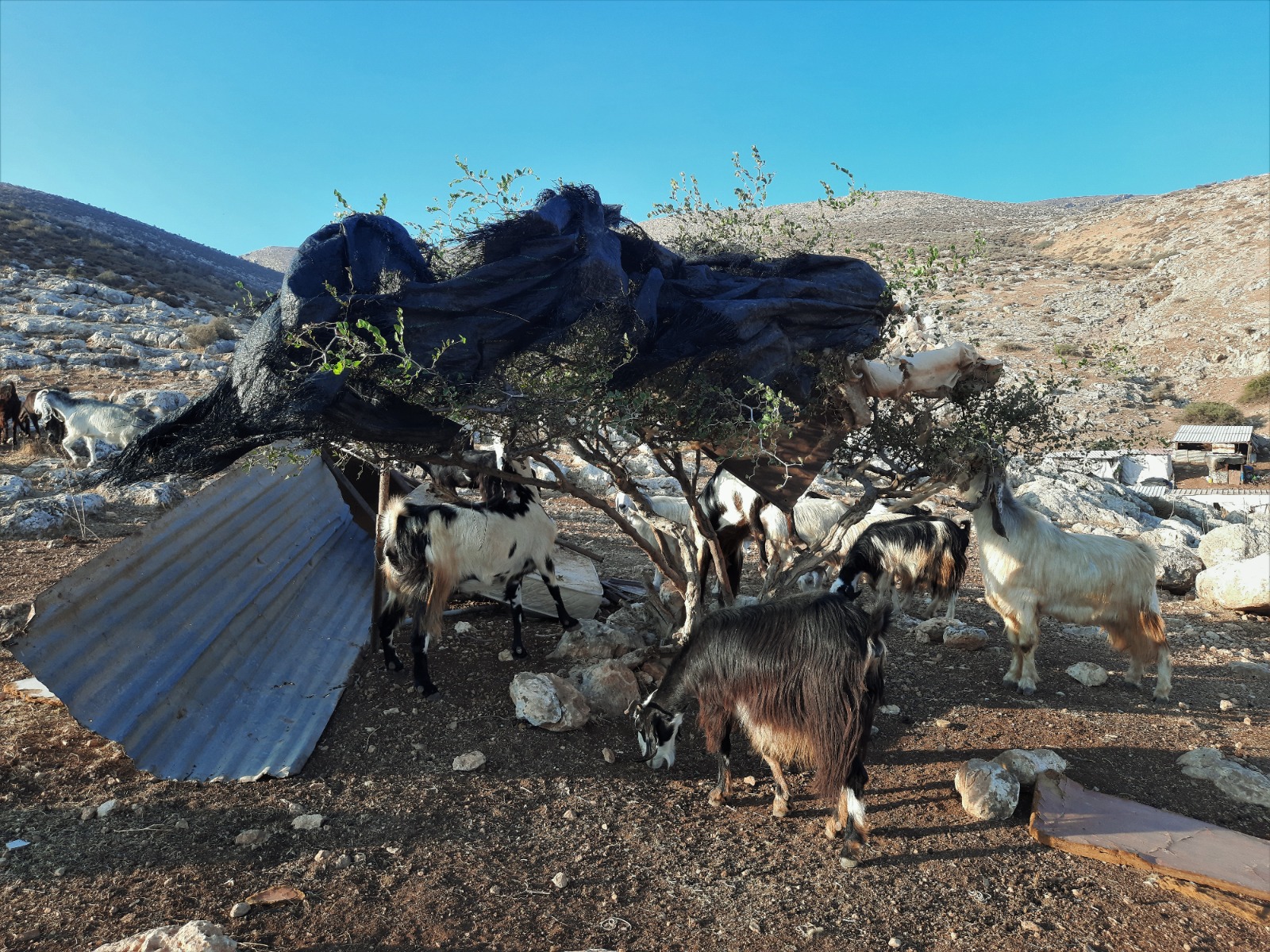 Shahar ShilohNov-3-2021Ein Shibli: grazing begins close to home
-
Ma'ale Efrayim
See all reports for this place-
Ma'ale Efrayim On the road connecting Route 90 (the Jordan Valley road) to the Allon Road.
-
Tayasir CP
See all reports for this place-
Located on road 5799, It is one of the checkpoints control the passage between the northern West Bank and the Jordan Valley. For a long time, it stood empty and open, with only a sign next to it warning against entering Area A. It was adjacent to an old military camp - now everything is neglected. How much money was invested here, and how much brainwashing was done to the soldiers of Netzah Yehuda and Kfir.
Today, it is very difficult to pass there. Many delays. Often, teachers from Tubas are not allowed to pass into the Valley to villages like Ein al-Bida where the local schools are located, and there are no classes. There are additional days when the checkpoint is closed. In general, there is a wait there of about two to four hours to go towards the Valley and also to return. Many times the Palestinians are forced to use the Hamra checkpoint, which also leads into Tubas and the West Bank, but there is also a huge queue there and a long wait.
Following a deadly attack on soldiers at the nearby base in February 2025, the checkpoint was completely closed for the time being. (Updated March 2025)
-
