
Hamra, Tayasir, Sun 13.9.09, Afternoon
Comment: The whole valley has apparently been turned into a firing area for the IDF. The overall aridity and poverty go hand in hand, except for the green, green patches of land near the Jewish settlements.
11.00 – Ma’alé Efraim checkpoint:
No traffic.
11.15 – Hamra checkpoint.
There is almost no traffic.
From Nablus: a line of 1 or 2, at the most 4 cars waiting.
To Nablus: idem
In spite of the fact that there is so little traffic the soldiers seem to be sleeping: they let the drivers bake in their cars for minutes on end: even five minutes in the sweltering heat are unbearable.
One driver had the pertinence to hit his horn shyly and very briefly, probably under the impression he had to wake someone up.
Let us not forget that our soldiers are doing the Palestinians a favor by letting them through the checkpoint!
The normal procedure: passengers coming from Nablus get out of the car to be checked personally and walk the 300 meters to be picked up by their transporter.
We met Fatchi , the coordinator of Palestinian Solidarity social services for the Jordan Valley, and loaded many packages of clothes on to his 4-wheel-drive truck. We considered accompanying him on his visit to the nearby Bedouin village but thought better of it as our car did not seem up to a drive on the stony, unpaved road.
Continuing on route 578, all along the stretch of 23 km. we see that the desert is littered with concrete slabs with writing on them, in English, Arabic and Hebrew, which says: “DANGER, firing area, entrance forbidden“ And, ludicrouly: we notice these especially at the entrance of every path leading towards a Bedouin encampment, except one*, where, according to a signpost, international organizations support the local population.
In a conversation we had with two Bedouin women and their common husband we understood: “….indeed groups of soldiers come there every week for three or so days for firing range training. Then the inhabitants have to leave; they move their tents for the duration and return after the soldiers have left.…..Recently a horse was stolen by settlers from Hemda. The Israeli police told them to file a complaint with the Palestinian Authority. Eventually they asked assistance from the Red Crescent. Some months before the same thing happened and their horse was then returned by soldiers of the Kfir Brigade, stationed in that area.
….They have a house in Udja (near Jericho) where the third wife lives with her children, who go to school there.
…Originally they came from Atir (near Beer Sheva), from where they were expelled in’48…” 13.00 Checkpoint Tayasir:
(*on our way here we saw this signpost)No special problems, hardly any traffic. as the saying goes: “only mad dogs and Englishmen go out in the midday sun."
We stopped on our way back at the remains of Hamam el Malik, to inquire about the well-being of the Bedouins who live there. We were received warmly, and invited to climb up to the upper rooms and sit down on one of the cots for a friendly chat in the utterly bare surroundings.
14.00 In the hope of finding something to drink and a snack we travel northwards to Mechola. Alas, the grocer there, the only one in the neighborhood, has closed until 16.00. We try our luck about 10 km. southwards on route 90 where once we made a refreshment stop, but the gas station, the restaurant, as well as the hotel, all are deserted. At Maskiot we want to verify the news that the settlement is building the infrastructure for new houses; we think we discerned some prefabs, but although the gate is opened for us we do not feel really welcome and decide not to pursue our search. Along the road leading towards the settlement a long row of new tree-saplings are planted: surely not a sign of settlements-freeze!
15.00 We wait to see if the gate for the Bedouin at Ghochia, opposite the Jewish settlements of Ro’ee (with its flourishing, green fields!) will be opened.
On the main road an army-car stands waiting with a rotating light, but as there are no Bedouins wanting to pass and we just look at each other until we leave at 15.20: no need to open the gate.
Hamra (Beqaot)
See all reports for this place-
One of the Jordan Rift Valley checkpoints that prevent direct transit between the West Bank and the Jordan Valley, in addition to Tayasir Checkpoint. Located next to Hamra settlement, on Route 57 and the Allon Road.
Read about the peple of the Jordan Valley and the quiet transfer happening there.
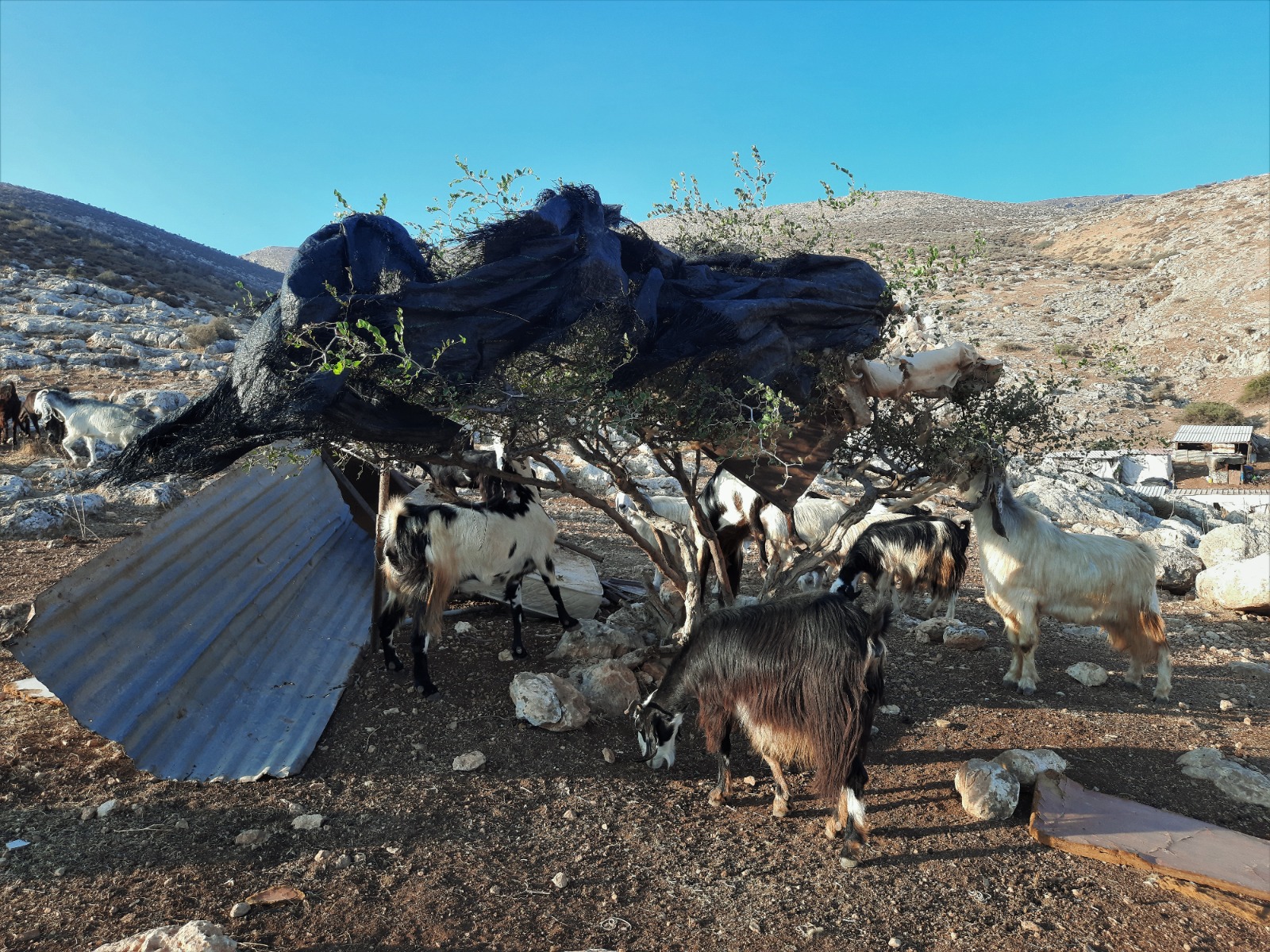 Shahar ShilohNov-3-2021Ein Shibli: grazing begins close to home
-
Tayasir CP
See all reports for this place-
Located on road 5799, It is one of the checkpoints control the passage between the northern West Bank and the Jordan Valley. For a long time, it stood empty and open, with only a sign next to it warning against entering Area A. It was adjacent to an old military camp - now everything is neglected. How much money was invested here, and how much brainwashing was done to the soldiers of Netzah Yehuda and Kfir.
Today, it is very difficult to pass there. Many delays. Often, teachers from Tubas are not allowed to pass into the Valley to villages like Ein al-Bida where the local schools are located, and there are no classes. There are additional days when the checkpoint is closed. In general, there is a wait there of about two to four hours to go towards the Valley and also to return. Many times the Palestinians are forced to use the Hamra checkpoint, which also leads into Tubas and the West Bank, but there is also a huge queue there and a long wait.
Following a deadly attack on soldiers at the nearby base in February 2025, the checkpoint was completely closed for the time being. (Updated March 2025)
-
