
Hamra, Tayasir, Sun 31.1.10, Afternoon
|
Hamra, Tayasir, Sunday, 31.1.10 pm We set off at noon. The landscape was marvellous, the rolling hills covered in a green and flowering carpet.
At Maalei Ephraim Checkpoint stood two soldiers, but no cars or pedestrians when we passed.
Along the road we saw an Israeli police car escorted by an armed soldier. The policeman was prying into a sack on a donkey’s back while two Palestinian shepherds stood alongside with a flock of sheep and goats. The moment we pulled up, the policeman glanced at us and, with the soldier, got in the jeep and drove off. We asked the shepherds what they wanted, and one said that they are always searched. The shepherds were from Hirbet Tana, by Beit Furiq. They bring the flock to these hills each day, and return in the evening.
Before arriving at Hamra Checkpoint, we passed through a place called Pushrat Beit Dejan. At the checkpoint, a car pulled up next to us and a man called Fathi introduced himself as acting in Maan, a Palestinian grassroots organisation "like yours," active in the north of the Jordan Valley. He saw our car with the MachsomWatch flag and thought it must be Daphna, so he followed us. He invited us to the family house on the hill overlooking Hamra Checkpoint. We drove behind him, and we received with joy and warmth by the family. This is the place to remember that Daphna is well known in every corner of the Valley, very popular and much liked. Before we understood what was happening, a table opened up and we sat with the family, Fathi and another visitor from Jerusalem. We ate lunch and chatted. The head of the family, Zorba, looked and behaved like Zorba, has 12 children and lots of grandchildren and a wife who fends for herself. It seems that everyone knows him, and people come to his door all the time. He told us about the life of the family and of the other encampments in the surroundings. The story included demolition orders given periodically and enforced. Constant destruction of buildings belonging to them. We also understood what Maan does: constant rebuilding with the help of European donations, mostly from the Norwegian government – as is recorded on a large notice at a number of spots in the area. Fathi explained that the objective was to act non-violently against the Occupation. No demonstrations. The sole function being the rebuilding of destroyed houses, and perhaps some multiplication ("for each one destroyed, we build two or three").
Because of the situation, they moved to building from mud and straw bricks, which are cheap and lightweight. In the housing areas can be seen the ruins of buildings and the mud brick houses. The idea, beyond easy building and correct ecology, is to show the occupier that the building is not concrete, and therefore does not constitute a house.
According to him, eight houses were once demolished, rebuilt, demolished a second time and rebuilt. Salam Fayad was there to lay a new brick, and a photo of them together hangs amid a group celebrating at Bilin. The Norwegian Ambassador and many delegations from Europe come to visit.
They contend that 200,000 dunams (50,000 acres) of pasture and farmland were taken from the residents of the area by Israel. The family lived on this spot befpre 1967. Under Palestinian custom they maintained life in two locations. They have a house in Tamun, a village ten minutes drive away, where they live in the hot months, and a house in the Valley where they live in the cold season. Since the Occupation upset their lives, and though they have no political involvement of any kind and never interfered or acted against the Occupation, they are subjected to incessant harassment at all levels of their living. Physical examination at checkpoints (including a pregnant woman and children), water problems – they have a container that they fill every fourth day at a distant village. Soldiers don’t allow the young son to sell fruit by the roadside. And the constant demolition orders… At the moment they are summoned to the Civil Administration, to a committee that will discuss their situation on 4.2.10, but they have no intention of attending since there is no chance that their views will be heard.
Zorba speaks a clear and beautiful Arabic, like a poet. He explains that everyone has the right to food, drink, a home, dignity and a normal life. He asks rhetorical questions. We are all in agreement.
We traded phone numbers, and will pass information to the peace fighters who may want to participate with them in building their new houses in the future.
Hamra Checkpoint
There was no activity when we passed, nor at Tayasir Checkpoint. Somebody who was waiting told us that today it’s all okay. Two men sat waiting for a permit to move a truck with pipes and gas balloons. The soldiers at the checkpoint tried to be unpleasant to us on the orders of the commander.
We passed by another encampment next to Hamam el Maliah and delivered a lot of clothes that we had brought specially.. They were pounced on in a way that aroused compassion. On the way back, we did not encounter any problems at any checkpoint. Little traffic on the roads and no pressure anywhere. Lovely scenery, green hills, depressing reality…
|
Hamra (Beqaot)
See all reports for this place-
One of the Jordan Rift Valley checkpoints that prevent direct transit between the West Bank and the Jordan Valley, in addition to Tayasir Checkpoint. Located next to Hamra settlement, on Route 57 and the Allon Road.
Read about the peple of the Jordan Valley and the quiet transfer happening there.
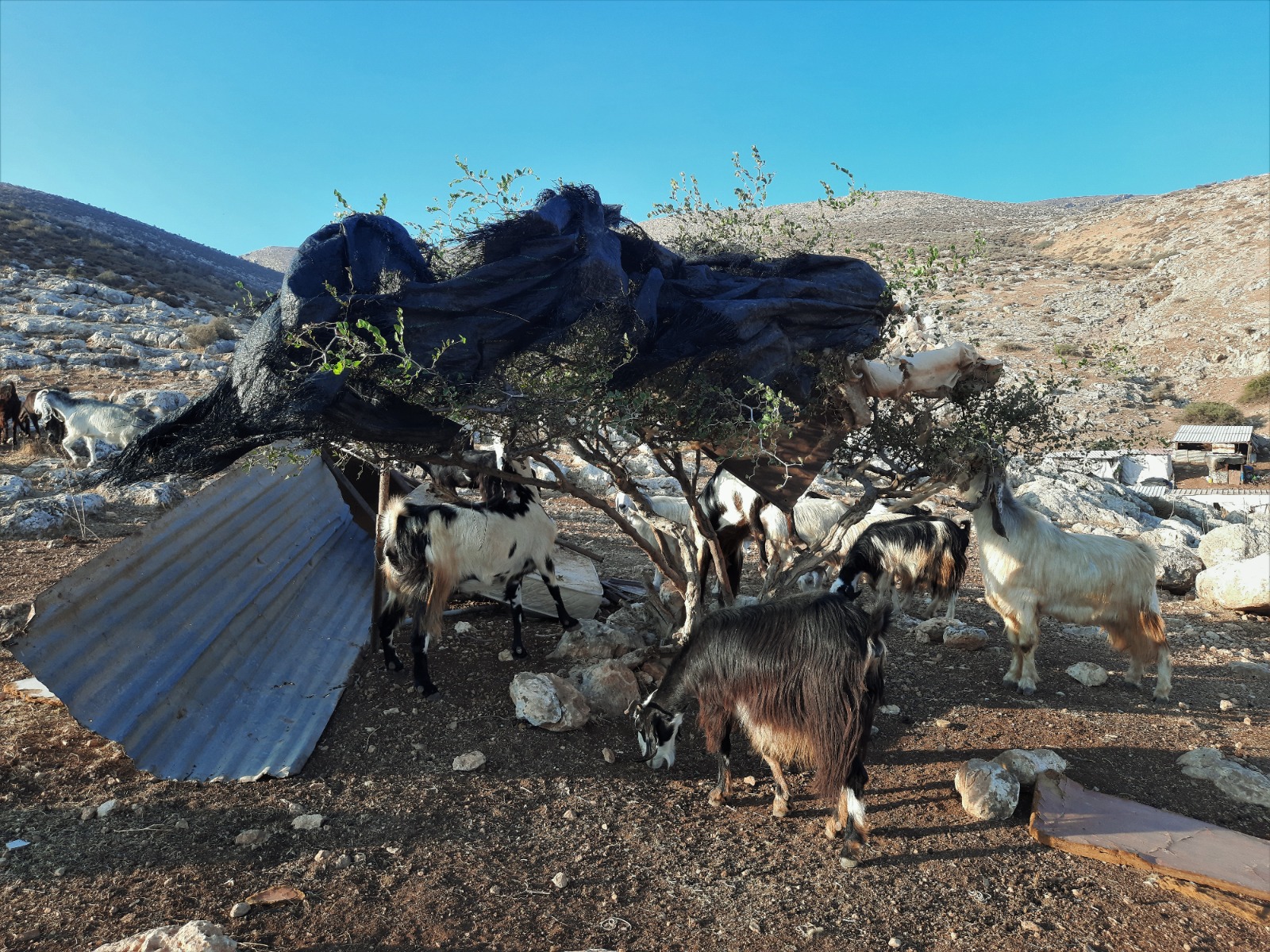 Shahar ShilohNov-3-2021Ein Shibli: grazing begins close to home
-
Tayasir CP
See all reports for this place-
Located on road 5799, It is one of the checkpoints control the passage between the northern West Bank and the Jordan Valley. For a long time, it stood empty and open, with only a sign next to it warning against entering Area A. It was adjacent to an old military camp - now everything is neglected. How much money was invested here, and how much brainwashing was done to the soldiers of Netzah Yehuda and Kfir.
Today, it is very difficult to pass there. Many delays. Often, teachers from Tubas are not allowed to pass into the Valley to villages like Ein al-Bida where the local schools are located, and there are no classes. There are additional days when the checkpoint is closed. In general, there is a wait there of about two to four hours to go towards the Valley and also to return. Many times the Palestinians are forced to use the Hamra checkpoint, which also leads into Tubas and the West Bank, but there is also a huge queue there and a long wait.
Following a deadly attack on soldiers at the nearby base in February 2025, the checkpoint was completely closed for the time being. (Updated March 2025)
-
