
Haris, Huwwara

09:30 We left from the Rosh Ha’ayin train station.
Signs along Highway 5 announce a celebration: the fifth anniversary of the Ariel Cultural Center. “Five years of culture,” the signs declare. That’s certainly worth celebrating. Israeli flags decorate every road junction. Remnants of the holidays, or another ostentatious “appropriate Zionist response” courtesy of the settlers?
10:10 Tapuach junction
No unusual activity at the junction, which is unexpected. A few soldiers sit in the compound beside the Border Police jeep, two more at the bus stop. Israeli and Palestinian vehicles go without interference in every direction. The closer we come to Huwwara, the greater the military presence. The entrance to Beita isn’t blocked but a military vehicle with soldiers alongside is parked on the opposite side of the road. An improvised emplacement made of three piled-up concrete blocks and a pair of armed soldiers stands next to the entrance.
At first glance, Huwwara seems calm. Most of the shops are open, civilian vehicles drive in both directions, residents are busy with their activities. But a more careful inspection reveals an increased military presence, partly visible, partly concealed. In an unfinished new building, whose ground floor holds shops with impressive facades, armed soldiers peer from the skeleton of the second floor, their weapons aimed at the bustling street. Military vehicles are stationed at various corners of the town.
We approach Huwwara checkpoint. Soldiers have erected a kind of tent at the access road to Yizhar and blocked with a jeep the way to the settlement by vehicles unwelcome to the settlers. And in fact, as we learn later, the army now openly and fully cooperates with the settlers.
In the center of Hawarra town we meet two youths who had a traumatic experience.
Four days ago they and other residents went to harvest olives in an area far from Yizhar, very near their town. There’s no need to obtain a permit to harvest there. Moveover: it’s the period when harvest is allowed, when the army is supposed to protect the residents. While they were working settlers suddenly appeared from Yizhar and shot at the pickers. One youth was wounded in the leg and fled. The second told us he was “badly beaten.” Soldiers arrived, and instead of arresting the hooligans took him to the Ariel police station for interrogation. He was released but arrested a day later, and again – luckily – released.
Residents of Huwwara have olive groves located nearer Yizhar. The harvest is at its height, but the army hasn’t yet issued permits allowing residents to harvest their olives, and it’s doubtful they’ll receive them. For why should the army look for trouble with the settlers, when its policy is to support and protect them?
While we were talking, word came of an incident in Madama. Settlers there also fired on people harvesting olives and injured a 15-year-old girl. The army evacuated her, it’s not clear to where. Were the trespassing settlers who shot to kill arrested? As of now we haven’t heard, and it’s likely we won’t.
11:30 Hares
We meet a man who speaks fluent Hebrew. Residents of Hars are also experiencing the settlers’ growing aggression. Yesterday evening two settlers from Revava came riding a motor scooter and sprayed tear gas on residents. Last week the same thing occurred three times. The settlers also throw rocks at Palestinian vehicles. Three days ago the army joined the settlers in an attack. Villagers were picking olives a few meters from a guard tower erected at the entrance to the village. Soldiers from a base inside Yakir settlement (additional proof of the symbiosis between the occupying army and the settlers, the lords of the land) came and attacked one of the men picking. We go to meet him. What did the soldiers accuse him of? Throwing three (!) rocks. In which direction? Toward the partially paved road behind the guard tower where vehicles pass very infrequently. He defends himself in spite of the blows: points to the plaza, on which no rock is visible. He demands that the soldiers bring him up to the guard tower where cameras document everything. As expected, the cameras didn’t show anyone throwing rocks. Nevertheless the soldiers handcuffed him, blindfolded him, tied a rope around his neck, drove him in a military vehicle to interrogation, and beat him during the entire trip. He was released with no explanation.
Today he’s harvesting olives again, in the same location. Signs of what he had gone through are obvious on his face. An old man comes with him from the olive grove, who says the entire area belongs to him and his family. The land on which the guard tower and the plaza were built was expropriated from him. “They wanted to pay me, but I didn’t want to take money from their hands,” he says. To our surprise, a Japanese woman appears from among the trees, wearing a straw hat, gloved. She’s a volunteer from an international women’s peace organization, lives with a family in Deir ‘Istiya and came to Hars to help with the olive harvest. She tells us what’s happening there. Settlers have also come to Deir ‘Istiya in recent nights, passing along the streets and frightening the residents. During the day the army also comes. She tells us about a bus carrying some sixty settlers who came to the village and rioted.
The picture is bleak: our impression is that the West Bank is not yet aflame. But, given the drastic increase in the serious incidents of harassment by settlers, with the open cooperation of the army representing the regime, it’s reasonable to assume that there’s an interest in seeing how much the residents can absorb. And when they respond, that will be the excuse needed to violently take over the entire population of the West Bank.
Haris
See all reports for this place-
Haris
The village has 4,500 people and they have 5,000 dunams of land. The entrance to the village is blocked and opened arbitrarily, without informing the residents.The village has a seasonal checkpoint that blocks the road to the agricultural land and this checkpoint opens once a year! 2,500-3,000 dunams were stolen from the village in order to build the settlements of Revava and Netafim, which are located west of Haris.
The center of the village is Area B and around Area C. The population grows but the occupation does not permit new construction in Area C.
-
Huwwara
See all reports for this place-
The Huwwara checkpoint is an internal checkpoint south of the city of Nablus, at the intersection of Roads 60 and 5077 (between the settlements of Bracha and Itamar). This checkpoint was one of the four permanent checkpoints that closed on Nablus (Beit Furik and Awarta checkpoints to the east and the Beit Iba checkpoint to the west). It was a pedestrian-only barrier. As MachsomWatch volunteers, we watched therre since 2001 two shifts a day - morning and noon, the thousands of Palestinians leaving Nablus and waiting for hours in queues to reach anywhere else in the West Bank, from the other side of the checkpoint the destination could only be reached by public transport. In early June 2009, as part of the easing of Palestinian traffic in the West Bank, the checkpoint was opened to vehicular traffic. The passage was free, with occasional military presence in the guard tower. Also, there were vehicle inspections from time to time. Since the massacre on 7.10.2023, the checkpoint has been closed to Palestinians.
On February 26, 2023, about 400 settlers attacked the town's residents for 5 hours and set fire to property, such as houses and cars. Disturbances occurred in response to a shooting of two Jewish residents of Har Bracha by a Palestinian Terrorist. The soldiers stationed in the town did not prevent the arson and rescued Palestinian families from their homes only after they were set on fire. No one was punished and Finance Minister Smotrich stated that "the State of Israel should wipe out Hawara." Left and center organizations organized solidarity demonstrations and support actions for the residents of Hawara.Hawara continued to be in the headlines in all the months that followed: more pogroms by the settlers, attacks by Palestinians and a massive presence of the army in the town. It amounted to a de facto curfew of commerce and life in the center of the city. On October 5, 2023, MK Zvi established a Sukkah in the center of Hawara and hundreds of settlers backed the army blocked the main road and held prayers in the heart of the town all night and the next day. On Saturday, October 7, 23 The "Swords of Iron" war began with an attack by Hamas on settlements surrounding Gaza in the face of a poor presence of the IDF. Much criticism has been made of the withdrawal of military forces from the area surrounding Gaza and their placement in the West Bank, and in the Hawara and Samaria region in particular, as a shield for the settlers who were taking over and rioting.
On November 12, 2023, the first section of the Hawara bypass road intended for Israeli traffic only was opened. In this way, the settlers can bypass the road that goes through the center of Hawara, which is the main artery for traffic from the Nablus area to Ramallah and the south of the West Bank. For the construction of the road, the Civil Administration expropriated 406 dunams of private land belonging to Palestinians from the nearby villages. The settlers are not satisfied with this at the moment, and demand to also travel through Hawara itself in order to demonstrate presence and control.(updated November 2023)
.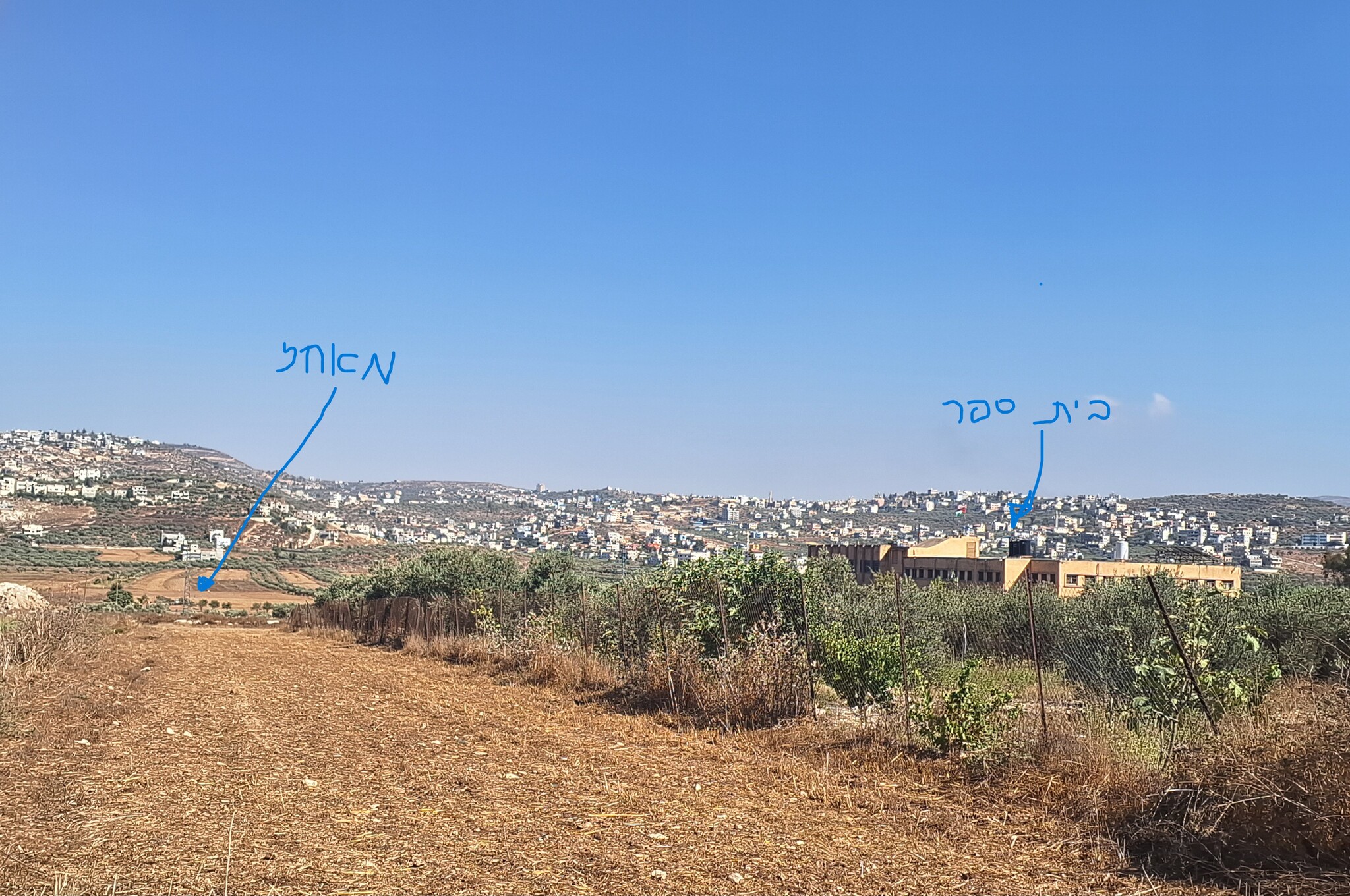 Ronit Dahan-RamatiAug-24-2026Huwara: The school on the outskirts of town and an outpost hidden among the trees
-
