
Hawwara & Beit Furik
Hawwara, Beit Furik Thursday 3/11/05 PMObservers: Hagar L. Nurit L.V.(reporting)transllation: Deb L. Summary: Eed Al Feter – a holiday today. At the Tapuach Intersection, traffic moves smoothly and there is no “separation”. At Hawware, there is unnecessary abuse and tension caused by the Boarder Police. At Beit Furik, traffic moves smoothly in both directions. 12:45 Zeeta – A dirt mound blocks the passage of cars to Road #5. The people of the village made an alternative road between the olive trees, but two days ago it was blocked by a ditch and rocks. Families ,all dressed in holiday clothes, are on their way to the village of Marda. We spoke to some of them and Hagar took pictures.13:05 Tapuach Intersection- Three eastbound cars pass through quickly. From the north there is no traffic. At the checkpoint there are two friendly soldiers from the artillery forces. According to them, there is no “separation”, and anyone can drive anywhere. We didn’t stay.13:10 Yitzhar Intersection- A rolling checkpoint. There are 10 vehicles, mostly taxis, waiting. The soldiers (paratroopers) explain to us that there is an “alert” out for a young man with an explosive belt. Therefore, it is necessary to check everyone even though they have already been checked at Huwwara and Beit Iba. The check is done relatively quickly, and no one is taken out of their cars. 13:20 Hawwara, The Southern portion- A relatively small number of taxis in the parking lot. There is no market. Families dressed in their very best clothes pass by. One child holds a large, noisy toy rifle (and this isn’t the only toy rifle that we see today. Why this particular toy? They don’t owe us an explanation. Still, it is beyond my comprehension why someone would bring a toy gun through a checkpoint in spite of all the bitter experiences that have come from it.?!) The adults complain loudly that they were held up for 2 hours at the checkpoint (even if it was actually only 3/4 of an hour, that is stressful enough especially on a holiday when they are off to visit family and their hands are filled with presents, cakes, and all kinds of cookies).13:25-15:0- At the northern checkpoint Sergeant A.( who boastfully and mockingly lies telling us that he is the officer of the checkpoint), greets us. He rudely gestures for us to move away from the checkpoint. He pretends he doesn’t know who we are and adds, “Go on, get out of here.” (Yah lah, telchu) Soon it becomes clear that the the officer of the checkpoint is actually Y., who allows us to stand at our regular places. From that moment on, we turn to him for help when we need it. At the time that we arrived, there were not very many people at the checkpoint. An older woman turns to us. She is discouraged that she has had to wait for over an hour for her brother. The Sergeant mentioned above, rudely gestures to her to move away (“Yahlah, Ruchi”– “Get out of here”). I explain to him, while restraining myself, that it is possible, and necessary to speak politely and respec! tfully to people, especially to one’s elders. There are two people checking IDs at the front booths. The two back turnstiles are working. A military police(MP) woman and a soldier are covering the area east of the cement barriers, near the electronic doorway. Their checking (one by one) is slow and apathetic. An older man is told to take off his belt (he could have passed through the humanitarian line). At the same time the soldier is flirting with the MP woman. The two of them speak to the pedestrians in an ugly manner and don’t really see them (note the comments in the section in red below). The time it takes from the back turnstiles to the front turnstiles is two to five minutes. The electronic doorway rings all the time (belts, money, telephones, shoes). At first there was a humanitarian line on the west side which was for women and the elderly. Only one of the front turnstiles is open. From 13:45 the number of people passing through increases. As the number of people&nbs! p;increases , the level of nervousness among those waiting rises. We turn to the officer of the checkpoint requesting that he assign more soldiers who will check on the west side. However, he claims, he doesn’t have the man power. The total amount of time at the checkpoint takes from a half-hour to three-quarters of an hour.14:00 -A father carrying an infant and a bag passes by. The MP woman has her hands in her pocket. The father doesn’t know what to do — to leave the infant on the high checking table in order to pass through the electronic doorway, or to take the infant with him. The MP doesn’t take her hands out of her pockets in order to take the baby. The other soldier who is guarding asks her if it isn’t dangerous–the infant could fall. She says, ” Are you afraid that if she falls, I won’t catch her?” The whole time the checkpoint is covered by Boarder Police. From time to time they come in to “make sure there is order”(straight, orderly lines) behind the turnstiles by shouting, but it doesn’t have much success. The officer of the unit, D. S. number 7436748, chases us away to stand behind the cement barrier on the east. We tell him that we are standing where the officer of the checkpoint has designated. He stands firm and claims the officer has ordered the change (a lie), and threatens to call the police. Two of the Boarder Police (BP) stand in front of the checkpoint facing the pedestrians who are coming from the south, and start to check thoroughly all those entering Nablus (their IDs, bags, and a body check). An example is a father who has a bag in his hand and a crippled child without a hand sitting on his shoulders. We wonder what he is checking. Hagar calls the Operations Officer of the Brigade, M. T. and within ! a few minutes the general checking is stopped. The soldiers check only the young men randomly. But every time S. comes by, the soldiers return to checking as he has requested. Our presence there makes him very nervous. He is rude and does everything he can to get rid of us. 14:30 -High Alert — One of the BP receives an order from S. to stand near the ID checking station. The BP stops every young man that comes out of the checkpoint and demands to see his ID, only seconds after it has already been checked. He diligently writes down all the personal details. When we ask why he is checking again after the person has just been checked, he answers that the first check was for the army and the second check is for the police!!!(The idea of doing all this at once in the checking station, next to the computer doesn’t seem to occur to him.) Hagar calls the Complaint Department of the MPs office in order to complain about the harassment and behavior of one of their officers. After awhile, the soldier from the BP who is writing down everything, goes to the checking station in order that the writing will look as if it is being done during the regular check of IDs. Some of the pedestrians get confused and go straight to him with their IDs.Those entering Nablus, including children, are forced to go on the road used for vehicles. As simple as that. From time to time an accident almost happens, but who cares.15:00 Beit Furik – Passage to Nablus is allowed today. Very few people go through at this hour. The vehicles are also passing through without waiting. The checking of pedestrians is thorough but there is no tension ,and no pressure. After a short stay,since everything is quite, we return to Huwwara.15:30 -The amount of people in the checkpoint is very small and they pass through quickly. On the eastern side of the checkpoint, the shift of soldiers has changed–Y. MP and N. from the Paratroopers. They run the line like clockwork, and even behave in a humane manner. It matters to them that parents with babies and little children don’t wait too long. Our general criticism of the soldiers is (and this is relevant not only of today’s shift) the way they carry out their conversations, yelling and laughing from one side of the checkpoint to the other. This includes loud chewing of gum, expressions of love, and throwing kisses in the air. All this stands out to the bystander. This behaviour, which may just be a question of their age and the long, stressful hours they are on duty (even if there is no bad intention), becomes a difficult thing to watch when just a few meters, or even less, away there are people who, without a choice if they want to get to their destination, are crushed behind bars, or caught in a turnstile for long periods of time .There is no pressure right now, or at any time on our shift, at the vehicle checking point. Two soldiers are handling this line pretty fast.16:07 There is one detainee from Awaatra. He just doesn’t look like a potential danger and he isn’t that young. When he wasn’t released after a half hour, we set out to ask if they would check why it was taking so long. When I tried to look for Officer Y. at the humanitarian line, it caused S. to shout at me. Hagar tried to explain to him but he was looking to trip us up at every opportunity and he calls the police to tell them we have crossed the security line. (Just a little while ago, this was the path that Palestinians who were leaving the checkpoint took, so what is this talk of a security line.)16:35 -We take the personal details of the detainee (except his ID number because he doesn’t remember it and he doesn’t have any other identifying papers with him). We lend him a telephone and writing tools so that he can get his ID number from his wife, and then we decide to leave quietly before the police come and hold us up after dark. First, however, we remind the officer that he can not keep someone longer than an hour for checking.As we are leaving Huwwara, we see the police driving toward the checkpoint. The whole way home we tried calling the detainee on the phone. At 17:30 S. told us that he was released and that there had been a mistake because of his name. (I hope they apologized on his being detained so long.) He thanked us for our help.
Beit Iba
See all reports for this place-
A perimeter checkpoint west of the city of Nablus. Operated from 2001 to 2009 as one of the four permanent checkpoints closing on Nablus: Beit Furik and Awarta to the east and Hawara to the south. A pedestrian-only checkpoint, where MachsomWatch volunteers were present daily for several hours in the morning and afternoon to document the thousands of Palestinians waiting for hours in long queues with no shelter in the heat or rain, to leave the district city for anywhere else in the West Bank. From March 2009, as part of the easing of the Palestinian movement in the West Bank, it was abolished, without a trace, and without any adverse change in the security situation.
 Jun-4-2014Beit-Iba checkpoint 22.04.04
-
Marda
See all reports for this place-
Marda
There are about 2500 inhabitants in the village. A large part of their lands was confiscated for the benefit of the settlement of Ariel, some of whose buildings are adjacent to the village.
They often feel under siege. At both entrances to the village from the main road (505) there are checkpoints and the army does close the yellow arms from time to time. The inhabitants of Marda own olive groves behind a fence. Rarely are they allowed to cultivate their agricultural plots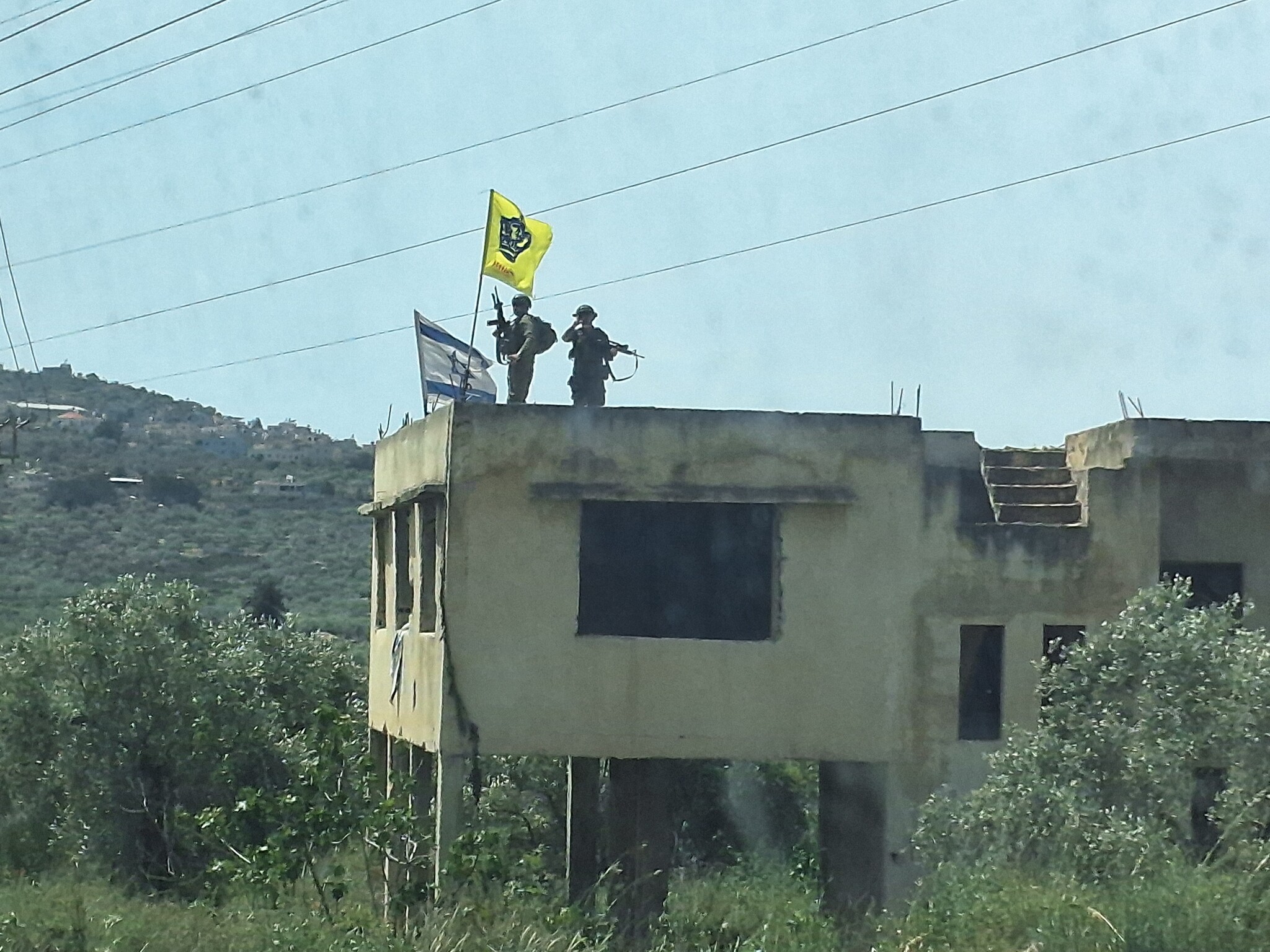 Ronit Dahan-RamatiApr-14-2026Marda. IDF post on the roof of a Palestinian home with the Messiah flag
-
