
Hebron
Hebron, Thursday 28.4.05, AMWatchers: Hagit B. (Hebrew report), mira B. (English report)Left 8:30, returned 12:30We turned into the Sansana road, thinking that maybe we’ll meet the MAGAV geep, of which there are rumors about bad handling of Palestinians. We saw it. No palestinians around.Sansana roadblock: Free pass. No detained people.60 road — regular blocks along the road and towards Palestinian villages. Few military vehicles. Few Palestinian taxis — there is, probably a permit to drive up to Samo’a. Dura-El-Pawar — on our way back, the soldiers seem to put a flying roadblock.Sheep’s junction: Free pedestrian pass.Daharia: Blocked.Hebron:We passed through Kiryat Arba without any problem and tried to find the “DERECH HAMITPALELIM” — a pedestrian road from Kirtyat Arba to Cave of Machpela, along which most palestinian houses have been destroyed and deserted. We found it on the left of the main exit from Kiryat Arba. The road starts in a Kiryat Arba garden named after Rabbai Goren. Most houses along the road are destroyed, shops are closed, and there are plenty of ugly racial graffiti, usually accompanied by a blue david star. Kiryat Arba itself is sorrounded all over by high safety fences. Further on this road, there is a palestinian house where the army has taken the forth floor. Palestinian families still live on the other floors. Another house — completely taken by the army. The whole road is not allowed for Palestinian vehicles.In front of the Cave of Machpela, very loud Hassidic music played through loudspeakers. It’s Passover, and jewish people pray in the cave (so, everybody should know that). Arrogant atmosphere. Army everywhere Plenty of roadblocks (MAGAV).We parked the car in front of the cave. Shop owners complain on troubles from the settlers. I’ stays there, and Hagit and me go over to the Jewish quarter.Abraham Avinu neighborhood: Right in front, the wall around the Palestinian house that was recently built by the army. Soldiers next to it. Some settlers started arguing against us, some more aggressively, and some are more politle. We tried to avoid these pointless discussions. KASBA:Soldiers all over.The Kasba is closed since the gun shot last week, towards the soldiers (from within the Kasba). All shops are closed. Roadblocks — between one palestinian street to another! People are not allowed to pass (except for going to the bank which is still open). Shop owners ask the soldiers for permission to open their stores. They complain on ruining their source of living. The soldiers seem quite unhappy with this job, but they do not let people pass, they put additional security fense in front of the road block. Frustrating atmosphere. People did not know about MachsomWatch, and are glad to talk. Some make sarcastic comments about Hebron being a Jewish city, and are glad/surprised to hear that we think differently. It seems that the Kasba is a roadblock that we should regularly watch!Towards Tel-Rumeida: The road to Tel-Rumeida is just full of soldiers — standing like every 50 meters or so. Unbelievable. A palestinian desrted street. All stores are closed. Most houses are desrted, broken windows. No palestinian vehicles. No Palestinians on the streets (but we saw few on upper apartments). A lot of Jewish graffiti about Hebron being a Jewish city, death to arabs, many Israeli flags right under a Muslim graveyard. Another roadblock under the Tel-Rumeida neighborhood. Sodliers check people (Palestinians) that wish to cross to their homes in Tel-Rumeida. Interestingly — right after this roadblock towards the Palestinian controlled region, we saw a lively city center. Now we know where are all the people in this seemingly dead city.Tel-Rumeida:I walked up to the Jewish settlment on top of the hill within the otherwise all Palestinian Tel-Rumeida neighborhood. Again — soldiers all along the way. The soldier watching the entrance to the Jewish settlment told me that it is safe for me to go in, since I am Jewish. A bus with what looks like settlers from other places arrives. The Jewish settlment here looks like a military base: very small, with soldiers at every corner. Sand bags, watching towers all around. Few caravans and a new impressive stone house.On the entrance to the settlement, an interesting wall sign (my own free transalation): “The renewers of the Jewish settlment in Hebron, renovation and enlargement of the Ishay ground, for the convenience of the Hebron settlers, with the help of the BINUI AND SHIKUN ministry and the Minhsl Lebnia Kafrit, TASHNACH 1998”.So, that’s where our tax money goes.The soldiers have vigils: 8am to 2pm, then 2pm to 8pm. At 9pm the roadblocks are closed and all the Palestinian neiborhood around Tel-Rumeida is under OTZER. We did not understand whether this is only during the holiday or regularly. We met the TIP people from the international peace forth — they act like police in the H2 regions. They think that our presernce within Hebron might be very helpful.Our overall feeling was a mixture of frustration, anger and a big shame for being part of this arrogant conquering machinery done on our behalf and swallowing the best of our youngsters. It is important that we watch over these internal roadblocks, and the invisible people that live over there wil see a different face of the israeli society.
Hebron
See all reports for this place-
According to Wye Plantation Accords (1997), Hebron is divided in two: H1 is under Palestinian Authority control, H2 is under Israeli control. In Hebron there are 170,000 Palestinian citizens, 60,000 of them in H2. Between the two areas are permanent checkpoints, manned at all hours, preventing Palestinian movement between them and controlling passage of permit holders such as teachers and schoolchildren. Some 800 Jews live in Avraham Avinu Quarter and Tel Rumeida, on Givat HaAvot and in the wholesale market.
Checkpoints observed in H2:
- Bet Hameriva CP- manned with a pillbox
- Kapisha quarter CP (the northern side of Zion axis) - manned with a pillbox
- The 160 turn CP (the southern side of Zion axis) - manned with a pillbox
- Avraham Avinu quarter - watch station
- The pharmacy CP - checking inside a caravan with a magnometer
- Tarpat (1929) CP - checking inside a caravan with a magnometer
- Tel Rumeida CP - guarding station
- Beit Hadassah CP - guarding station
Three checkpoints around the Tomb of the Patriarchs
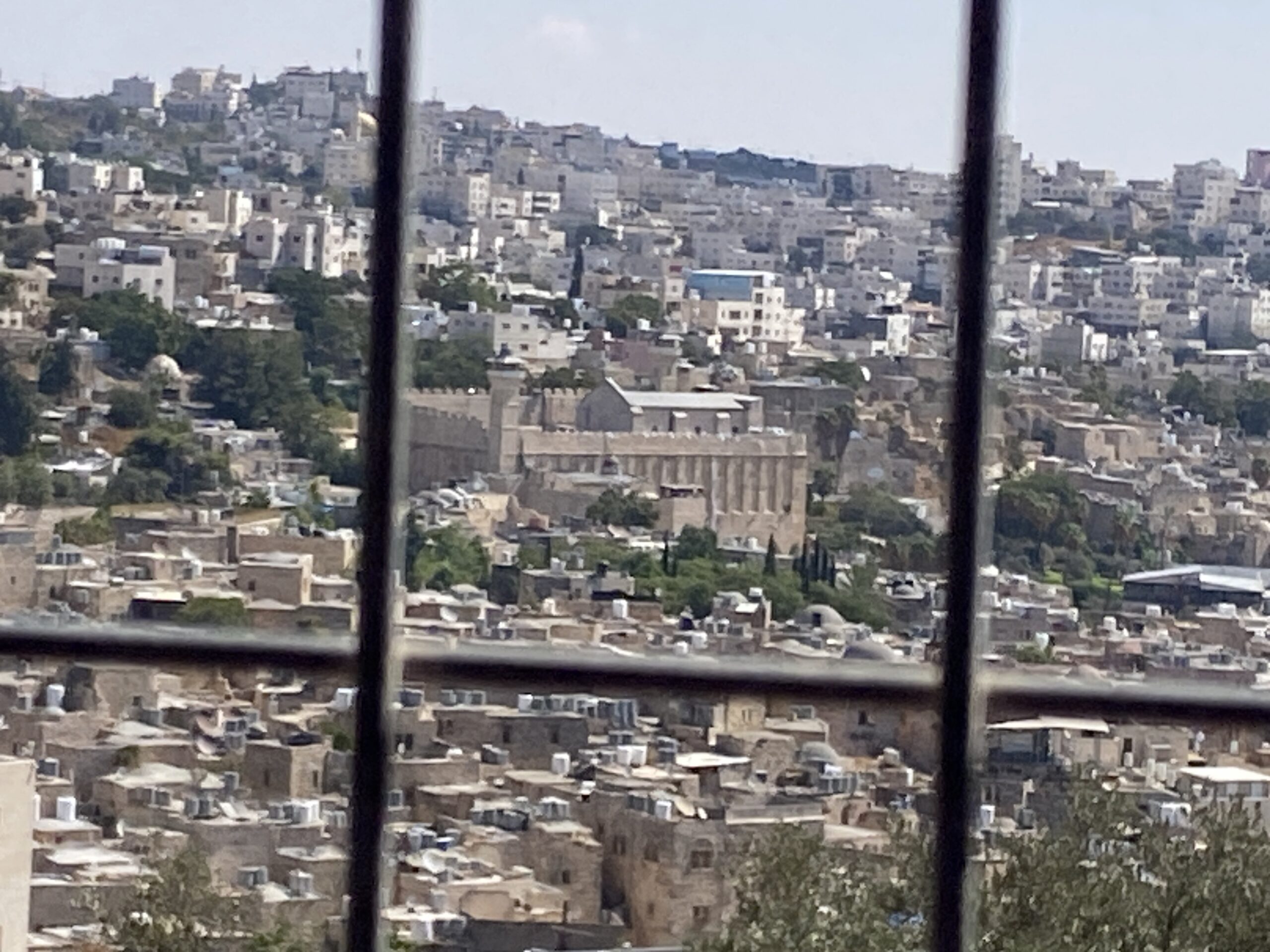 Yael ZoranSep-24-2026Hebron and the Cave of the Patriarchs from Beit Hashalom
-
