
Hebron, Sansana, South Hebron Hills, יום ה’ 4.9.08, בוקר
Observers: Zippi, Naama, Ofra
Translation: Naomi
06:45 – Sensana checkpoint (Meytar)
Parking on the Palestenian side is packed, but checkpoint is almost empty. Two buses full with families have already arrived at the checkpoint and people stand, waiting to be checked. As we arrive we see an elderly lady waiting close to one of the gates. A few minutes later, Shlomi (the checkpoint's commander in chief) arrives and lets her through the special, handicapped gate. The woman's companion walks next to them. From a short talk with him, we understand that today's workers have already passed. Due to the fast there are about 200 people less than usual at the checkpoint today. Prisoners' families – between 150-250 pass each day. Check time averages 45min.
7:00 – Road 60.
As previously reported, road works have been completed and I wonder whether the piles of earth and other debris from already-wired roads will remain in place as a souvenir from the old road.
Blockages are in place and, contrary to recent publications according to which ten have been removed in the area South of Mount Hebron, no change can be detected. What was open (a few blockades that have been uplifted a few months ago) is still open but most accesses to road 60 and the villages are still blocked. Who invents those news and on what basis?
Abeda – a Sofa stands on the side of the road. Its doors are open and soldiers are half in, half out of it. (Upon our return, the vehicle is still there).
Doura junction – el faur workers in the fields. Vegetables have ripened and lettuce, cabbage etc., can all be picked up.
Upon entering to Kiryat Arba, we notice the construction of two buildings next to the Mifeal Hapayis Hall. Construction is almost over. The buildings look like large apartment blocks, capable of housing several tens of families.
7:30 – Hebron
Give'at Haharsina – nothing changed. The place is filthy and stinking. Children pass by us on their way to school. We stand there for a few minutes, explaining a few things about the place to Na'ama when a sloppy dressed soldier approaches. He looks as if he fell out of bed or some such things, asks what we're doing here and that we leave the place. Obviously, we refuse to do so and following a few minutes of half-hearted debate/omission, he leaves the place.
Pharmacy checkpoint – a few early-bird kids walk past. We walk a bit with Na'ama, showing her the deserted road and telling her stories about its nostalgic (at least to some) past, when it was bustling with pedestrians and shoppers.
Tel Rumeida – the soldiers spread a few metal wires in order to regulate pedestrian movement. Wires were set up so, that children who reach them must all wait behind, awaiting their turn. At this time, children have already started waking up to school. As we arrive, a group of five soldiers arrives and they stand in place, joining the two soldiers and borders policeman who are already there. Eight soldiers are thus busy checking the school bags of children, aged 5-15yrs.
Tens of children pass here on their way to school and all, even before they have started formal studies, are being taught by soldiers what the proper place of an Arab is.
It is very frustrating to stand her. The soldiers arrange the children in line. Whoever does not stand properly is moved back to a line drawn on the road. Those who did not stand behind the wire to the soldiers' satisfaction will not be checked. Every school bag is opened up. Treatment is degrading and debasing. Terrible. Even a child who sits in a wheelchair is checked. Another boy, who accompanies him, opens up their bags. And although eight soldiers are present, the line becomes longer and longer. Only one or two soldiers are really busy checking the kids. The others are laughing, talking, exchanging opinions and only occasionally putting the children back in order and always, always, behind that line. And I think to myself, how fortunate it is that those soldiers have had several months of basic training already, and then a training, and a still more advanced training, and how fortunate it is that the army invests so many efforts in their professionalization when it all ends here, with their cruel treatment of those 5yrs olds. For after all, these are only children who are taken to be so dangerous.
Under those circumstances, even our walk up to the neighborhood is hardly objected to. A borders' policeman asks us where we are heading to. And we, in passing, respond that we're climbing up. After a minute's attempt to decipher our intention, he leaves us. Checking up the kids is evidently much more important, making it impossible for him to pay us any attention. As we walk down towards the Tarpat Checkpoint we see new graffiti on the wall alongside the road. Golani (soldiers) have added the tree (olive tree), their unit's pride and glory, and the settlers kids', too, have added a few new writings and drawings. Was this what the Brigadier meant when talking about improving the appearance of the place?
50m. from the Rumeida checkpoint, down the path – Tarpat Checkpoint. Here, too, a few tens of children walk by. They all pass a security/magnetic screening. Bags are not opened up and the kids pass through almost running. Only those who look a bit older are checked.
The proud soldiers have set up two flags of the state of Israel. They also put up their unit's symbol (the olive tree), set up a shade and it seems as if someone has even started painting, but broke down midway and didn't get back to it yet. Towards 8:30 the stream of children stops and we leave the place.
A young English man, a volunteer (who belongs to no organization) who is married to a local Palestinian woman stands next to the checkpoint. He tells us that yesterday, the soldiers asked the kids, who have just come back home from a day at school, for the birth certificates. Without them, they cannot get through, they claimed.
The Cave of Machpela – there are no detainees on either checkpoint and since it is still early morning, pedestrian movement is scarce and shops are still shut.
Getting out of Hebron we see a truck. Is it loading concrete blockades? Uploading them? Unclear. We will have to wait for next week to see.
We are impressed by the detailed and colorful signs, pointing to the "Hebron Heros" neighborhood.
We would like to find out more about the area between Kiryat Arba and Hebron through our sources, as it seems as if there was considerable mess there and all the tents have disappeared, but it is too early and there's no one to talk to.
At the exit gate from Hebron, there are four transporters and a few tens of special unit policemen. We have no time to wait and see how this unfolds (and no energy, either: the children's checkup has exhausted us or, anyway, me.)
Hebron
See all reports for this place-
According to Wye Plantation Accords (1997), Hebron is divided in two: H1 is under Palestinian Authority control, H2 is under Israeli control. In Hebron there are 170,000 Palestinian citizens, 60,000 of them in H2. Between the two areas are permanent checkpoints, manned at all hours, preventing Palestinian movement between them and controlling passage of permit holders such as teachers and schoolchildren. Some 800 Jews live in Avraham Avinu Quarter and Tel Rumeida, on Givat HaAvot and in the wholesale market.
Checkpoints observed in H2:
- Bet Hameriva CP- manned with a pillbox
- Kapisha quarter CP (the northern side of Zion axis) - manned with a pillbox
- The 160 turn CP (the southern side of Zion axis) - manned with a pillbox
- Avraham Avinu quarter - watch station
- The pharmacy CP - checking inside a caravan with a magnometer
- Tarpat (1929) CP - checking inside a caravan with a magnometer
- Tel Rumeida CP - guarding station
- Beit Hadassah CP - guarding station
Three checkpoints around the Tomb of the Patriarchs
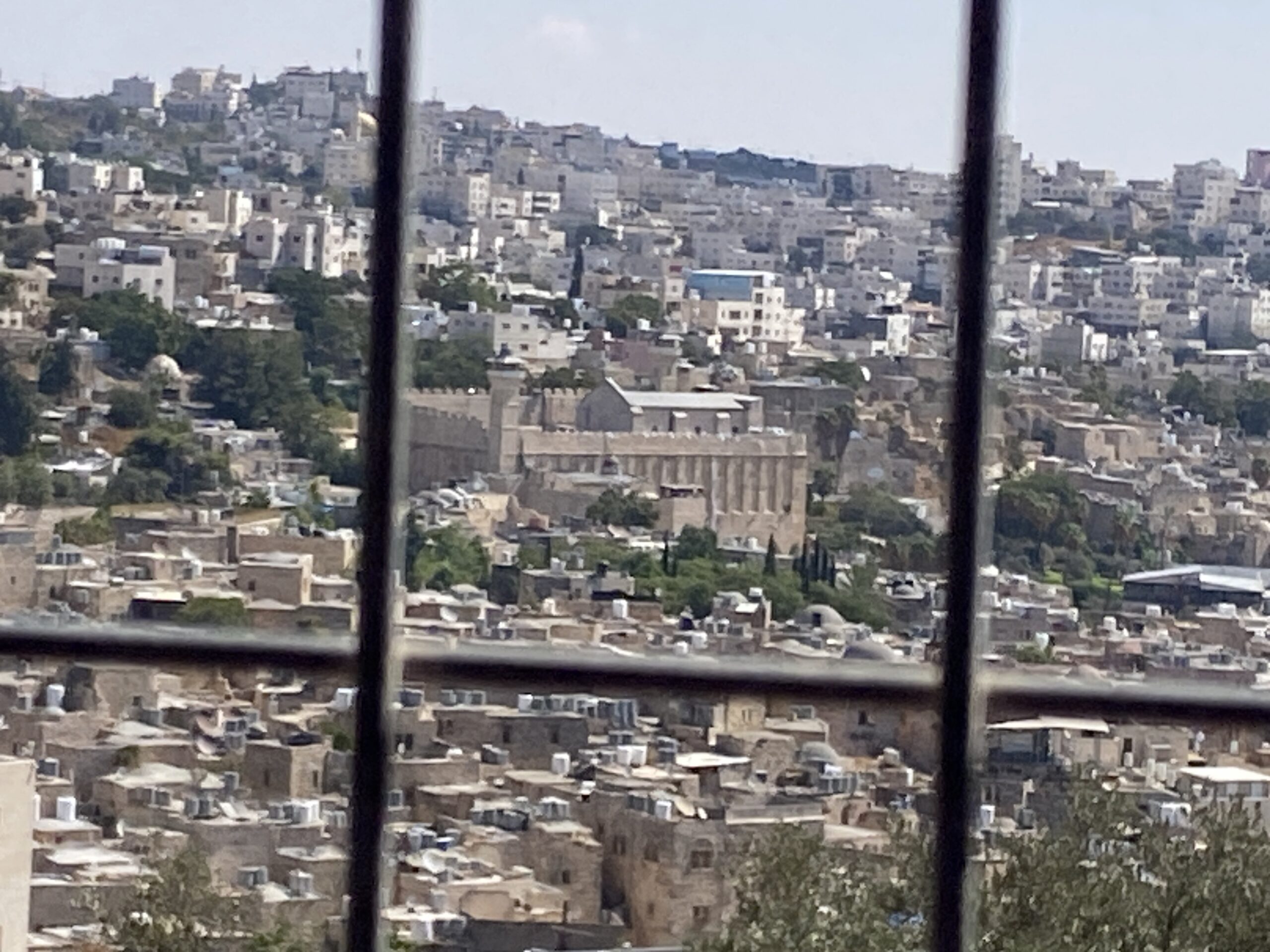 Yael ZoranSep-24-2026Hebron and the Cave of the Patriarchs from Beit Hashalom
-
Meitar checkpoint / Sansana
See all reports for this place-
Meitar Checkpoint / Sansana The checkpoint is located on the Green Line and serves as a border crossing between Israel and the West Bank. It is managed by the Border Crossing Authority of the Defense Ministry. It is comprised of sections for the transfer of goods as well as a vehicle checkpoint (intended for holders of blue identity cards, foreign nationals or diplomats and international organizations). Passing of Palestinians is prohibited, except for those with entry permits to Israel. Palestinians are permitted to cross on foot only. The crossing has a DCO / DCL / DCL / DCL (District Coordination Office), a customs unit, supervision, and a police unit. In the last year, a breach has been opened in the fence, not far from the crossing. This breach is known to all, including the army. There does not appear to be any interest in blocking it, probably as it permits needed Palestinian workers without the bureaucratic permits to get to work in Israel. Food stalls and a parking area economy have been created, but incidents of violent abuse by border police have also been recorded. Updated April 2022
-
South Hebron Hills
See all reports for this place-
South Hebron Hills
South Hebron Hills is a large area in the West Bank's southern part.
Yatta is a major city in this area: right in the border zone between the fertile region of Hebron and its surroundings and the desert of the Hebron Hills. Yatta has about 64,000 inhabitants.
The surrounding villages are called Masafer Yatta (Yatta's daughter villages). Their inhabitants subsist on livestock and agriculture. Agriculture is possible only in small plots, especially near streams. Most of the area consists of rocky terraces.Since the beginning of the 1980s, many settlements have been established on the agricultural land cultivated by the Palestinians in the South Hebron Hills region: Carmel, Maon, Susia, Masadot Yehuda, Othniel, and more. Since the settlements were established and Palestinians cultivation areas have been reduced; the residents of the South Hebron Hills have been suffering from harassment by the settlers. Attempts to evict and demolish houses have continued, along with withholding water and electricity. The military and police usually refrain from intervening in violent incidents between settlers and Palestinians do not enforce the law when it comes to the investigation of extensive violent Jewish settlers. The harassment in the South Hebron Hills includes attacking and attempting to burn residential tents, harassing dogs, harming herds, and preventing access to pastures.
There are several checkpoints in the South Hebron Hills, on Routes 317 and 60. In most of them, no military presence is apparent, but rather an array of pillboxes monitor the villages. Roadblocks are frequently set up according to the settlers and the army's needs. These are located at the Zif Junction, the Dura-al Fawwar crossing, and the Sheep Junction at the southern entrance to Hebron.
Updated April 2022
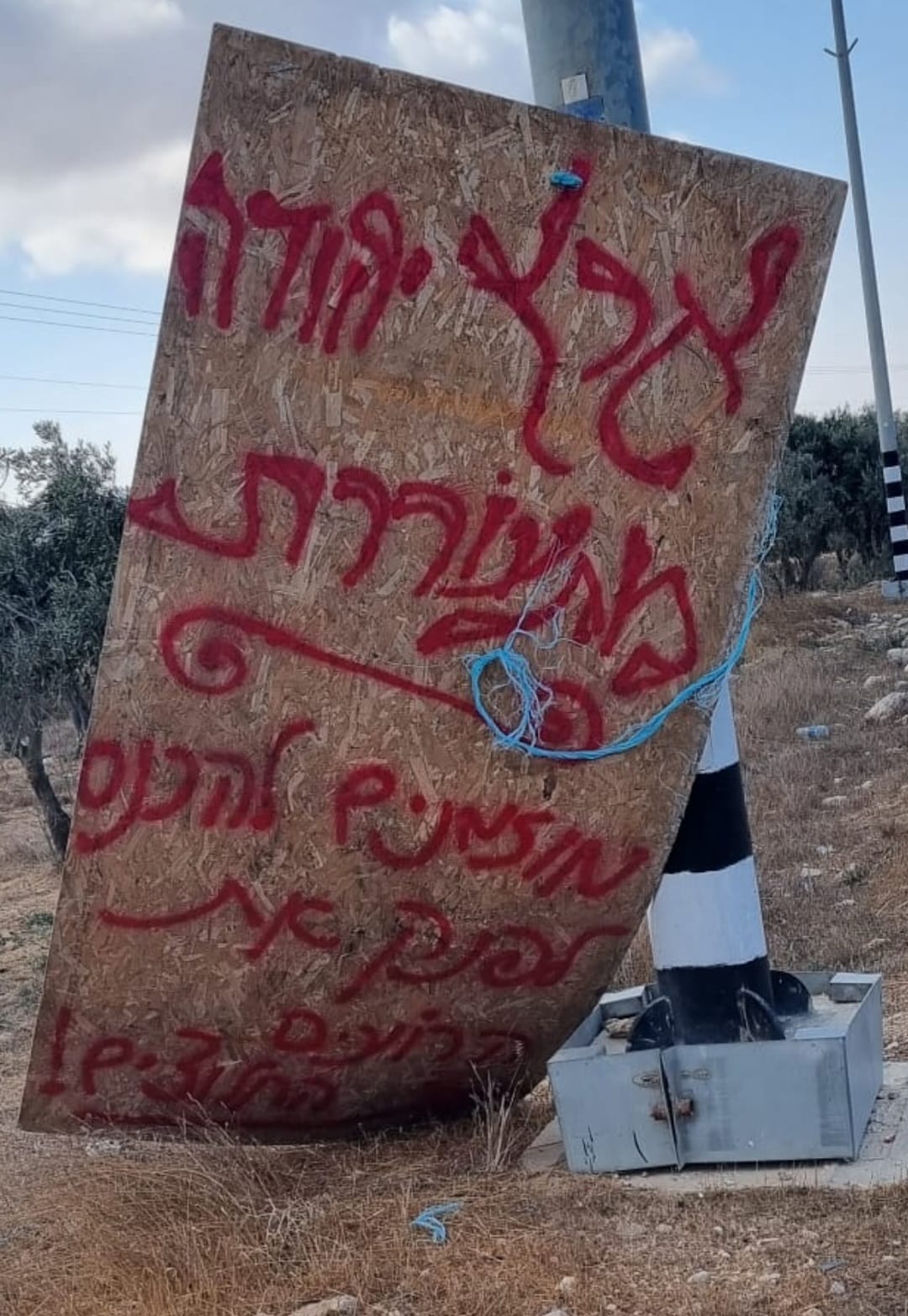 Smadar BeckerOct-17-2026A sign placed by those who call themselves the Pioneer Shepherds, at the outpost adjacent to Qawawis
-
