
Hebron, Sansana, South Hebron Hills, Tue 11.3.08, Morning
6:30-10:00
The Meitar Pass (Sansana)
We arrived at twenty to seven, and there still was a long line, apparently this was the situation on Sunday as well. Due to the past closure there were a lot of workers returning to work (About 1,500). The check goes fast and the long line is due to the fact that they are standing in line, and all of the checking positions are manned. At 7:20 all of the workers have passed. There are more workers with permits to come to the CP with their cars, thus the parking lots of the Palestinian side are filled.
The toilets on the Palestinians side are still filthy. Shlomi, the CP commander told us that he submitted four names as candidates to work of the Civil Administration, but hasn’t received an answer from them. I don’t understand why a worker from the Israeli side cannot clean the Palestinian side as well.
Good news: According to Shlomi, the CP will stay open on Friday’s until 4:00PM. Hurray!!! While we are there, one of the Palestinians turns to Shlomi and explains that he has a 24-hour permit, but when he tried to return home at 8:00PM the CP was closed, and he was told that he could only return from Tarqumiya. This adds more expense to his travels. But this is the situation for now; CP Sansana will remain closed from 7:00PM because there is no budget to man it for 24 hours.
Highway 60
The work progresses at a steady pace – and we have been thinking to ourselves, how much money is going into this, and for whose benefit?! For a handful of settlers. At the 317 junction – at highway 60 reserve soldiers are at their watch beside a concrete pillbox, watching over the area. (Perhaps) because of the fact that besides our car traveling on this road, no vehicle can be seen, on our way back the soldiers are gone.
Between Shima’a and Samoa on the right side of the road, concrete barriers have been left anywhere and everywhere making it difficult to travel on this road. A’, our driver, told us that the day before these barriers weren’t there. We see children walking to school, and the pleasant weather puts smiles on their faces. All of the barriers are still in their places, and some of them have been renewed.
Dura el Fawar – Traffic is flowing – the pillbox is manned. The Sheep Junction – there are many pedestrians crossing the road, and no army. Shayuch- Hebron – an army jeep is parked there with soldiers inside the jeep. They aren’t holding anyone back, but while we are there a young woman crosses the road and the area looks deserted.
Hebron
At the exit to Kiryat Arba an army jeep is parked, and there are soldiers in it.
The Disputed House – Beit Ha’Meriva – The place looks a bit abandoned and when we are there observing, the Palestinian girls go to school without anyone delaying them. The position of the Border Police looks abandoned – after a while however we notice them standing in the area of the cemetery. Down by the bus station we don’t see any soldiers- the Nachal Unit is the one manning the area of Hebron, and perhaps there are different orders.
Givat Ha’Charsina – Today the soldier isn’t standing at the CP but rather at the gate to the base, and we see a Palestinian car parked by their home (Has the Messiah returned?). They have allowed them to drive all the way home.
Givat Ha’Avot – Soldiers are now guarding the neighborhood – at a place that they weren’t at in the past.
in Tzir Ha’Mitpalilim – There is an army jeep with soldiers inside.
The Pharmacy CP – Despite the fact that the soldiers are not allowed to check children or their possessions, they are still doing it to a few of them. On the way back to the Abu Snena neighborhood, the residents don’t have to go through the magnometer or CP. The small gate is always open and wheelchairs can also pass through there. The patrol was getting ready for it’s rounds when we were there. A peace activist was there with his car, and a settler stopped by him. We had to instruct him not to pay any attention to the settler. It is always nice to meet these activists.
The Tarpat CP – There is no electricity at the CP so everyone passes through the side gate. There is almost no checking done there, but a patrol is about to go out to the H1 area.
In the picture – Shuhada Street and the soldiers with the dog.  An example of a nearly abandoned street.
The Cave of the Patriarchs CP – No one is being delayed.
Bassem’s Shop – He isn’t there and his children are playing with rulers, turning them into guns. They look just my child when he was small…only they truly do experience a real war.
Road No. 317 – 356
All of the roadblocks are in place, and there is very little traffic on the roads aside from us. Beside the post – some settler women who have stopped their car and are taking a picture of a memorial monument. Then they take a picture of us.
On Saturday we received a phone call from shepherds that live under the settlement “Carmel.” It seems that those folks from the new neighborhood have nothing better to do with their time than pick on the shepherds, running after them, and stealing their sheep. This happens on a day-to-day basis. The police and the army are aware of what’s going on, but they hardly ever find the culprits. For more on this go to: http://villagesgroup.wordpress.com/2008/02/11/visit-to-tuba-saturday-february-9-2008/
Stories from Cherbat Tuwani:
We were asked to come to visit because Jamal claims that the folks from Ta’aush have forgotten them a bit, and have moved to Susisa…
The events that he has related to us are very distressing. Here are but a few of them:
• The settlers from the Ma’on Farm have set up an obstruction that would lead to Um Tuba. The soldiers that accompany the children from Cherbat Tuwani to their school took down a barrier and wait for the children on the other side, thus the kids have to walk near the crazies from the farm. Why didn’t the army take down the obstruction? Only the army can answer that.
• The Civil Administration has decided on a boundary that divides the area of Cherbat Tuwani from the settlers on the farm. Neither side can cross the line. However- when new soldiers arrive they get their orders from the settlers – and thus these soldiers arrest the Palestinians when they are on their side of the boundary. The soldiers are told by the settlers where the line is. If the Palestinians complain or oppose the settlers, the settlers threaten them with arrest and that they will be arrested at the Checkpoints, and that that will turn them into non-desirables for work in Israel by the GSS etc.
• At this point there is no way to go with a herd alone. There must be at least three people together because they fear the settlers.
• About a month ago an area of Palestinian land under a settlement called Mitzpeh Abigail with an area that has an olive orchard, was closed for a month and declared a closed military area. During that time the villagers were not allowed to work their land. Under the auspice of the army in the meantime, the settlers broke off the branches of the olive trees.
• Soldiers have been cruel to the sheep, and have broken their teeth.
• Under the watchful eye of the army, settlers have stolen sheep from the villagers.
• With the blessings of the soldiers the settlers graze the sheep on the Palestinian land. This leaves nothing for the Palestinian’s sheep to graze on.
• A settler who drives an old Renault pickup truck, and carries a weapon with which he threatens children and the elderly. They haven’t dared come close enough to write down the license number. When the volunteers from CPT come close enough to photograph him, he moves away.
• Jamal asked for help with these problems. Together with the tea in Jumah’s home, we called the commander of the Yehuda Brigade and asked to meet with the people of Cherbat Tuwani with us as observers. We didn’t want to speak for them, and since the army is in command of this area, they should hear the complaints from the source. Much to our surprise, the army agreed, and set the date for the meeting at the first week of April with the brigade commander and representatives of the village. We’ll be there: the “Amazing Social Workers of the Occupation.”
Hebron
See all reports for this place-
According to Wye Plantation Accords (1997), Hebron is divided in two: H1 is under Palestinian Authority control, H2 is under Israeli control. In Hebron there are 170,000 Palestinian citizens, 60,000 of them in H2. Between the two areas are permanent checkpoints, manned at all hours, preventing Palestinian movement between them and controlling passage of permit holders such as teachers and schoolchildren. Some 800 Jews live in Avraham Avinu Quarter and Tel Rumeida, on Givat HaAvot and in the wholesale market.
Checkpoints observed in H2:
- Bet Hameriva CP- manned with a pillbox
- Kapisha quarter CP (the northern side of Zion axis) - manned with a pillbox
- The 160 turn CP (the southern side of Zion axis) - manned with a pillbox
- Avraham Avinu quarter - watch station
- The pharmacy CP - checking inside a caravan with a magnometer
- Tarpat (1929) CP - checking inside a caravan with a magnometer
- Tel Rumeida CP - guarding station
- Beit Hadassah CP - guarding station
Three checkpoints around the Tomb of the Patriarchs
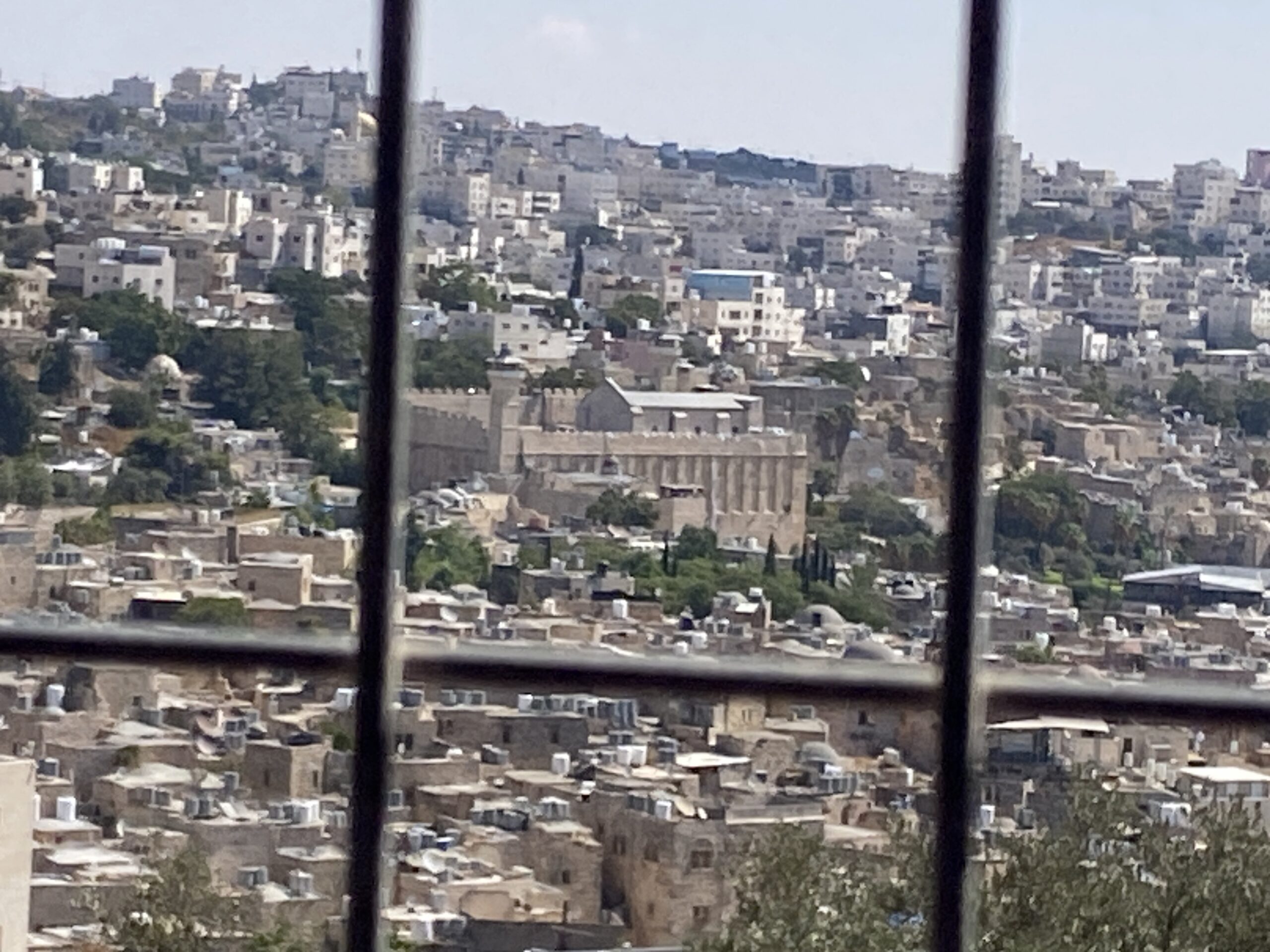 Yael ZoranSep-24-2026Hebron and the Cave of the Patriarchs from Beit Hashalom
-
Meitar checkpoint / Sansana
See all reports for this place-
Meitar Checkpoint / Sansana The checkpoint is located on the Green Line and serves as a border crossing between Israel and the West Bank. It is managed by the Border Crossing Authority of the Defense Ministry. It is comprised of sections for the transfer of goods as well as a vehicle checkpoint (intended for holders of blue identity cards, foreign nationals or diplomats and international organizations). Passing of Palestinians is prohibited, except for those with entry permits to Israel. Palestinians are permitted to cross on foot only. The crossing has a DCO / DCL / DCL / DCL (District Coordination Office), a customs unit, supervision, and a police unit. In the last year, a breach has been opened in the fence, not far from the crossing. This breach is known to all, including the army. There does not appear to be any interest in blocking it, probably as it permits needed Palestinian workers without the bureaucratic permits to get to work in Israel. Food stalls and a parking area economy have been created, but incidents of violent abuse by border police have also been recorded. Updated April 2022
-
South Hebron Hills
See all reports for this place-
South Hebron Hills
South Hebron Hills is a large area in the West Bank's southern part.
Yatta is a major city in this area: right in the border zone between the fertile region of Hebron and its surroundings and the desert of the Hebron Hills. Yatta has about 64,000 inhabitants.
The surrounding villages are called Masafer Yatta (Yatta's daughter villages). Their inhabitants subsist on livestock and agriculture. Agriculture is possible only in small plots, especially near streams. Most of the area consists of rocky terraces.Since the beginning of the 1980s, many settlements have been established on the agricultural land cultivated by the Palestinians in the South Hebron Hills region: Carmel, Maon, Susia, Masadot Yehuda, Othniel, and more. Since the settlements were established and Palestinians cultivation areas have been reduced; the residents of the South Hebron Hills have been suffering from harassment by the settlers. Attempts to evict and demolish houses have continued, along with withholding water and electricity. The military and police usually refrain from intervening in violent incidents between settlers and Palestinians do not enforce the law when it comes to the investigation of extensive violent Jewish settlers. The harassment in the South Hebron Hills includes attacking and attempting to burn residential tents, harassing dogs, harming herds, and preventing access to pastures.
There are several checkpoints in the South Hebron Hills, on Routes 317 and 60. In most of them, no military presence is apparent, but rather an array of pillboxes monitor the villages. Roadblocks are frequently set up according to the settlers and the army's needs. These are located at the Zif Junction, the Dura-al Fawwar crossing, and the Sheep Junction at the southern entrance to Hebron.
Updated April 2022
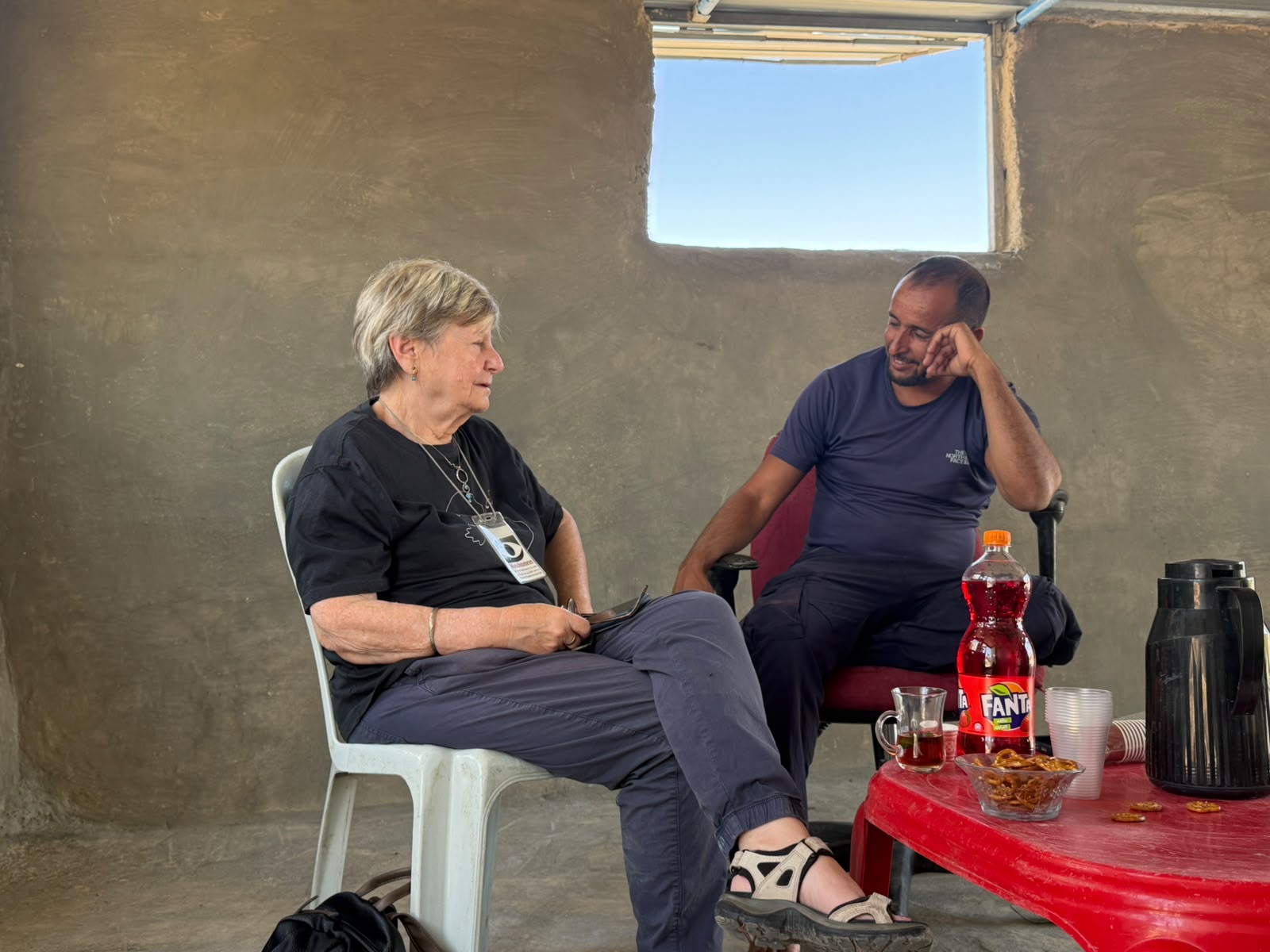 Muhammad D.Oct-10-2026Smadar with Najeh in Umm Qusa
-
