
Hebron, South Hebron Hills


On the way I decided to take a closer look at Meitarim. From Route 60 turn right towards Susya, immediately at the corner of the entrance. A large complex of industrial buildings, a large supermarket, and the buildings of the Southern Hebron Regional Council (Photos 1). The complex is well maintained of course. The name Meitarim is meant to burn into the consciousness that the occupation is erased, Meitar and the southern Hebron Mountains are the same. This is indeed the case in the consciousness of the national religious public in the area, Beit Yatir and Meitar from exactly the same root, everything is fine.
2. Visit to Simia. Photo 2: Here the two buildings, the nursery and the animal corner, were demolished. Figure 5: A greenhouse is now being quickly built over the field beyond the cistern. When Jews are building the country it is excellent, when Palestinians are building it is a problem.
3. A visit to the mother of Ata Jaber and his sister (Ata is not at his house on the hill across the road). It is clear that Road 60, when paved as a bypass of Hebron, was paved on Palestnian family lands. The constant taking over of their lands continues. After all the winery up built higher up was on their lands and their own passage to the top was blocked. The entrance junction to Kiryat Arba was recently expanded. The excavation works covered crops with dust that killed them. From their lands about 5 feet was confiscated , without compensation. When they the farmland was uprooted to pave a road, they asked for at least this good land for their other fields be left but received no answer. The land was stolen from them. Also the irrigation pipe which led to the fields was damaged and since then the only irrigation is from the pit which is under the house. In addition, next to the entrance path to the house there is a vineyard, from which the settlers stole a lot of precious fruit while sabotaging and destroying everything around them. Atta erected an Ascor fence there in an attempt to protect the vineyard. M. Points to the new house next to the old house and says that Atta paid tens of thousands of shekels in bribes to the settlers so that they would not destroy a house he built on his private land.
4. At the entrance to Kiryat Arba, 2 new ads. The two soldiers there are interested in why I’m filming. I say I’m from the Watch checkpoint. The response is recorded on their faces but they do not respond with words. I’m interested in where they are from. One from a moshav in the western Negev, is surprised that I even know the moshavim there and know where it is. The other from Sakhnin, asks if I know where it is. I recommended he do an education series for his friend about what happened there on the first time the Arabs held a Land demonstration. No Comment.
5. Later in the day, at the home of my children in Gush Etzion, I saw “Hebron in our hearts, a Shabbat Hebron special edition” (for the upcoming Hayyei Sara weekly Torah portion) distributed to Makor Rishon subscribers. Its contents included: “Activities of the organization for ‘Renewing Hebron’s Jewish Community’”; “Activities of the ‘Enlarge thy Tent’ group” (who buy buildings from Arabs, thereby “redeeming” the structures); “For Rabbanit Miriam Levinger of blessed memory”; “Steadfastly maintaining our forefathers’ rights – despite everything”; “A uniquely empowering festival at the Cave of the Patriarchs”; “Aerial view of Greater Hebron showing all Jewish settlements”; “The secret negotiations and renovations – How Hebron buildings were acquired”; “Redemption of Hebron’s ancient Jewish quarter (the ‘shuq’)”; “’And you shall possess it and dwell therein’, including a quote from Ussishkin, one of those who redeemed Emeq Hefer”. It’s filled with vibrant color photos. And, in fact, much of the large parking lot between the pharmacy, the girls’ school and the boys’ school, Beit Hamachpela and the Cave of the Patriarchs has already been fenced off. M. notes it’s intended for a huge tent for those attending the upcoming Shabbat Hayyei Sarah.
Much activity on the street uphill past the Tel Rumeida grocery. Well-built men in tailored suits and even a similarly stylish woman stand together in discussion with Palestinians who live on that street. I attached my Machsom Watch tag, showing it to them. M. notes we’re the only human rights organization which continues to appear here during the COVID epidemic. The silent security personnel finally relent to explain they’re from the United States embassy. I can’t resist telling them in English that since Biden won it’s necessary to replace the US ambassador to Israel, who’s a right-wing Jew with a settler’s mentality. I didn’t expect an answer but one responded, “There’ll be changes, but it’s not up to me.” Their fancy vehicles drive down from Tel Rumeida, the people themselves descend on foot. We don’t know whether they also met with settlers.
Hebron
See all reports for this place-
According to Wye Plantation Accords (1997), Hebron is divided in two: H1 is under Palestinian Authority control, H2 is under Israeli control. In Hebron there are 170,000 Palestinian citizens, 60,000 of them in H2. Between the two areas are permanent checkpoints, manned at all hours, preventing Palestinian movement between them and controlling passage of permit holders such as teachers and schoolchildren. Some 800 Jews live in Avraham Avinu Quarter and Tel Rumeida, on Givat HaAvot and in the wholesale market.
Checkpoints observed in H2:
- Bet Hameriva CP- manned with a pillbox
- Kapisha quarter CP (the northern side of Zion axis) - manned with a pillbox
- The 160 turn CP (the southern side of Zion axis) - manned with a pillbox
- Avraham Avinu quarter - watch station
- The pharmacy CP - checking inside a caravan with a magnometer
- Tarpat (1929) CP - checking inside a caravan with a magnometer
- Tel Rumeida CP - guarding station
- Beit Hadassah CP - guarding station
Three checkpoints around the Tomb of the Patriarchs
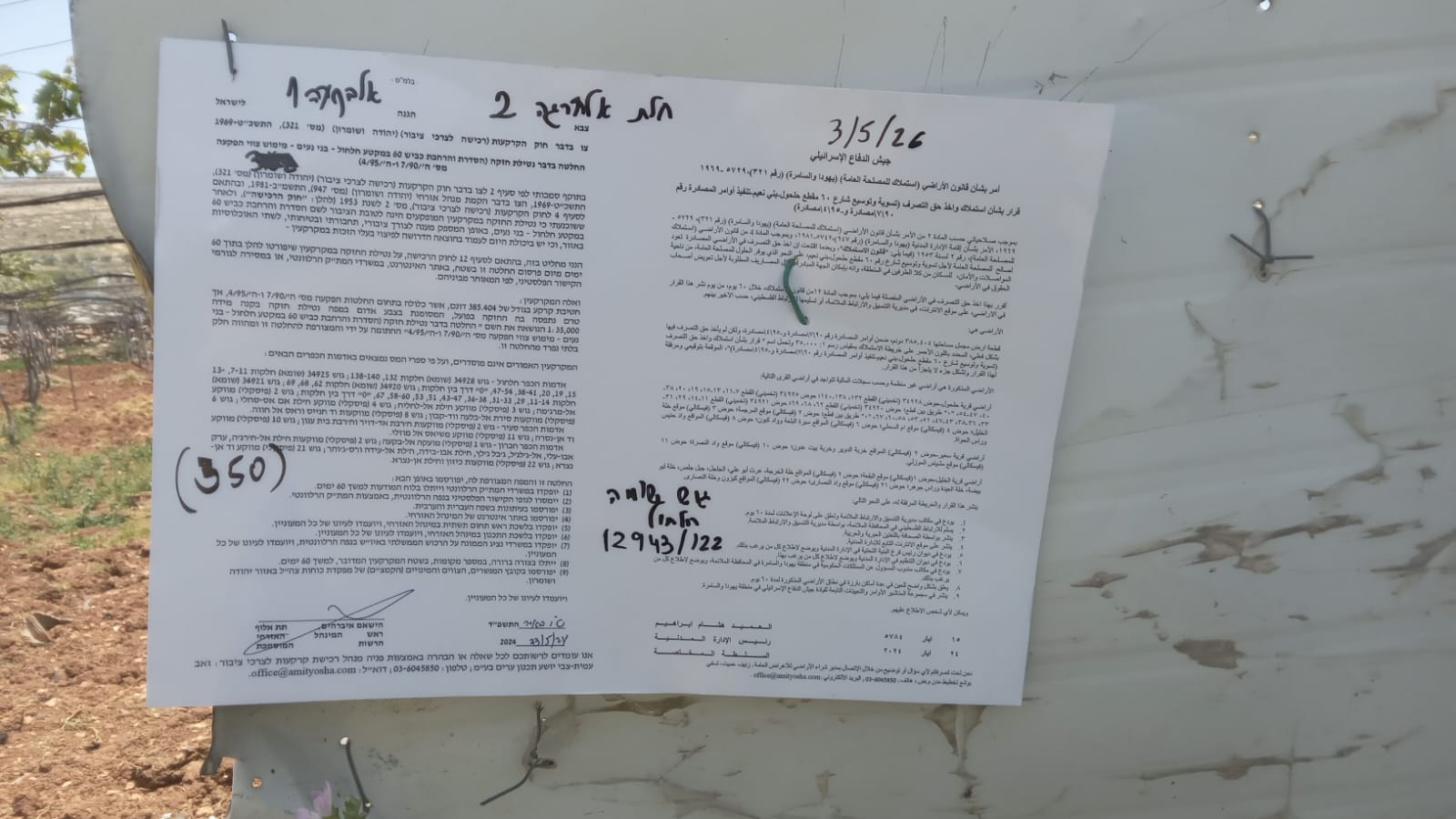 Muhammad D.May-13-2026Hebron - Request for compensation for land expropriation
-
South Hebron Hills
See all reports for this place-
South Hebron Hills
South Hebron Hills is a large area in the West Bank's southern part.
Yatta is a major city in this area: right in the border zone between the fertile region of Hebron and its surroundings and the desert of the Hebron Hills. Yatta has about 64,000 inhabitants.
The surrounding villages are called Masafer Yatta (Yatta's daughter villages). Their inhabitants subsist on livestock and agriculture. Agriculture is possible only in small plots, especially near streams. Most of the area consists of rocky terraces.Since the beginning of the 1980s, many settlements have been established on the agricultural land cultivated by the Palestinians in the South Hebron Hills region: Carmel, Maon, Susia, Masadot Yehuda, Othniel, and more. Since the settlements were established and Palestinians cultivation areas have been reduced; the residents of the South Hebron Hills have been suffering from harassment by the settlers. Attempts to evict and demolish houses have continued, along with withholding water and electricity. The military and police usually refrain from intervening in violent incidents between settlers and Palestinians do not enforce the law when it comes to the investigation of extensive violent Jewish settlers. The harassment in the South Hebron Hills includes attacking and attempting to burn residential tents, harassing dogs, harming herds, and preventing access to pastures.
There are several checkpoints in the South Hebron Hills, on Routes 317 and 60. In most of them, no military presence is apparent, but rather an array of pillboxes monitor the villages. Roadblocks are frequently set up according to the settlers and the army's needs. These are located at the Zif Junction, the Dura-al Fawwar crossing, and the Sheep Junction at the southern entrance to Hebron.
Updated April 2022
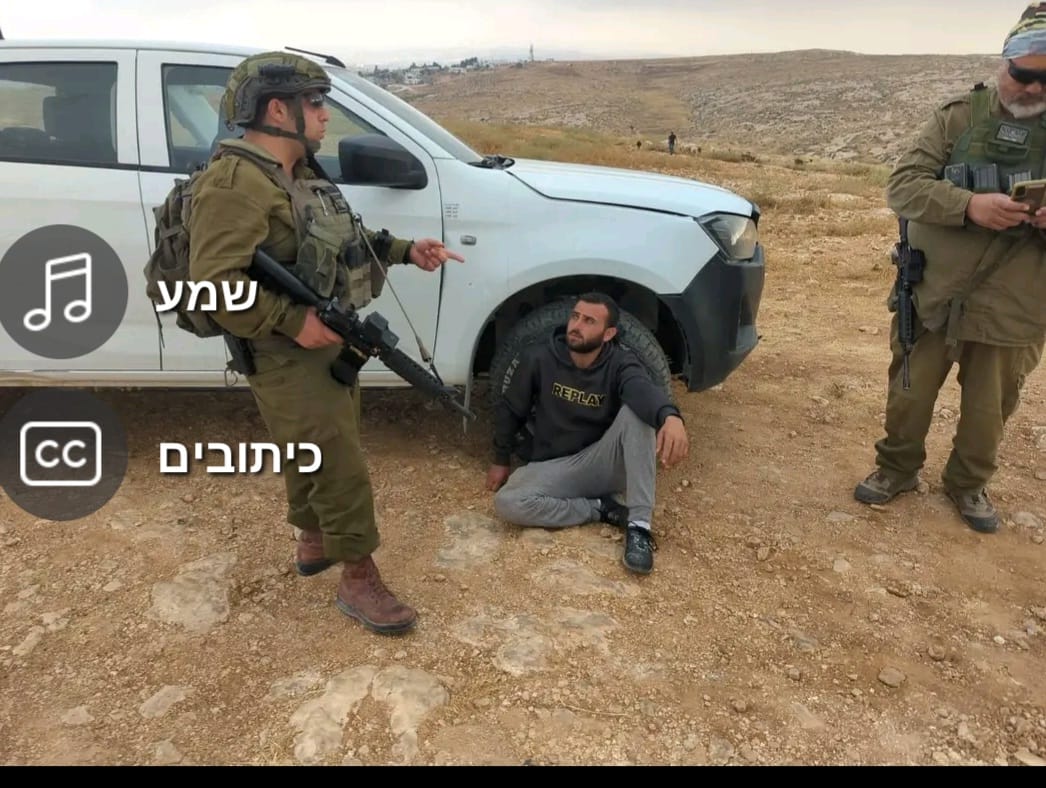 A Palestinian residentJul-6-2026Sha'ab al-Butum - M. and F. Jabarin arrested after settler attack on their home
-