
Huwarra
Huwwara 13 March 2005Watchers: Edna L., Arza A., Yael B., and (reporting): Ditza Y. 8:00 a.m.Huwwara South: no activity at the roadblock. The few who are on their way to Nablus are checked at the northern roadblock.8:05 a.m.Huwwara North: very few in the queue at the checkpoint. No one is held up.An Arab Jerusalemite reporter needs to get to Nablus for her work on a welfare newspaper in Geneva. She was not allowed into Nablus but the roadblock officer, N., tried to help as did the D.C.O. rep., Oleg, who phoned various authorities for help. In the end, after about 20 minutes or half an hour, the officer got a pass from the I.D.F. spokesman and the woman crosses.Iron hurdles separate the roads of those entering and those leaving Nablus. However, they are unstable and twice in a number of minutes they fell on small children who bumped into them. The children, or at least one little girl gets hurt.After we drew the attention of the soldiers to what is happening one of them brings a sandbag to stabilise the hurdles.A taxi driver is put in the lock-up. He is angry, abusive and hysterical. He claims that the roadblock officer broke the windscreen of his taxi. The officer says that the driver crossed the roadblock boundary line and when the soldiers approached him he started to drive away. He states that when taxi drivers cross the boundary they block the road and yesterday, for example, three ambulances were forced to wait a quarter of an hour. However, according to him, he did not break the taxi windscreen. We ask the officer to go to the taxi with the driver so that, if the windscreen is not smashed – the driver will calm down. The officer agreed and when the driver had been checked we accompanied them to see the taxi. The windscreen was indeed smashed and the Palestinian was very tense and helpless. He told us that he has four small children. Up until the previous day he had worked for a taxi owner who sacked him because he had crossed the ‘sacred line’ then as well. The keys were taken away from him and the taxi owner had had to come to the roadblock to pick them up. In the evening, after much searching, he had managed to find another taxi owner and he now had to go back to him with a smashed windscreen. He had earned 42 NIS this morning and the price of a new windscreen is 2,000 NIS. Where will he find the money? What will he say to the owner? He started to shout at the soldiers demanding that they arrest him because he cannot go home. He threatened that he would disturb the soldiers until they arrested him. He cursed his father for bringing him into the world.We are aware that much worse things happen in the occupied territories. We hear and read about the destruction of houses and damage to Palestinian property by the I.D.F. However, it is very hard to be present in such a situation. It is oppressive; it disturbs us and makes us feel ashamed. This is another example of the corruption of the occupation. The roadblock officer does not appear to us to be violent or unprincipled, but the power he has and the legitimisation of disrespectful behaviour towards Palestinians have their own consequences.And another thing: the taxi stand at the roadblock. Something which is repeated day in day out: drivers cross the ‘sacred line’ and their sentence at best is to be put in the lock-up, at worst their taxis are impounded and, as noted above, their taxis are damaged.The soldiers blame the Palestinians. They claim that they are told many times to bring someone to organise the queue, but they don’t do it. The army is satisfied that they have made the suggestion and stupidly, or worse wilfully, wanting to make the lives of the Palestinians more difficult, they allow this unbearable situation to continue.9:30 a.m.Back to normal roadblock routine: a man carrying a large sack full of clothes (for sale it appears) is forced to empty the sack on the rather dirty roadblock floor because the checking equipment in the lorry parked nearby has failed.Two additional taxi drivers. Yesterday their keys were confiscated and they have come to pick them up. The officer claims that the keys were not given to him, they were passed to the police, it seems. The taxi drivers insist that the keys are at the roadblock, but they are not found. The officer cannot tell us when the keys will be returned to their owners if they are actually at the police station. The drivers do not wait for us to try and clarify what happened to the keys and return to Nablus.10:15 a.m.The taxi driver whose windscreen is smashed is still not prepared to leave the roadblock, but we successfully got him to calm down somewhat.We leave the roadblock.At the recommendation of Ada R., I suggest to the driver that he puts in a claim for damage to the Army through the Centre for the Defence of the Individual, although his prospects of being reimbursed are practically nil.10:30 a.m.Beit Furik: very little activity at the roadblock.When we arrived, we heard the roadblock officer instruct the soldiers not to talk to us. When we questioned him about this – he claimed that this is an order from above.While we were there, two lorries tried to cross – but they were forced to retrace their tracks. One of them – just as we arrived at the roadblock; the second one – the driver had no permit to cross in this lorry (he had a permit for himself). His claim that the lorry belonged to his brother did not help. The officer’s argument: how do I know it is not stolen?10:55 a.m.We left the roadblock.
Huwwara
See all reports for this place-
The Huwwara checkpoint is an internal checkpoint south of the city of Nablus, at the intersection of Roads 60 and 5077 (between the settlements of Bracha and Itamar). This checkpoint was one of the four permanent checkpoints that closed on Nablus (Beit Furik and Awarta checkpoints to the east and the Beit Iba checkpoint to the west). It was a pedestrian-only barrier. As MachsomWatch volunteers, we watched therre since 2001 two shifts a day - morning and noon, the thousands of Palestinians leaving Nablus and waiting for hours in queues to reach anywhere else in the West Bank, from the other side of the checkpoint the destination could only be reached by public transport. In early June 2009, as part of the easing of Palestinian traffic in the West Bank, the checkpoint was opened to vehicular traffic. The passage was free, with occasional military presence in the guard tower. Also, there were vehicle inspections from time to time. Since the massacre on 7.10.2023, the checkpoint has been closed to Palestinians.
On February 26, 2023, about 400 settlers attacked the town's residents for 5 hours and set fire to property, such as houses and cars. Disturbances occurred in response to a shooting of two Jewish residents of Har Bracha by a Palestinian Terrorist. The soldiers stationed in the town did not prevent the arson and rescued Palestinian families from their homes only after they were set on fire. No one was punished and Finance Minister Smotrich stated that "the State of Israel should wipe out Hawara." Left and center organizations organized solidarity demonstrations and support actions for the residents of Hawara.Hawara continued to be in the headlines in all the months that followed: more pogroms by the settlers, attacks by Palestinians and a massive presence of the army in the town. It amounted to a de facto curfew of commerce and life in the center of the city. On October 5, 2023, MK Zvi established a Sukkah in the center of Hawara and hundreds of settlers backed the army blocked the main road and held prayers in the heart of the town all night and the next day. On Saturday, October 7, 23 The "Swords of Iron" war began with an attack by Hamas on settlements surrounding Gaza in the face of a poor presence of the IDF. Much criticism has been made of the withdrawal of military forces from the area surrounding Gaza and their placement in the West Bank, and in the Hawara and Samaria region in particular, as a shield for the settlers who were taking over and rioting.
On November 12, 2023, the first section of the Hawara bypass road intended for Israeli traffic only was opened. In this way, the settlers can bypass the road that goes through the center of Hawara, which is the main artery for traffic from the Nablus area to Ramallah and the south of the West Bank. For the construction of the road, the Civil Administration expropriated 406 dunams of private land belonging to Palestinians from the nearby villages. The settlers are not satisfied with this at the moment, and demand to also travel through Hawara itself in order to demonstrate presence and control.(updated November 2023)
.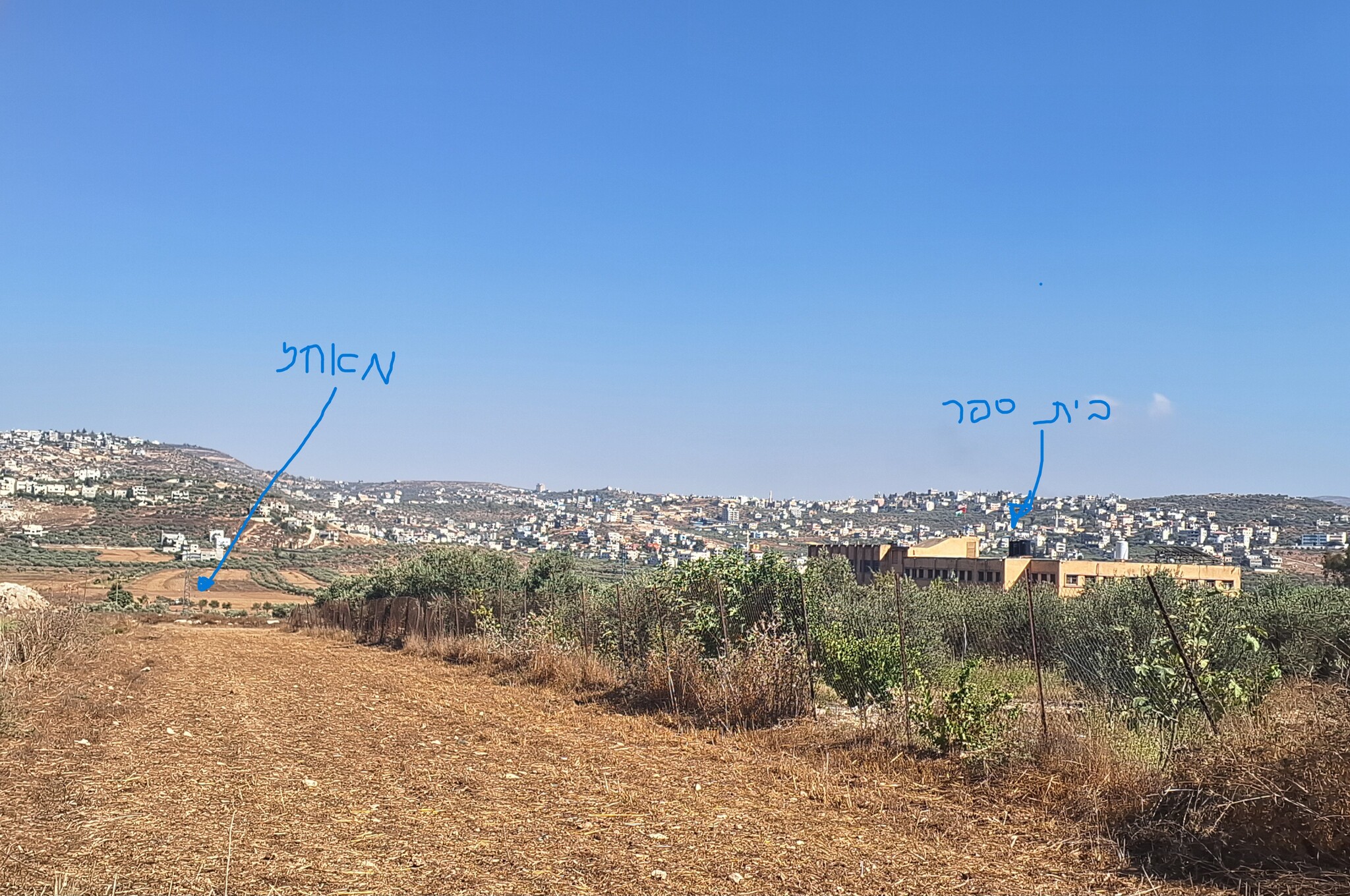 Ronit Dahan-RamatiAug-24-2026Huwara: The school on the outskirts of town and an outpost hidden among the trees
-
