
Huwwara
Huwwara Wed. 9/11/05 PMObservers: Daliah V. Hagar L.(reporting)Translation: Deb L.Summary: Huwarra was very busy because on Wednesdays the students go home for the week-end. Even though there were MPs and soldiers checking, it wasn’t enough. The time it took to go through the checkpoint was 42 minutes. The long waiting caused anger, frustration and tension in both the Palestinians and the soldiers. The soldiers expressed their stress by threating, shouting, punishing, pushing and confiscating IDs. Beit Furik is still closing early, at 5:30PM, even though it is no longer Ramadan.1:35PM Marda -(just below Ariel) — rolling checkpoint. The soldiers there give us no information. It may be because the army is carrying out some military action in the village. 1:40PM -The road going to Zeeta and Jameen is still blocked by a mound of dirt with a ditch, boulders, and more dirt around the olive orchards next to the road (this was where the Palestinians had tried to make an alternative route and it was blocked). We asked a local if there were any other blockades along the way to Huwarra and he said no.1:50PM Za’atara Intersection – There were three southbound cars and the traffic was moving in all directions. According to the soldiers the checkpoint was open (no “seperation”). The expansion of Road Number 60 is progressing fast, as well as what looks like the new checkpoint. 1:55PM -The Yitzar-Huwarra intersection was open. When we arrived at Huwarra we saw a jeep with BPs heading toward this intersection and heard that they were going to set up a rolling checkpoint there. However, because of the build-up of pressure at Huwarre, we were not able to get back here to check it out.2:02 – 4:35PM Huwarra- We spoke to A., the officer of the checkpoint. He allowed us to stand behind the line of people waiting to enter the checkpoint, which was near the area where vehicles leaving Nablus are checked. Through out the shift, however, there were soldiers who tried to get us to move and to stop taking pictures. There were about 60 pedestrians. Only one checking booth for IDs was being manned. There were two lines near the electronic doorway where parcels were checked. The checking of parcels was going slowly and from time to time had to be stopped because there was a backup of people waiting for their IDs to be checked. IT TOOK 45 MINUTES FOR SOMEONE TO PASS THROUGH THE CHECKPOINT. The vehicle line moved quickly at the beginning. It was run by an efficient, hardworking MP woman. It took 3 minutes for cars and 15 minutes for buses that were filled with passengers. Sometimes there was an additional vehicle line run by A., the DCO Representative. There was an humanitarian line open the whole time which was run by the DCO Representataive and occasionally by an MP as well. The MP was rude and even pushed a young man. The checkpoint officer spoke to the MP about his behavior.When we arrived at the Huwarra, there were B’etzelem representatives there. There was also a representative of a Holy Scriptures company from Jerusalem who tried to get two of his employees into Nablus where other employees were waiting. He had been waiting since 12:45PM. His ID(with his permit to enter Nablus inside) had been taken by the officer from the previous shift who was no longer there. They had to locate his ID. After 3 hours of waiting and several telephone calls to the Commander of the Brigrade, he was allowed through. During our shift, the officer of the checkpoint had to “steal from Peter to pay Paul”. That is, due to the limited man power he had to move soldiers from one place to another according to the pressure that was on a particular checking station. As a result of the pressure, when both the pedestrian lines and the vehicle lines were long, even the checkpoint officer lost patience and started to shout.From 2:36PM – 4:30PM there were at least 200 people at the checkpoint, if not more, at any one time. This created a mounting tension and anger among those who were waiting, and as a result of the potential danger, the soldiers let the people on the humanitarian line through without even checking them. There wasn’t one person who was detained because of a need to check his ID but they were detained as a means of punishment. There was even a case where a Sergant Major wanted to take an ID from someone, and to send him away telling him to come the next day to get the ID back. We managed to prevent this from happening but it resulted in a very harsh exchange with the checkpoint officer. At the height of this mounting pressure (from 2:30PM – 3:00PM),the officer decided to work without the electronic doorway and this increased the pace of the checking. The efficient MP woman, mentioned above, started checking IDs and she worked fast. The guard also checked IDs and he was fast as well. However, this didn’t change the humiliating nature of the “dance” that one had to go through at the checkpoint: lifiting one’s shirt up to the chest, lifting up the legs of one’s pants, having one’s back frisked, having coats checked. There was one case where I saw how embarrassed a young man was to lift his shirt in front of the female MP, that I turned away in order not to increase his discomfort. At one point 3 young men got caught in the turnstile and when the guard went over to help them and to restore order to the line, the checkpoint officer called across to the guard in order to stop him. “That’s there problem. Let them figure it out.” This solution was actually perferred by the others who were waiting on line, even if taking their desire into account was not the intention.3:00PM -At this time, even though the checking of IDs started to be done by the Matak Representative A. and another soldier, the waiting was still 40 minutes .Three soldiers were especially despicable in their behaviour: One soldier who wore a bullet proof vest that belonged to a Sergeant Major, a soldier who spoke with a Russian accent, and an MP man (the other MPs were all women) who spoke very rudely and would yell, not only at the Palestinians, but also at the other soldiers as well.There was a particular incident that needs, urgently, to be checked. The officer of the checkpoint and the Sergeant Major pointed out a group of about 5 young men who stood at the entrance to the checkpoint to the guard, who stood at the electronic doorway. “You see the young man with the black coat and the notebooks, etc…” The guard was told to prevent these men from entering the checkpoint. This same guard had been detaining people for at least 15 minutes as a punishment when I told him it was not lawful. As a reaction to me, he sent the men back to the end of the line, which was actually a harsher punishment. I had a hard time explaining this to the men who had hoped I’d be able to help them. And again, this same guard, told one of the men waiting on line to step aside until he found a Palestinian who knew Hebrew. He wanted to tell him not wear his coat to the checkpoint but to carry it a bag because it looked like an army coat. (I didn’t see any resemblance to an army coat and wondered what the man was going to do in the winter. Would he have to buy a new coat in order to please the soldier?) This particular soldier was not rude. He had kindly let a family with a baby and a young toddler go around the line instead of having to go through it . Yet, at the same time, he didn’t hesitate to detain 5 men as a punishment when , clearly, these were the instructions he had been given.4:40PM – 5:20PM Beit Furik- The line of pedestrians moved quickly and there were very few cars. The officer informed us that, according to the instructions he had gotten today, the checkpoint would be closed at 5:30PM. There was only one MP woman doing the checking. She had to check both directions of pedestrian traffic and so she would spend a few minutes on one side and then on the other.5:25PM -On the way back from Beit Furik, we saw that there were very few people at Huwarra. The Huwarra-Yitzar intersection was open, at Zataara there were no cars, and at the entrance to Murda, there was no rolling checkpoint.
Marda
See all reports for this place-
Marda
There are about 2500 inhabitants in the village. A large part of their lands was confiscated for the benefit of the settlement of Ariel, some of whose buildings are adjacent to the village.
They often feel under siege. At both entrances to the village from the main road (505) there are checkpoints and the army does close the yellow arms from time to time. The inhabitants of Marda own olive groves behind a fence. Rarely are they allowed to cultivate their agricultural plots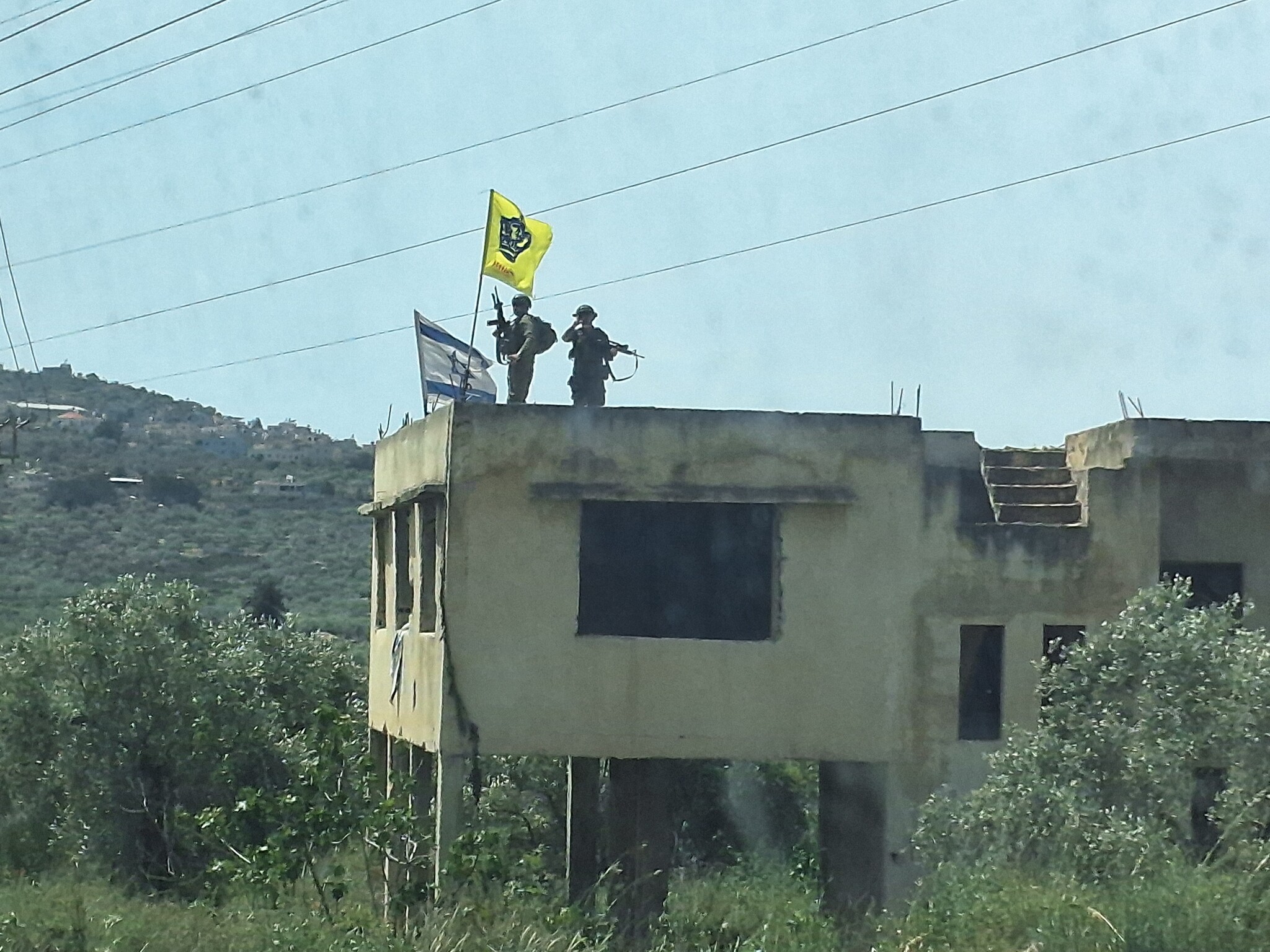 Ronit Dahan-RamatiApr-14-2026Marda. IDF post on the roof of a Palestinian home with the Messiah flag
-
