
Huwwara
Huwwara north 21.9.04 AMObservers: Yael P, Nechama A, Josh, guest photographer, Etty P (reporting)8.30:A short line and seven detainees. Several students appeal to us from the end of the line after having been turned back. They are studying at all kinds of medical or anonymous colleges (unnamed, under the auspices of the Higher Education Department of the Palestinian Ministry of Education) and they ask how they can reach Nablus and their studies. A soldier, A., explains that the army does not recognize those institutions and that only a-Najah University has an agreement with the army.The passageway beside the detainees’ hut is closed and, after checking, people pass through on the left hand side of the checking position. A student from a-Najah is detained – he is under suspicion.8.50:9 detainees, 3 of them are released, including young men without permits who live in Nablus. Another student from a-Najah is detained – he too is suspect.Three Border Policemen with a large jeep arrive to help at the checkpoint. Shortly afterwards they donate the computer in their jeep for checking procedures which significantly shortens the waiting period. Six more students from a-Najah are now detained but are released so fast that there is no room for complaint.9.15:Now there are 26 detainees who are released at a dizzying pace. A vehicle of the Palestinian cellular phone company is detained because three of the passengers are Israelis and one of them has not been coordinated with the DCO, although he says he goes through every week and they know who he is. The vehicle continues on its way and he is left to wait for the DCO permit.A boy detainee, accompanied by his mother, has an alarming fresh scar on the upper part of his arm. By the time I talk to Dalia Basa – he has been released and allowed through. At this stage our old friend Sergeant Y from last week arrives. He is angry at me for contacting the DCO and reprimands me for talking to the soldiers, reminding me that he is in charge. A young detainee who has been turned back after his ID has been returned to him approaches us. He has a credit card and needs to take money out in order to pay the DCO for a licence of some kind, but there is no bank in his place of residence, Bita, and the nearest place is Nablus. The soldiers know nothing about it. I telephone the DCO and the woman soldier who answers doesn’t understand what the problem is. Doesn’t he have a bank in Bita? She eventually asks someone who confirms that there is no source of cash in Bita or anywhere near. She protests: “Is that a reason for letting them in?”I ask her to tell the soldiers to let the man through and she asks for the details. I tell her he’s been checked and she asks why, in that case, they won’t let him through. I explain again that they didn’t know there was no bank in Bita. She finally agreed to talk to the soldiers and the young man was allowed to pass.A young pregnant American woman with her Palestinian mother-in-law and sister-in-law and a baby wants to enter Nablus and explains that her husband’s family are there. The soldiers ask the DCO who say she must come and coordinate the visit. I was surprised because a week ago there was a very similar case of a Palestinian-American couple who wanted to visit his family in Nablus, who went through thanks to A. from the DCO. Attempts to reach the DCO failed when nobody answered the phone. I asked our observers on the north side to talk to 2nd Lieutenant N. from the DCO who was on the spot. He talked to me and explained that they need to go to the DCO and I persuaded him to talk to them first. They went over to the north and it transpired that her in-laws live in Jericho and the relatives in Nablus are more distant, which is not enough to ensure entry without prior coordination. This is in contradiction to previous reports, which state that the purpose of barring entry for holders of foreign passports is to keep out foreign peace activists. Ada wrote that the army is not authorized to arrest holders of foreign passports. The soldiers at the checkpoints don’t know this. Perhaps we should clarify the point with more senior officers.A taxi driver from Ramallah wants to enter Nablus because his vehicle licence, issued in Nablus, lapsed on the 16th. He was turned back by the soldiers who sent him to the DCO. On the other hand, a student transferring from a medical college to a-Najah, who waited a long time after his papers were returned – eventually goes through. There are problems regarding Josh, the photographer although we assure the soldiers that he is not photographing faces. One of the soldiers and an older border policeman claim that this is a military area and a military installation. We insist that photography is permitted and tell them to call the police to prove that it is prohibited. Josh decided to take pictures from not too close up and in particular pictures of Palestinians.A woman settler tried to launch a friendly discussion which turns into a pointless argument. “Why are you helping our enemies, people who want to murder us? She was pleasant but refused to leave and couldn’t understand why we didn’t want to continue the conversation.A young man arrived who had been checked and cleared but turned back; all he wanted was to transfer a small chip to someone on the other side. Suddenly a young and self-assured Palestinian emerged from nowhere and the soldiers let him through to take the chip… We can only guess why he was granted relative freedom.All in all, a reasonably encouraging watch despite the hostility of some of the soldiers and in particular Sergeant Y, who treats us and anyone at the checkpoint with revulsion and tries to appear authoritarian although the soldiers don’t cooperate.Huwwara southObservers: Yona A, Tal A. as reported to Etty P.9.00: only 6 detainees who waited about half an hour. 2nd Lieutenant L. is efficient, businesslike and cooperative but most of the time is not at the checkpoint, but sitting in the hut or checking cars and his absence is felt. There is only one soldier checking and so the line is growing. 2nd Lieutenant N. from the DCO is helping but he too is occupied with the taxis. A young physician with a work permit is detained because the last four figures of his ID were on the black list. He is eventually released.2 taxis were confiscated because they crossed the virtual line, and the soldier lost the keys of another taxi. They are angry with the drivers because one escaped them and ran down a Palestinian pedestrian. They ignore the fact that the drivers cross the line and run away because they are struggling for a livelihood because there is no regular parking space as there is on the south side.2nd Lieutenant L. explains how the new procedure of confiscating cars works. The officer goes out to catch the taxi with a soldier, the driver brings the taxi to the checkpoint and it is taken to a regular parking lot with a policeman for a week. The Palestinian drivers lose out under this new procedure because previously they waited only four days.This watch was frustrating because the checking at the checkpoint and by phone was slow.On the way back two unannounced checkpoints, one at the Jit junction with 12 vehicles, the other at Amtan, north of Funduk.
Huwwara
See all reports for this place-
The Huwwara checkpoint is an internal checkpoint south of the city of Nablus, at the intersection of Roads 60 and 5077 (between the settlements of Bracha and Itamar). This checkpoint was one of the four permanent checkpoints that closed on Nablus (Beit Furik and Awarta checkpoints to the east and the Beit Iba checkpoint to the west). It was a pedestrian-only barrier. As MachsomWatch volunteers, we watched therre since 2001 two shifts a day - morning and noon, the thousands of Palestinians leaving Nablus and waiting for hours in queues to reach anywhere else in the West Bank, from the other side of the checkpoint the destination could only be reached by public transport. In early June 2009, as part of the easing of Palestinian traffic in the West Bank, the checkpoint was opened to vehicular traffic. The passage was free, with occasional military presence in the guard tower. Also, there were vehicle inspections from time to time. Since the massacre on 7.10.2023, the checkpoint has been closed to Palestinians.
On February 26, 2023, about 400 settlers attacked the town's residents for 5 hours and set fire to property, such as houses and cars. Disturbances occurred in response to a shooting of two Jewish residents of Har Bracha by a Palestinian Terrorist. The soldiers stationed in the town did not prevent the arson and rescued Palestinian families from their homes only after they were set on fire. No one was punished and Finance Minister Smotrich stated that "the State of Israel should wipe out Hawara." Left and center organizations organized solidarity demonstrations and support actions for the residents of Hawara.Hawara continued to be in the headlines in all the months that followed: more pogroms by the settlers, attacks by Palestinians and a massive presence of the army in the town. It amounted to a de facto curfew of commerce and life in the center of the city. On October 5, 2023, MK Zvi established a Sukkah in the center of Hawara and hundreds of settlers backed the army blocked the main road and held prayers in the heart of the town all night and the next day. On Saturday, October 7, 23 The "Swords of Iron" war began with an attack by Hamas on settlements surrounding Gaza in the face of a poor presence of the IDF. Much criticism has been made of the withdrawal of military forces from the area surrounding Gaza and their placement in the West Bank, and in the Hawara and Samaria region in particular, as a shield for the settlers who were taking over and rioting.
On November 12, 2023, the first section of the Hawara bypass road intended for Israeli traffic only was opened. In this way, the settlers can bypass the road that goes through the center of Hawara, which is the main artery for traffic from the Nablus area to Ramallah and the south of the West Bank. For the construction of the road, the Civil Administration expropriated 406 dunams of private land belonging to Palestinians from the nearby villages. The settlers are not satisfied with this at the moment, and demand to also travel through Hawara itself in order to demonstrate presence and control.(updated November 2023)
.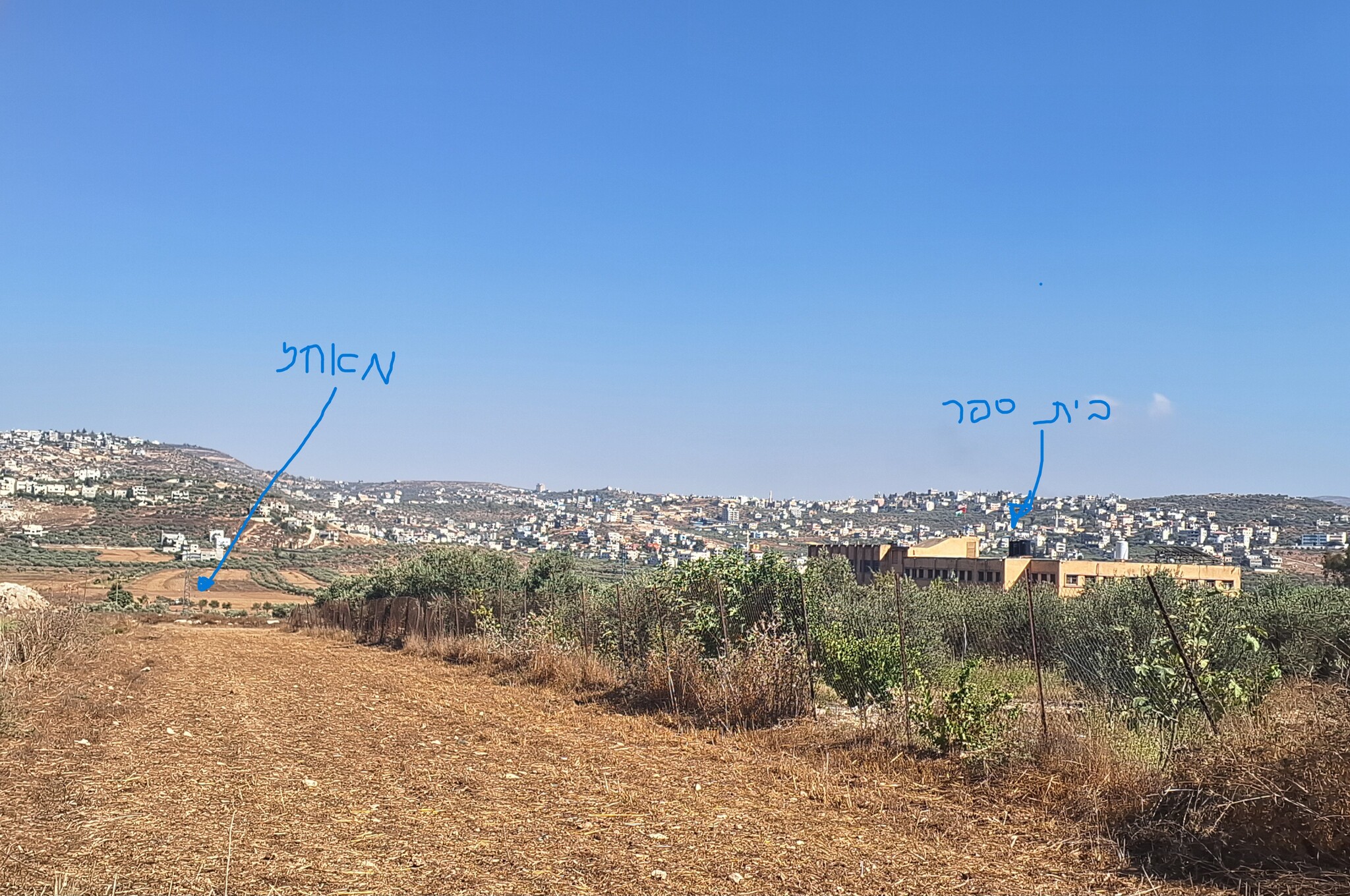 Ronit Dahan-RamatiAug-24-2026Huwara: The school on the outskirts of town and an outpost hidden among the trees
-
