
Huwwara
HUWWARA, Saturday 26 June 2004 AM Watchers: Hedva, Hava (reporting) Huwwara NorthDespite a three-day military incursion into Nablus, and only one day after three Palestinians had been killed there, there was nothing out of the ordinary apparent at the checkpoint.The usual orders were in force: men between the ages of 16 and 30 were not allowed through without permits. On the other hand, the passage of women was almost free. There was an Arabic-speaking representative of the District Coordinating Office (DCO) at the checkpoint [the DCO is the section of the army that handles civilian matters; it usually has representatives at the checkpoints, ostensibly to alleviate the lot of the Palestinians]. This soldier checked ID cards like the rest and did not assume any extra authority in deciding who could and could not go through. To our appeals, he responded : “I am bound by the orders”.We arrived straight in the middle of a row. The checkpoint commander was raining threats and abuse down on a taxi driver: “Give me the keys! Give me the keys, I am talking to you!! If you move from here, I’ll pump a bullet into you!” The driver was trying to explain something, but the soldier seized the keys and waved him rudely towards the taxi which was parked in the checkpoint area. “Don’t move or I’ll break your windows! Get into the car! Drive! Slowly! Slowly, I tell you!!”The driver explained that his mother had just arrived from Jordan and he had come to meet her. Soldier: “He’s absolutely not allowed to drive further into the checkpoint area than that large green sign at the entrance.””Does it say so in Arabic?” we inquired . “I don’t know,” said the soldier. “I certainly didn’t put the sign there, but he (the Palestinian) knows very well that what he did is forbidden.”Hedva went to check. Nothing of the kind was written there in Arabic. The assumption that “They know very well” is used all too often as a pretext for punishments and abuse. Can we complain? The driver’s keys were confiscated and he was given a form, in Hebrew, informing him that in four days time he can come and get his taxi back. Our appeals to lessen the punishment were useless.There were four detainees when we arrived and by the end of the taxi incident there were six. Two of them allegedly had “fake IDs”. One was on his way to medical treatment in Ramallah and had only a referral written in English.”How do you know the IDs are fake?””Of course we know, what do you think!””Nevertheless?””There are pin holes in the paper.”After about a half-an-hour everybody was released. We saw few people who were turned back.Huwara SouthThe soldier here spoke Arabic better than Hebrew and still all the Palestinians answered him in Hebrew. If they failed to explain themselves, they tried English. He talked Arabic to them – they understood but still answered in Hebrew. The soldier made obvious efforts to be humane. A certain minimum of yelling and threats seemed to be part and parcel of how he interpreted his role at the checkpoint, but it was apparent, too, that he was aware of dealing with human beings.One detained man reported that he’d been waiting for several hours in the sun. He had no hope of getting away till the end of the day – as was confirmed by the soldier:”He’ll stay here till 16:00.””Why?””Ask him – he knows”. (Again that “he knows”.)He did not know. He had a paralyzed father in a nearby village and his sister was at home and he neededto get to Nablus to draw money from the bank. After some nagging and some back-and-forth from the soldier to the detained man , and after some threats (apparently indispensable) he was released and on his way to Nablus.We drove to Jit where an unannounced roadblock is usually in evidence. The place was deserted. We drove home. There were no unannounced roadblocks along Highway 60.
Huwwara
See all reports for this place-
The Huwwara checkpoint is an internal checkpoint south of the city of Nablus, at the intersection of Roads 60 and 5077 (between the settlements of Bracha and Itamar). This checkpoint was one of the four permanent checkpoints that closed on Nablus (Beit Furik and Awarta checkpoints to the east and the Beit Iba checkpoint to the west). It was a pedestrian-only barrier. As MachsomWatch volunteers, we watched therre since 2001 two shifts a day - morning and noon, the thousands of Palestinians leaving Nablus and waiting for hours in queues to reach anywhere else in the West Bank, from the other side of the checkpoint the destination could only be reached by public transport. In early June 2009, as part of the easing of Palestinian traffic in the West Bank, the checkpoint was opened to vehicular traffic. The passage was free, with occasional military presence in the guard tower. Also, there were vehicle inspections from time to time. Since the massacre on 7.10.2023, the checkpoint has been closed to Palestinians.
On February 26, 2023, about 400 settlers attacked the town's residents for 5 hours and set fire to property, such as houses and cars. Disturbances occurred in response to a shooting of two Jewish residents of Har Bracha by a Palestinian Terrorist. The soldiers stationed in the town did not prevent the arson and rescued Palestinian families from their homes only after they were set on fire. No one was punished and Finance Minister Smotrich stated that "the State of Israel should wipe out Hawara." Left and center organizations organized solidarity demonstrations and support actions for the residents of Hawara.Hawara continued to be in the headlines in all the months that followed: more pogroms by the settlers, attacks by Palestinians and a massive presence of the army in the town. It amounted to a de facto curfew of commerce and life in the center of the city. On October 5, 2023, MK Zvi established a Sukkah in the center of Hawara and hundreds of settlers backed the army blocked the main road and held prayers in the heart of the town all night and the next day. On Saturday, October 7, 23 The "Swords of Iron" war began with an attack by Hamas on settlements surrounding Gaza in the face of a poor presence of the IDF. Much criticism has been made of the withdrawal of military forces from the area surrounding Gaza and their placement in the West Bank, and in the Hawara and Samaria region in particular, as a shield for the settlers who were taking over and rioting.
On November 12, 2023, the first section of the Hawara bypass road intended for Israeli traffic only was opened. In this way, the settlers can bypass the road that goes through the center of Hawara, which is the main artery for traffic from the Nablus area to Ramallah and the south of the West Bank. For the construction of the road, the Civil Administration expropriated 406 dunams of private land belonging to Palestinians from the nearby villages. The settlers are not satisfied with this at the moment, and demand to also travel through Hawara itself in order to demonstrate presence and control.(updated November 2023)
.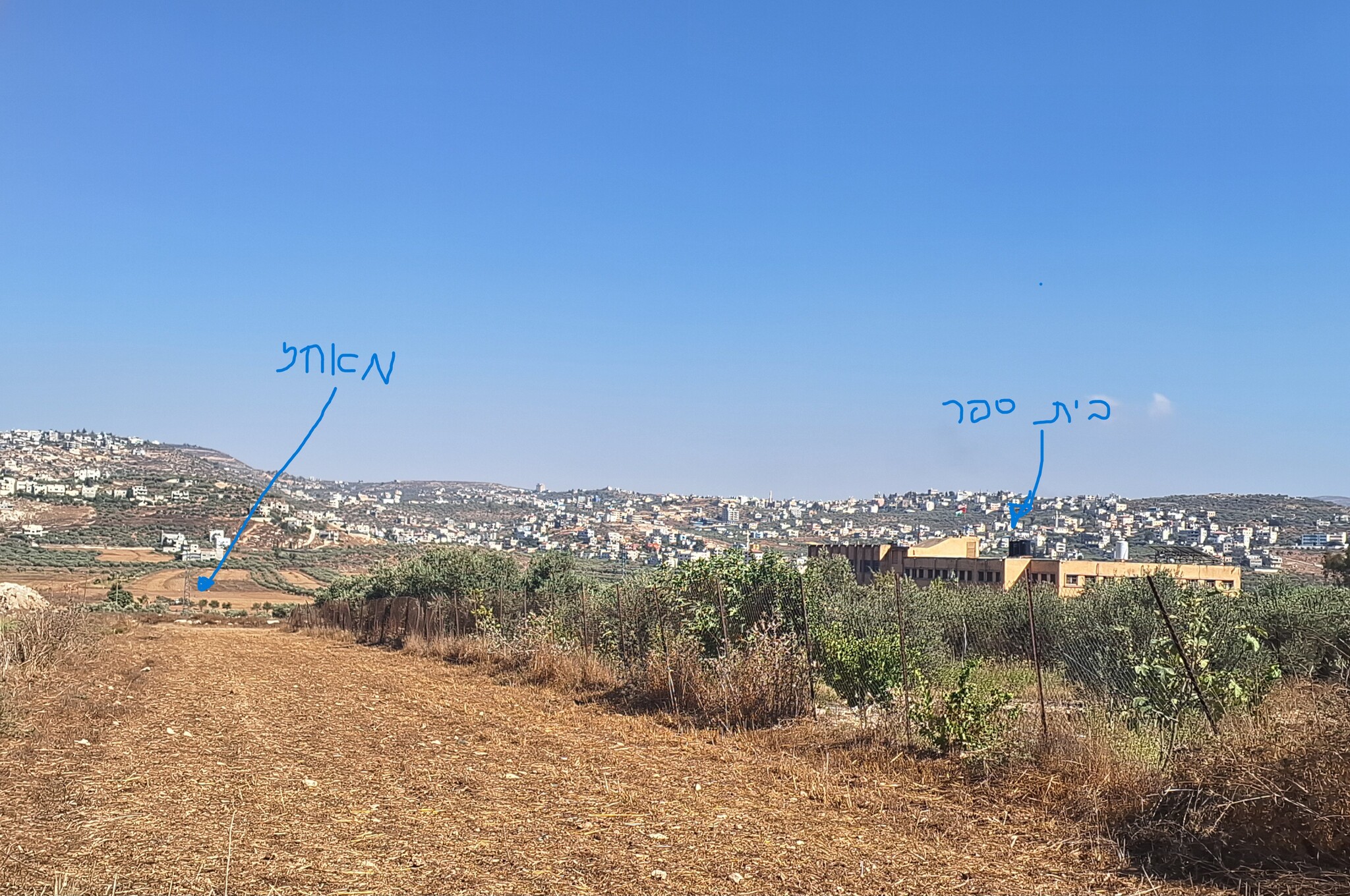 Ronit Dahan-RamatiAug-24-2026Huwara: The school on the outskirts of town and an outpost hidden among the trees
-
