Huwwara
Huwwara, Sunday 19.2.06 PMObservers: Noa P., Judit B., Hanna B., Tal H., Galit G. and Naomi L. (reporting)On her way from Jerusalem Hanna reports multiple checkpoints – in Luban and a bit earlier. No long waiting lines, but is this a sign of things to come? Along the road, signs demand “Open the Atarot Road!” – for settlers of course.Yitzhar-Huwara Junction – about 20 vehicles waiting.Huwwara checkpointCP commander – second lieutenant A. Another officer, E., running things part of the time. During the entire vigil, no DCO representative present, any phone connection with the DCO or Brigade HQ impossible. The detector dogs and their ladies were also notably absent, unlike in our recent vigils.15:00 – about 80 people waiting behind the turnstiles, at the ID checking post a soldier points his rifle at people waiting from a distance of less than 1 meter. 2 ID checking posts throughout the vigil, do not keep up the pace. At the body-search posts as well, rifles are pointed at Palestinians at very close range. Tiny children with their father stand about 10 cm. from the rifle barrels. About 70 women waiting in their special line.The young men’s checking line is repeatedly halted whenever the ID checks don’t keep up and the lines keep getting filled. Nevertheless no extra waiting lines are opened and a one whole soldier stands there just to make sure Palestinians do not get too close to the ID checking posts.A bulldozer shuffles soil east of the CP, not quite clear to what end. The CP commander introduces himself to us and designates a new virtual line which we are not to cross. He “is glad to work with us”, appreciates our work very much, and expresses deep concern for our personal safety. Just yesterday a Palestinian arrived at the CP with SUCH a long knife in his sleeve. We explained we do not work with the army, and are here to monitor and record the violation of human rights at the CP, and from his designated observation point we will not be able to do this properly. [Later we were no longer asked to move].15:30 – All public transport passengers as well as men in private vehicles are told to disembark, IDs are taken to the computerized ID checking posts. The elderly trying to cross on the street are turn back. When they argue, the women’s line is halted. Passengers of a red VW argue with soldiers so the vehicle line too is halted although all of 4 soldiers are present at the checking post. Only after the passengers relent and go back to Nablus is the vehicle line allowed to snail on to the checks.15:50 – Palestinians keep arriving, still only one soldier inspecting the double young men’s line that stretches all the way to the end of the shed. Second Lieutenant E. (MP) is mainly busy ordering people as on a parade ground – move forward, back, don’t pass etc. He stands next to the young men’s checking line and distracts the soldiers. The pace slows down.16:00 – facing the ID checking post people are told to line up in two lines now – over and under the age of 30. They all line up anew. The soldier securing the line now points his weapon at a distance of 10 cm. from their bodies. Eli is irritated when one of us stands behind him at the ID checking post. “It’s bothersome”… An ambulance has been waiting for 10 minutes, the 3 MPmen check a merchant’s cart, opening box after box, the soldier too says, “Go on, you’ve been here for a quarter of an hour already”. He secures the two girl-soldiers who supervise the opening and lining up of the boxes. A sergeant pops up from somewhere, helping the porter to reload the cart and asks the girl soldiers to open 2 inspection lines. The ambulance is checked at long last – having waited over 15 minutes.16:25 – The women and elderly line is conducted very slowly. Each of them negotiates with the soldier. We couldn’t hear anything from where we stood, but gestures were easy to follow, again and again an elderly woman would be questioned about some address or other that appears on her ID or her connection to the birth certificate of the child she carries in her arms, etc. Occupation oppression everywhere. A woman whose ID was lost 2 years ago, presents a temporary note that has run out a year ago, wants to go to her home in a village near Huwara. E. sends her into the detainees’ pen. A bus arrives, its passengers ordered off and beyond the concrete wall, to stand on the mud, who knows for the sake of what security consideration this time.The women’s line already stretches out beyond the shed. Only one soldier checking, every man checked against the list of wanted men, women pass a bit faster.16:35 – a young man is detained because of a decorative traditional knife he bought on a trip to Jericho and apparently forgot inside his bag. The soldier who checked his belongings found it and confiscated it. He was still sitting in the detainees’ pen when we left, we do not know where he ended up.A man tells us that the army killed 2 persons and seriously wounded another in a military incursion inside Balata refugee camp. This explains the entry of army and border patrol jeeps into Nablus and their presence outside. The inspection of vehicles is completely halted. 2 soldiers sit in the shack, joined by another 3 for an apple break that lasts 5 minutes during which not one vehicle is inspected. A 40-year old looking man wants to exit Nablus with a big box. He asks permission to place the box on a concrete wall on the other side of the turnstile after it is inspected. The soldier refuses and sends him off to stand in line.16:45 – about 100 people in the shed and facing the 2 ID checking psots. One… by… one… The checks are extremely slow. Again the vehicle checks are halted although both MPwomen and officer E. are around. After a 5 minute break they get back to work. The soldier who has checked women is back to sniffing around the other lines. This time it’s “Well? If I see 2 people in the turnstile at the same time once again, I close down the line.” This to elderly men cramped in line and dying to get home, while only a single checking post awaits themA car with a yellow plate arrives from Nablus. 5 soldiers surround it. They have plenty of time. A military vehicle (one of many today) insists on passing in the entering lane, and a superfluous chaos is created.17:00 – ID checking post idle because the body searches have slowed down even more. All lines are very long, at least 200 people waiting.17:10 – women’s line over and out. The checking soldier turns to keeping ‘order’ in the men’s line. An empty truck is refused entry to Nablus. Drivers from Beit Dejan holding valid permit but Awarta checkpoint already closed. A phone call to N.at army ‘hotline’ informs us that DCO decreed trucks only pass at Awarta and if he got there too late, tough luck. Another truck arrives from Ya’abad, not allowed through at Jit Junction. 2 soldiers checking vehicles rudely address young man asking to cross and truck driver who wants to understand why he is not let through. Another soldier joins this tough, brutal chorus – “Go on, get lost or I’ll get you towed away!” etc.The trucks are sent to Beit Iba Checkpoint (far off on the north-western side of Nablus), with a promise of DCO’s Assaf that they will be allowed through there. Finally only one truck takes off in that direction.A student from Abu Dis near Jerusalem, whose residence is registered as Ya’abad in his ID, is not let through because of closure. Asher, CP commander, tries really hard but E. decrees “no go”. A. asks him to produce “any kind of proof at all that you live in Abu Dis”. The student has none such, not even a student ID, and is turned back to Nablus. Along our vigil A. shows his will to help and use judgment, and most of the time the soldiers address Palestinians politely.18:30 – we leave.Beit FuriqObservers: Tal H., Noa P., Naomi L. (reporting)17:10 – because of a power failure the soldiers do not let the crowd of pedestrians through. Phones at Brigade HQ and DCO are not responding and there is no one to turn to. Our question why people are not let through around the turnstiles is left unanswered by the soldiers. After about 15 minutes the current is back, the magnetometer bleeps loudly (and superfluously) and people proceed quickly to a brief ID check.A fully veiled woman has trouble standing at the turnstile with men so they make way for her. A detainee sits in the pen. His ID number closely resembles that of a certain wanted man, so he is constantly held up at each checkpoint he needs to cross daily. Luckily it is never for too long, and with a hopeless, friendly smile, he says he’s already used to this. (5 checkpoints a day! T.H.)A van and a private car stand there, bound for Nablus. We thought they were just waiting for a signal from the soldiers to enter the checking lane. 17:20 – Two women, one limping heavily, request entry to Nablus to visit their hospitalized mother. The soldier refuses – it’s already past 5 p.m. We said that as far as we know entry into Nablus is allowed until 5:30 p.m., but he insists. The detector-dog trainer sends two passengers of a private car to the detainees’ pen so the dog can perform its sniff-out inspection and finally find the wee can its mistress hides in the car at the end of the inspection. In order not to distract the dog she requests the passengers to remove any food stuffs they have in the car.17:30 – we finally realize why the 2 vehicles are standing at the entry to the CP. The van owner is from Hebron (in the south) and has come to Nablus 5 days ago to purchase a vehicle. He says he exited by Beit Furiq CP and used the ‘masters’ highway’ until he was caught 5 hours ago by an army jeep and returned to the CP. The second car was also driving the forbidden road and waiting “only” 2 hours since getting caught. After we showed interest, the soldier returned their IDs to them and instructed them to go to Beit Furiq village. They explained in vain that they had no one there and request to go back to Nablus in order to exit at some other CP. After we called the army ‘hotline’ (N.), the CP commander said he’d look into this again.The private car vanished, bound for Beit Furiq, and the van got to go back into Nablus hoping to be let out at Huwara, a hope that was refuted soon enough. At Huwara he waited another 2 hours and was not allowed to exit. He drove through Ein El Bidan to Anabta. There he was not allowed to proceed. We don’t know how he got to Tul Karm and from there to Jubara where he was not allowed through again. At 21:00 he called and asked Naomi to speak to the Jubara CP commander, a young rude soldier who asked whether Naomi helps the Arabs a lot, and ‘Shame on you!!”, slamming the phone shut. N. explained the driver how to exit Jubara by the underpass and reach Za’atra Junction. After 21:35 reception was out and we have no idea if and when he got to Hebron safely.N. arrived home, after going through all CPs & rolling CPs, from Juabara in the north to Hebron, at 03:30 AM (part of the roads with the help of Nadim)The stranglehold of occupation and oppression is felt everywhere, heavier than ever.
Huwwara
See all reports for this place-
The Huwwara checkpoint is an internal checkpoint south of the city of Nablus, at the intersection of Roads 60 and 5077 (between the settlements of Bracha and Itamar). This checkpoint was one of the four permanent checkpoints that closed on Nablus (Beit Furik and Awarta checkpoints to the east and the Beit Iba checkpoint to the west). It was a pedestrian-only barrier. As MachsomWatch volunteers, we watched therre since 2001 two shifts a day - morning and noon, the thousands of Palestinians leaving Nablus and waiting for hours in queues to reach anywhere else in the West Bank, from the other side of the checkpoint the destination could only be reached by public transport. In early June 2009, as part of the easing of Palestinian traffic in the West Bank, the checkpoint was opened to vehicular traffic. The passage was free, with occasional military presence in the guard tower. Also, there were vehicle inspections from time to time. Since the massacre on 7.10.2023, the checkpoint has been closed to Palestinians.
On February 26, 2023, about 400 settlers attacked the town's residents for 5 hours and set fire to property, such as houses and cars. Disturbances occurred in response to a shooting of two Jewish residents of Har Bracha by a Palestinian Terrorist. The soldiers stationed in the town did not prevent the arson and rescued Palestinian families from their homes only after they were set on fire. No one was punished and Finance Minister Smotrich stated that "the State of Israel should wipe out Hawara." Left and center organizations organized solidarity demonstrations and support actions for the residents of Hawara.Hawara continued to be in the headlines in all the months that followed: more pogroms by the settlers, attacks by Palestinians and a massive presence of the army in the town. It amounted to a de facto curfew of commerce and life in the center of the city. On October 5, 2023, MK Zvi established a Sukkah in the center of Hawara and hundreds of settlers backed the army blocked the main road and held prayers in the heart of the town all night and the next day. On Saturday, October 7, 23 The "Swords of Iron" war began with an attack by Hamas on settlements surrounding Gaza in the face of a poor presence of the IDF. Much criticism has been made of the withdrawal of military forces from the area surrounding Gaza and their placement in the West Bank, and in the Hawara and Samaria region in particular, as a shield for the settlers who were taking over and rioting.
On November 12, 2023, the first section of the Hawara bypass road intended for Israeli traffic only was opened. In this way, the settlers can bypass the road that goes through the center of Hawara, which is the main artery for traffic from the Nablus area to Ramallah and the south of the West Bank. For the construction of the road, the Civil Administration expropriated 406 dunams of private land belonging to Palestinians from the nearby villages. The settlers are not satisfied with this at the moment, and demand to also travel through Hawara itself in order to demonstrate presence and control.(updated November 2023)
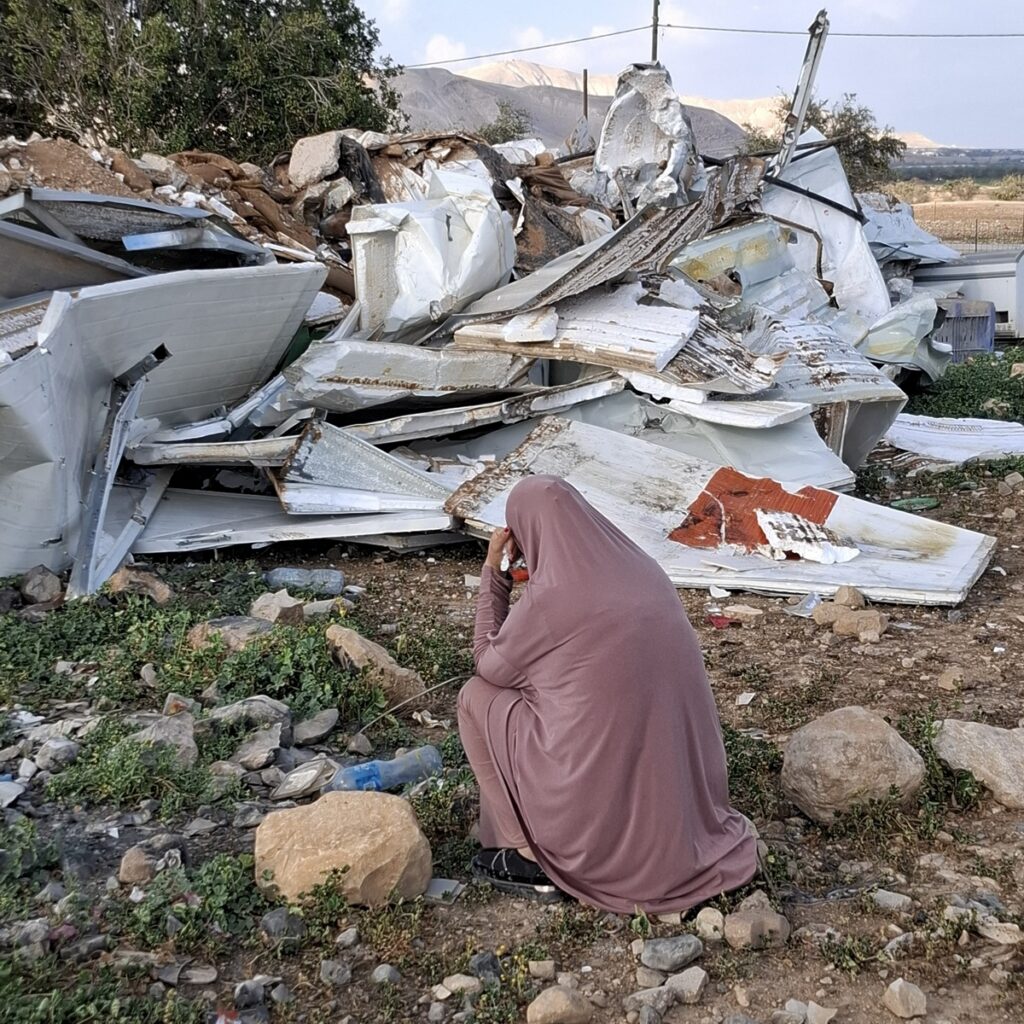
. Shoshi AnbarMay-18-2025Huwara: The old houses in Area C
-
Jerusalem
See all reports for this place-
The places in East Jerusalem which are visited routinely by MachsomWatch women are Silwan and Sheikh Jarrah. During the month of Ramadan, also the Old City and its environs are monitored.
-