
Huwwara
HUWWARA, Thursday 30 September 2004 AMObservers: Michal S., Naomi L., Asnat O.(reporting)Visitor: Doritcolour=red>We arrived at the checkpoint 07:00 to find it full of men and women detainees: we counted about 25 women and 30 men. Their numbers grew all the time.Around 10:00 there was a noticeable reduction in traffic through the checkpoint, but the number of detainees remained unchanged.At 11:00 we left the checkpoint following an incident with a volunteer reservist.Two new patterns seem to have emerged at the checkpoints: 1. The detention of young women — once an exception, recent reports indicate it is now a norm. 2. The opening of official police investigations against our members following complaints lodged by soldiers which have been disproportionate to actual events, and appear to have been driven by animosity to our activities.Immediately on our arrival, a volunteer reservist (A.H., we have his full name),in full army gear and carrying a rifle, ran towards us, shouting: “Show me your ID cards! Show me your IDs!!” He also shouted in the direction of the checkpoint commander, telling him “I’m afraid they might stab me.” The whole situation seemed comical – an armed and fully-equipped soldier, afraid of a few women armed only with sunglasses and mobile phones…But the very insanity of thesituation was seriously alarming to us , and we were really afraid. We spoke with the checkpoint commander, telling him that, as he was surely aware, Machsomwatch women come to the checkpoint every day on a regular basis. He ignored everything. The volunteer continued shouting that we must identify ourselves to him, and that he would not leave us alone until we did. We told him that we did not need to show our ID cards to soldiers. He started yelling at Michal, saying that he wasn’t sure that she was Jewish, and how would he know. Michal responded to him. But his mad reaction was to run to the checkpoint commander and demand that the police be called. The commander did indeed try to convince him to leave well alone and back down, but he didn’t push his point too strongly. The volunteer called the police, and we told the checkpoint commander that we were calling his superior officer, Captain I. We also called the army’s own “Humanitarian Hot Line” about the detainees, and mentioned this event as well. Another call was to the Army Spokesperson’s office.We were quite confident , believing – based on several previous Machsomwatch reports – that we had no obligation to show ID cards to soldiers, and that the law required us to identify ourselves only to the civilian police. Later we found out that this was apparently not the case!!!The volunteer refused to do his job while we were there! We, however, continued with our regular activity until 10:34, when the police arrived. The volunteer was asked to put his complaint in writing, and the police officers then asked Michal to wait at the checkpoint while they decided whether to take her into the Ariel police station for questioning on the alleged offence of “conduct insulting to a public servant.” At this point we called L.Y., a Machsomwatch member and lawyer who works in the area of civil rights; in addition to calming us down, she also told us that we were indeed obliged to present our ID cards on demand to soldiers at the checkpoints. We drove to the police station, recorded our statements and Michal was released on bail.
Huwwara
See all reports for this place-
The Huwwara checkpoint is an internal checkpoint south of the city of Nablus, at the intersection of Roads 60 and 5077 (between the settlements of Bracha and Itamar). This checkpoint was one of the four permanent checkpoints that closed on Nablus (Beit Furik and Awarta checkpoints to the east and the Beit Iba checkpoint to the west). It was a pedestrian-only barrier. As MachsomWatch volunteers, we watched therre since 2001 two shifts a day - morning and noon, the thousands of Palestinians leaving Nablus and waiting for hours in queues to reach anywhere else in the West Bank, from the other side of the checkpoint the destination could only be reached by public transport. In early June 2009, as part of the easing of Palestinian traffic in the West Bank, the checkpoint was opened to vehicular traffic. The passage was free, with occasional military presence in the guard tower. Also, there were vehicle inspections from time to time. Since the massacre on 7.10.2023, the checkpoint has been closed to Palestinians.
On February 26, 2023, about 400 settlers attacked the town's residents for 5 hours and set fire to property, such as houses and cars. Disturbances occurred in response to a shooting of two Jewish residents of Har Bracha by a Palestinian Terrorist. The soldiers stationed in the town did not prevent the arson and rescued Palestinian families from their homes only after they were set on fire. No one was punished and Finance Minister Smotrich stated that "the State of Israel should wipe out Hawara." Left and center organizations organized solidarity demonstrations and support actions for the residents of Hawara.Hawara continued to be in the headlines in all the months that followed: more pogroms by the settlers, attacks by Palestinians and a massive presence of the army in the town. It amounted to a de facto curfew of commerce and life in the center of the city. On October 5, 2023, MK Zvi established a Sukkah in the center of Hawara and hundreds of settlers backed the army blocked the main road and held prayers in the heart of the town all night and the next day. On Saturday, October 7, 23 The "Swords of Iron" war began with an attack by Hamas on settlements surrounding Gaza in the face of a poor presence of the IDF. Much criticism has been made of the withdrawal of military forces from the area surrounding Gaza and their placement in the West Bank, and in the Hawara and Samaria region in particular, as a shield for the settlers who were taking over and rioting.
On November 12, 2023, the first section of the Hawara bypass road intended for Israeli traffic only was opened. In this way, the settlers can bypass the road that goes through the center of Hawara, which is the main artery for traffic from the Nablus area to Ramallah and the south of the West Bank. For the construction of the road, the Civil Administration expropriated 406 dunams of private land belonging to Palestinians from the nearby villages. The settlers are not satisfied with this at the moment, and demand to also travel through Hawara itself in order to demonstrate presence and control.(updated November 2023)
.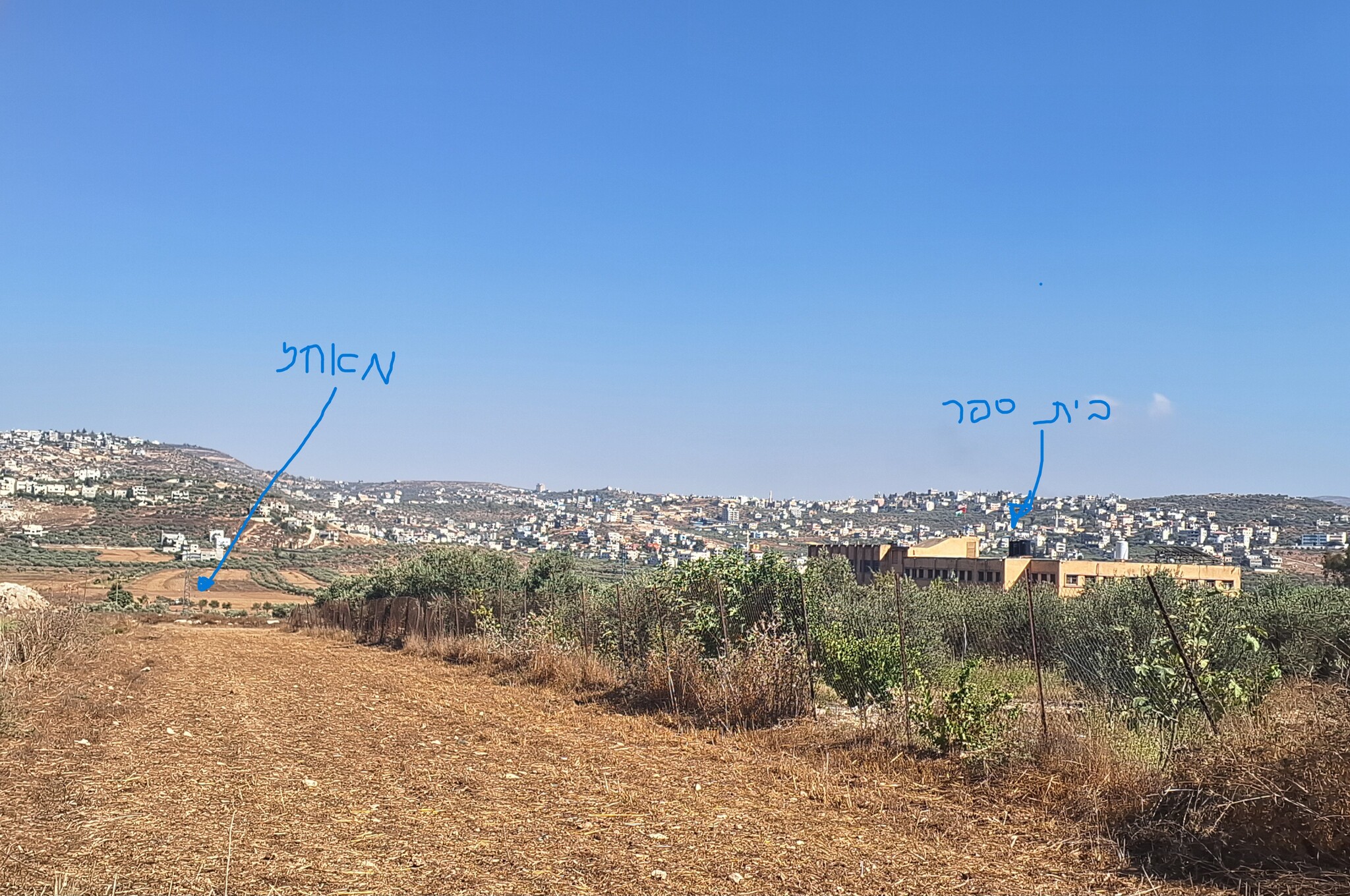 Ronit Dahan-RamatiAug-24-2026Huwara: The school on the outskirts of town and an outpost hidden among the trees
-
