
Huwwara
Huwwara, Monday 4 October 2004 Noon (10:45-13.50)Observers: Gal K., Orli P., Tal H., Aya K. (reporting)colour=red>There were relatively few people at the checkpoint but this only deepened the all-pervading ominous feeling: Are there new instructions? Are more people kept from moving about? More unannounced checkpoints ? Or are people simply giving up, adjusting to the existing possibilities? Closing up inside their appetite for life? And still – there is here a life force that Israel, through its uniformed and armed servants, cannot quench or crush.Huwwara NorthAn ambulance with a cancer patient from Nablus was waiting for permission ( so far denied) to transfer the patient to a private Israeli ambulance that had been waiting for him for over an hour. The reason for denying passage (according to the Jewish ambulance driver) was that the photo in the patient’s ID card did not really resemble him since his face was bloated from medication.The soldier seemed to be trying try to do something and consulted his superiors, who didn’t appear to welcome the idea…The private ambulance driver, an Israeli Jew, looking very upset, asked me who we were and said that this was his first time here, and he’d never seen anything like it : it was quite unbelievable… I told him about our duty, his and mine, to bear witness to what we see, to tell the truth. “No one will believe me”, he said.A military car stopped next to us: inside were two older high-ranking officers, who asked me very cordially if I know H., and how was she, and how much they were looking forward to meeting her. ( Later I find out they were scheduled to meet two Machsomwatch women who were to show them, at first hand , the horrors of the checkpoint .) I used the opportunity to tell him what had been, and was still, happening right in front of us. I tried to sound as non-judgmental as possible and praised the soldier who’d been “doing his best” but…. The officer seemed pleased at that and said, “Sure, what a terrible story, how could this soldier really resolve it , what an awful situation…” So I said, “Why don’t you get out of your car and take care of this case, you, the more responsible, senior officer… You have the authority, the maturity, the responsibility…” And he, his gaze never faltering, told me with such a sympathetic look that of course, he’d be right back, he just needed to drive over there, pointing to some near-by parking are , and off he went , not to return for a long while, accompanied by the Machsomwatch women whom he’d expected , and never asking or mentioning the ambulance and the cancer patient who was delayed for over an hour and who was indeed finally let through, with no top brass involved.At the detainees’ shed, 15 men were waiting , some for quite a long while [detainees are, typically, men aged from 16 to 30 or 35 who have no passage permits; their ID details are phoned through to the General Security Services (GSS, also known as the Shabak or the Shin Bet, the Hebrew acronym for the GSS) for checking against a central list of security suspects and the answers are then relayed back to the checkpoints. This cumbersome process can take considerable time, and that can be prolonged even more if the soldiers wait to accumulate a batch of ID cards before passing them on to the GSS , or if they behave in a similarly tardy manner at the end of the process, waiting until they have a batch of GSS clearances before they release individual detainees. Meanwhile, the detainees are virtually prisoners at the checkpoint where the soldiers retain the ID cards until the entire process is completed]. Because of the ambulance episode, according to the soldier, none of the ID card numbers had been transmitted for GSS clearance, so the detainees’ wait was likely to continue for much longer. As we know, if soldiers are “allowed” to detain people up to three [four, according to some claims] hours, which sucker of a soldier would settle for less? So what if it’s also possible to release them after five minutes or half an hour?! Some of the detainees were on their way to the District Coordinating Office (DCO) [the army section that handles civilian matters; it generally has representatives at the checkpoints ostensibly to alleviate the lot of the Palestinians] . They had stamped applications for magnetic cards [the first pre-requisite to getting almost any permit and in itself some indication of minimal security clearance]. This was the period of the Jewish High Holy Days and the DCO closed early, and so they were in a hurry. But this , of course, was of no concern to anyone!One of the detainees explained that if he didn’t make it in time, or even if he did but then couldn’t get through the paperwork, he’d be held on the way back as someone who’d left Nablus without a special permit and then he’d be detained again for hours!! We learned that in fact the ID details are sent through to the GSS by fax rather than by phone. Why? And today, on top of everything else, the fax at the GSS offices hadn’t been working properly so everything had been held up.A while later — the fax had been fixed. Hallelujah!!A soldier called one of the detainees over, and wrote down numbers. When we asked what the soldier had wanted, the detainee told us that the soldier had asked for his own cell phone number and that of his friend. Then, he said, he’d let him go. When we queried this with the soldier he said he had given the two number to the GSS, but they were still not letting the others go.Two points: How was a man seduced into disclosing his and his friend’s numbers? Second, according to the soldier, the GSS would not clear them all unless they received two phone numbers –?! (Why is this a condition ?) It seems clear that it is harassment that is behind all this and that any means towards that end are legitimate.A woman-soldier roughly ordered someone in the line to “Open! Open!” his luggage. He knelt, opened the bags, spread their entire contents on the ground, obeying her orders. She, meantime, was looking elsewhere, chatting with her friends, not giving him the time of day, not even glancing at him and his luggage . Time passed. He waited, not saying a word, his belongings spread out on the ground. Then she remembered , or perhaps her behaviour had been intentional anyway. She looked at him again, and, without having so much as glanced at his bags, told him to go ahead. He collected everything and passed on quickly.The “Blue and White” ladies came [a very “patriotic” nationalist group of woman who come to the checkpoints to “encourage the soldiers” and who have on occasion clashed with Machsomwatch women]. But this time their visit passed without incident.Huwwara South There were 10 detainees in the shed. One young man was sitting on the ground, outside the shed. The checkpoint commander inquired why he was there, the young man explained. “What?!” The soldier who’d been was chatting casually a moment ago, bellowed at him, “Get back in there!!” his face flushed, almost foaming at the mouth. “Get up!” The man got up, not hurriedly, and the soldier pushed him inside, and then for good measure pushed him some more. “Now! Now!”People on their way to a funeral were detained for an ID check.Newly-weds – he from Nablus, she from Jerusalem – on their way to Nablus so that the young bride ccould meet her new family. But no, she was not allowed into Nablus. No, and no and no: it can only become a possibility if she gets a special one-time DCO permit that can take at least three hours to reach her here. “Why?” she asked, getting the answer that people from Jerusalem may not visit Nablus. Because: ” We worry about her”, said the soldier. “Because Nablus is full of crazy terrorists and we’re afraid they’d kill her!” ” But I’m a doctor,” the young man added.” I’m a doctor.” Yet the answer remained the same,” No, and that’s it.” So they went away. ID checks on the detainees on both sides of the Huwwara checkpoint took at least two-and-a-half hours. We asked one of the soldiers why he thought this was so. He said that only lately he’d understood how it worked. Several days ago, about 20 minutes before the GSS shift changed, he’d sent them a number of ID numbers for checking. Within less than 20 minutes he’d received answers for all of them. The next time, he sent numbers to a shift that had just begun (and whose staff were in no hurry…) and the check lasted three hours!One of the detainees at the southern checkpoint had only a few hours earlier been released from an 11-day arrest. He asked us to help speed his release, arguing that he’d been checked anyway, since he’d been under arrest until now. He was in a hurry to get to Nablus and have a doctor check him, he said, since he’d been badly beaten in prison. The problem was that when he’d been released, he had not been given any release documents.Suddenly I realized this was not the first time I’d met a Palestinian who’d been under arrest for a week or two and then released without any official release papers. This is highly disturbing, because it seems to be systematic. Administrative detention, as evil and corrupt a system as it is, has certain procedures. Now there appears to be some extension of the evil, another method of arresting people and not registering them anywhere: for whatever is not registered, just did not occur. And if it did not occur, then anything may be done in this domain!A soldier beckoned a Palestinian who was waiting his turn in line to come closer. He checked his ID card , waited a bit, and then asked , poker-faced: “Got a special permit?” The man looked aghast. It obviously hadn’t occurred to him that he might need one. “Got a special permit?” the soldier repeated. “No,” replied the man, perplexed. “What permit?” “Just kidding! Go ahead!” laughed the soldier, and waved him through.
Huwwara
See all reports for this place-
The Huwwara checkpoint is an internal checkpoint south of the city of Nablus, at the intersection of Roads 60 and 5077 (between the settlements of Bracha and Itamar). This checkpoint was one of the four permanent checkpoints that closed on Nablus (Beit Furik and Awarta checkpoints to the east and the Beit Iba checkpoint to the west). It was a pedestrian-only barrier. As MachsomWatch volunteers, we watched therre since 2001 two shifts a day - morning and noon, the thousands of Palestinians leaving Nablus and waiting for hours in queues to reach anywhere else in the West Bank, from the other side of the checkpoint the destination could only be reached by public transport. In early June 2009, as part of the easing of Palestinian traffic in the West Bank, the checkpoint was opened to vehicular traffic. The passage was free, with occasional military presence in the guard tower. Also, there were vehicle inspections from time to time. Since the massacre on 7.10.2023, the checkpoint has been closed to Palestinians.
On February 26, 2023, about 400 settlers attacked the town's residents for 5 hours and set fire to property, such as houses and cars. Disturbances occurred in response to a shooting of two Jewish residents of Har Bracha by a Palestinian Terrorist. The soldiers stationed in the town did not prevent the arson and rescued Palestinian families from their homes only after they were set on fire. No one was punished and Finance Minister Smotrich stated that "the State of Israel should wipe out Hawara." Left and center organizations organized solidarity demonstrations and support actions for the residents of Hawara.Hawara continued to be in the headlines in all the months that followed: more pogroms by the settlers, attacks by Palestinians and a massive presence of the army in the town. It amounted to a de facto curfew of commerce and life in the center of the city. On October 5, 2023, MK Zvi established a Sukkah in the center of Hawara and hundreds of settlers backed the army blocked the main road and held prayers in the heart of the town all night and the next day. On Saturday, October 7, 23 The "Swords of Iron" war began with an attack by Hamas on settlements surrounding Gaza in the face of a poor presence of the IDF. Much criticism has been made of the withdrawal of military forces from the area surrounding Gaza and their placement in the West Bank, and in the Hawara and Samaria region in particular, as a shield for the settlers who were taking over and rioting.
On November 12, 2023, the first section of the Hawara bypass road intended for Israeli traffic only was opened. In this way, the settlers can bypass the road that goes through the center of Hawara, which is the main artery for traffic from the Nablus area to Ramallah and the south of the West Bank. For the construction of the road, the Civil Administration expropriated 406 dunams of private land belonging to Palestinians from the nearby villages. The settlers are not satisfied with this at the moment, and demand to also travel through Hawara itself in order to demonstrate presence and control.(updated November 2023)
.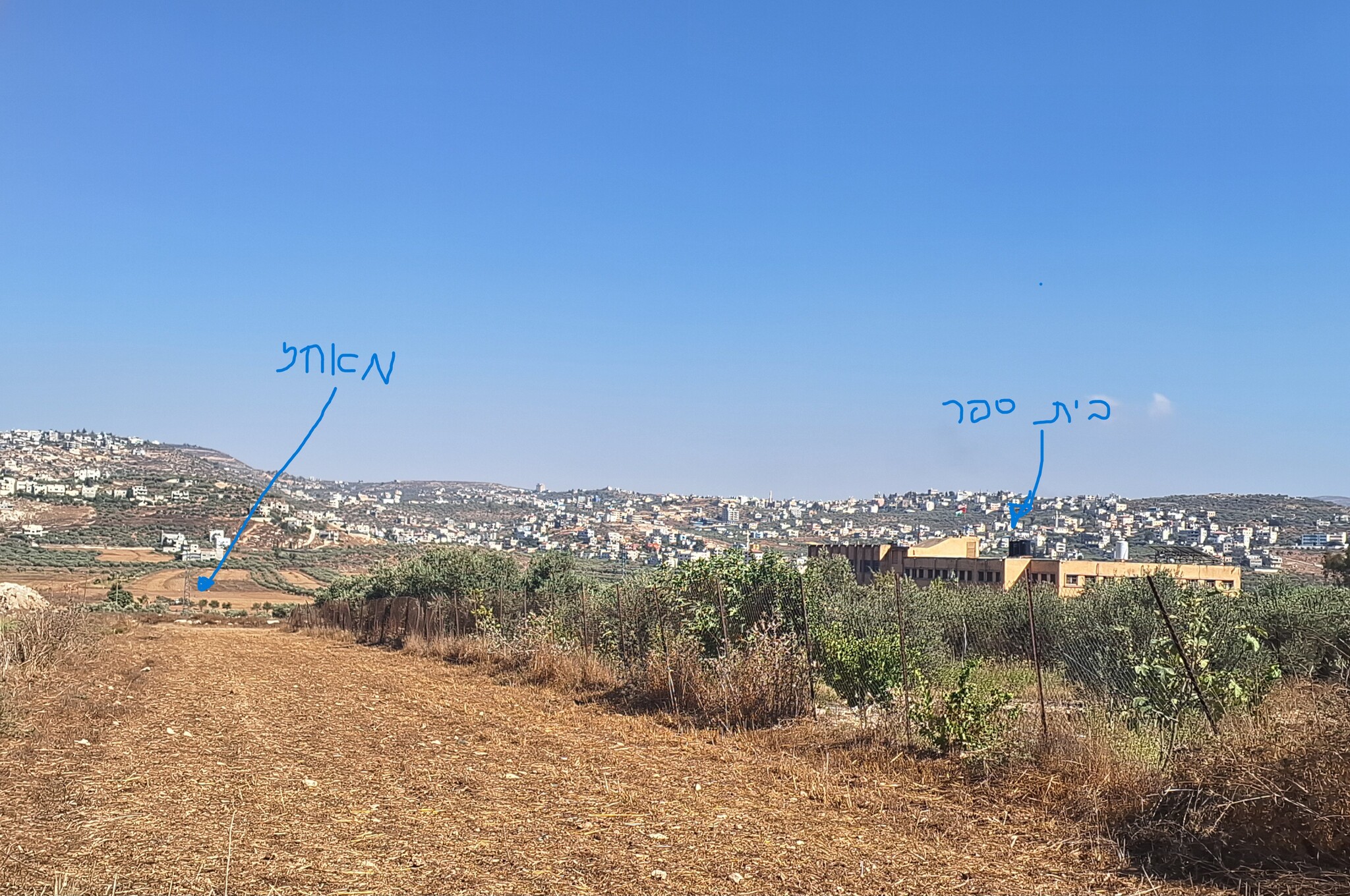 Ronit Dahan-RamatiAug-24-2026Huwara: The school on the outskirts of town and an outpost hidden among the trees
-
