
Huwwara
HUWWARA, Thursday 2 August 2004 AM Observers: Rina T., Nili L, Asnat O. (reporting)colour=red>Huwwara North Arriving at the checkpoint we saw 14 detainees, all of whom were released within an hour [detainees are, typically, men aged from 16 to 30 or 35 who have no passage permits; their ID details are phoned through to the General Security Services (GSS, also known as the Shabak or the Shin Bet, the Hebrew acronym for the GSS) for checking against a central list of security suspects and the answers are then relayed back to the checkpoints. This cumbersome process can take considerable time, and that can be prolonged even more if the soldiers wait to accumulate a batch of ID cards before passing them on to the GSS , or if they behave in a similarly tardy manner at the end of the process, waiting until they have a batch of GSS clearances before they release individual detainees. Meanwhile, the detainees are virtually prisoners at the checkpoint where the soldiers retain the ID cards until the entire process is completed]. Two women soldiers checked the women, while two male soldiers checked the men. The checkpoint was clearly in operation, and the women soldiers made extra sure that we were aware that they were combatants, just like the men. In fact, these specific soldiers were very blunt – even more than their male colleagues.As the checkpoint commander arrived to release the detainees, he stood behind the inspection position and, lowering his gaze, waited for everyone to be quiet: just like a schoolteacher, except for the lowered gaze, which clearly did not come from respect to the audience. He spoke very slowly, pausing occasionally, as if he were trying to catch someone talking or failing to concentrate, which would have been a good reason to stop the process there and then.Since only few people wanted to pass through this side, we went to Huwwara South.Huwwara SouthIt was a very tense shift: there were difficulty cases among the detainees and a lot of tension in the air – among the soldiers, between them and the Palestinians entering Nablus, and also between the soldiers and our Machsomwatch team. Throughout the shift there were 13-21 people in the detention area, some of whom had to wait an hour, and some much more, before clearance came through.At 08:00, a Palestinian tried to pass without showing his permit. A soldier ran after him, took his papers from him and sent him to the detention area, saying: “You’ll sit here all day for this!” After looking at the papers, the soldier added: “What a fool – he actually has a permit” [to pass through to Nablus].An hour-and-a-half later we asked the checkpoint commander if he could find out what was happening with this man . Without even looking, he told us the man was having further, more detailed screening. We asked him to check again if the required permit was among the man’s papers, and he said it was. We could do nothing further but wait. At 10:50, another group of detainees was released, and we again asked the checkpoint commander to check if the man’s permit was there. After we’d insisted on this a few times, he said that the permit was not to be found. To our question as to whether it had somehow got lost, the commander said: “No – it’s just not available right now.” We told him what the soldier who’d caught the man had said, and asked him to check whether this soldier was holding the man’s permit; at this point we were told that the soldier in question was presently manning a guard tower; but the commander said he would try to find out. We waited.At 11:20 we called the District Coordinating Office (DCO) to inform them about this detainee, and they promised to look into the matter [ the DCO is the army section that handles civilian matters; it generally has representatives at the checkpoints ostensibly to alleviate the lot of the Palestinians] . At 11:40 we spoke again with the checkpoint commander, who said he’d check on it. At 11:56 we called Captain I. , who answered very crudely that he would check on it, and hung up the phone. At 12:00 we called the army’s “humanitarian” hotline and spoke to E. who usually listens and really tries to help. He noted the details and said he’d look into it. We repeatedly asked the commander to check with the first soldier to see if he had the man’s permit and at 12:50, after the soldier had returned from guard duty, the permit was “magically” found. We asked to see it, and the commander showed it to us with a smile on his face. At 12:53, the detainee’s ID number was communicated to the GSS for security screening. We updated the “humanitarian” hotline, and eventually left for home, hoping that the man would be allowed to pass after this screening. By the time we left, he had waited five hours and could expect to wait at least another hour.If this wasn’t an example of detaining purely as punishment – I don’t know is.. How is it possible for a soldier to punish someone like this without the knowledge and approval of his commander? Below is another instance of the same soldier’s behavior, including a refusal to follow direct orders by a superior officer (from the DCO). In short – every soldier simply does what he deems fit.Given that the authority to punish, “teach them a lesson”, and scare people is apparently vested in every checkpoint soldier – it becomes difficult even for the commander to track each and every case on his shift. As he became available to deal with two Palestinians who (for whatever reason) were not allowed to enter Nablus, the soldier who’d been dealing with them turned to him and asked : “Why are you interfering in something that’s within my authority?” Such arguments occur regularly.Here are additional examples of violence on the part of the soldiers at the checkpoint:One of the soldiers called to a boy selling figs at the checkpoint: “Come here ‘Scary’ – I want to take you to D ” (the officer ). The child, scared, tried to walk away. The soldier caught him and said: “Now we’ll ask D. if what you said is true.” The boy, on the verge of tears, said: “D. hits, D. hits.” When they got to D, he was angry at the lad and asked crossly: “Is that what I said, ‘Scary’?” He grabbed the boy by the edges of his clothing, checked out of the corners of his eye to see if anyone (i.e. we) could see him, and then decided to let the boy go, contenting himself with a warning to him not to hang around the checkpoint.A soldier took two people’s papers – not detaining them, yet asking them to wait for him on the side of the road. The checkpoint commander arrived and asked them what they were doing there, to which they responded that their papers were with the soldier. To the commander’s question as to why he did not send them to the detainees’ area, the soldier said they did not need to be detained – they’d just got on his nerves.After we’d received many requests for help from Palestinians, and after we’d made several phone calls, the DCO officer finally arrived at the checkpoint. He allowed a young man accompanying his blind father to enter Nablus with him; permitted the husband of a 7-week pregnant woman who was bleeding to enter Nablus and go to the hospital with her; and let through a young man ( accompanied by his mother), who’s An-Najah student who wanted to hand in his registration papers which had earlier been rejected by the soldiers – (they’d claimed incorrectly that registration had ended).While the DCO officer dealt with these issues, a young man arrived and sat on the fence. The soldier whom we mentioned above, and who was now busy checking motor vehicles, crudely told the man to go away. When the man replied that he wanted to speak to the officer, the soldier went up to him and started pushing and shoving him with his body, his gun held close to his chest, slapping and shouting at him, too. The DCO officer told him to stop and said he would deal with the man. But the soldier continued shoving and hitting the Palestinian to get him to move away, in spite of another instruction from the DCO officer to go back to his regular duty. The Palestinian shouted back: “What do you want? I want to talk to the officer.” Suddenly, the soldier lifted his gun and pointed it towards the man’s belly – shouting at him to go away, his finger on the trigger. At this point I intervened and standing very close to the soldier, I asked him how he felt about this distance between us (this deliberate invasion of other people’s personal space is precisely the body language used by the soldiers themselves to the Palestinians). At that point the soldier tried to push me away, but I didn’t budge. He pushed me more strongly, but I still didn’t move.I didn’t notice exactly what happened at that point. Maybe the officer told him to go away, and possibly he just left on his own accord. But he returned a few minutes later, holding a pen and paper, and asked me (in a commanding tone) for my ID card. I refused to give it to him, and he left – only to return soon with officer D., who positioned himself extremely close to me (intimidation tactics?), demanding to see my ID card. I refused. He threatened to declare the checkpoint a “closed military area”, thereby making it inaccessible to Machsomwatch, and I replied that he might want to speak to everyone involved to find out what happened – before taking any drastic steps. D.’s answer was that it was sufficient for him to hear about this from his soldier. D. then left me alone and in the next 30 minutes conducted a kind of “field trial.” The soldier gave his version of the story, and the witness – the DCO officer – provided his version. After probing into the two conflicting versions for a long time (the soldier lied without missing a heartbeat), D. finally approached the accused (me) to help him figure out what happened. I told him that all these details were not so important, but he needed to know three things: (1) that the soldier had used physical violence against the Palestinian; (2) that the soldier had disobeyed a direct order from the only officer in the area, D., who had told him to leave the man alone; and (3) that the soldier had pointed his weapon at the man, with his finger on the trigger. After another discussion between the two officers, it was all over. We can only guess at the verdict, but D.’s subsequent demonstration to the soldier of the several ways of handling and pointing his weapon may provide a clue.As our shift continued, we noticed signs of stress in the behavior of one of the soldiers. One of the Palestinians seemed to upset him, and he lashed out at him: “You’d better be careful around me! I’m starting to get that shake.” From that moment on, the way he handled people changed. His face twitched and he started addressing them by the use of pantomime, smiling to them in irony. We couldn’t tell what had happened, but he must have been going through something very difficult. His transformation into a totally different person also happened during our shift a week ago. One didn’t need to be a psychologist to recognize that he needed help, and was about to break.
Huwwara
See all reports for this place-
The Huwwara checkpoint is an internal checkpoint south of the city of Nablus, at the intersection of Roads 60 and 5077 (between the settlements of Bracha and Itamar). This checkpoint was one of the four permanent checkpoints that closed on Nablus (Beit Furik and Awarta checkpoints to the east and the Beit Iba checkpoint to the west). It was a pedestrian-only barrier. As MachsomWatch volunteers, we watched therre since 2001 two shifts a day - morning and noon, the thousands of Palestinians leaving Nablus and waiting for hours in queues to reach anywhere else in the West Bank, from the other side of the checkpoint the destination could only be reached by public transport. In early June 2009, as part of the easing of Palestinian traffic in the West Bank, the checkpoint was opened to vehicular traffic. The passage was free, with occasional military presence in the guard tower. Also, there were vehicle inspections from time to time. Since the massacre on 7.10.2023, the checkpoint has been closed to Palestinians.
On February 26, 2023, about 400 settlers attacked the town's residents for 5 hours and set fire to property, such as houses and cars. Disturbances occurred in response to a shooting of two Jewish residents of Har Bracha by a Palestinian Terrorist. The soldiers stationed in the town did not prevent the arson and rescued Palestinian families from their homes only after they were set on fire. No one was punished and Finance Minister Smotrich stated that "the State of Israel should wipe out Hawara." Left and center organizations organized solidarity demonstrations and support actions for the residents of Hawara.Hawara continued to be in the headlines in all the months that followed: more pogroms by the settlers, attacks by Palestinians and a massive presence of the army in the town. It amounted to a de facto curfew of commerce and life in the center of the city. On October 5, 2023, MK Zvi established a Sukkah in the center of Hawara and hundreds of settlers backed the army blocked the main road and held prayers in the heart of the town all night and the next day. On Saturday, October 7, 23 The "Swords of Iron" war began with an attack by Hamas on settlements surrounding Gaza in the face of a poor presence of the IDF. Much criticism has been made of the withdrawal of military forces from the area surrounding Gaza and their placement in the West Bank, and in the Hawara and Samaria region in particular, as a shield for the settlers who were taking over and rioting.
On November 12, 2023, the first section of the Hawara bypass road intended for Israeli traffic only was opened. In this way, the settlers can bypass the road that goes through the center of Hawara, which is the main artery for traffic from the Nablus area to Ramallah and the south of the West Bank. For the construction of the road, the Civil Administration expropriated 406 dunams of private land belonging to Palestinians from the nearby villages. The settlers are not satisfied with this at the moment, and demand to also travel through Hawara itself in order to demonstrate presence and control.(updated November 2023)
.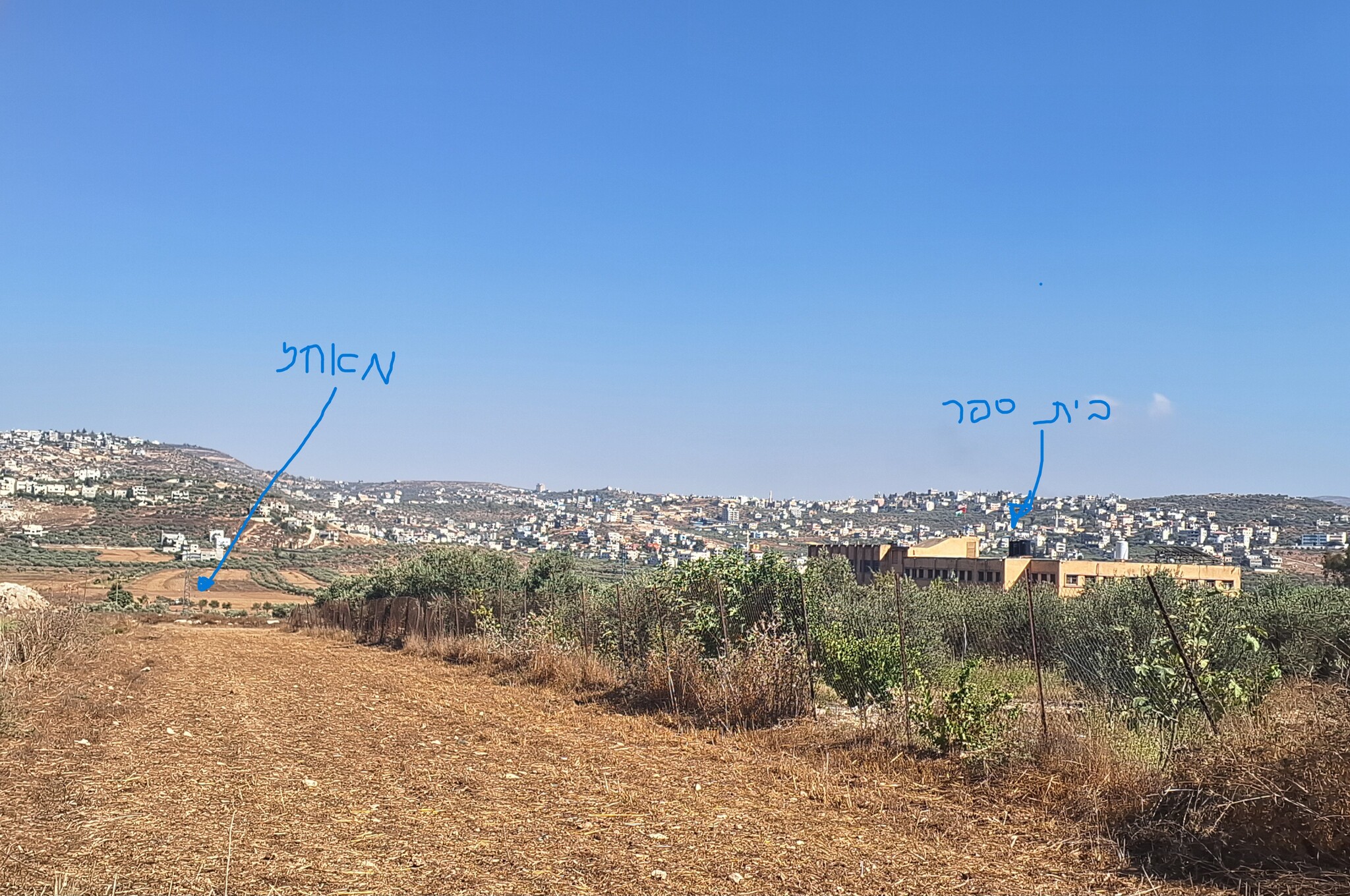 Ronit Dahan-RamatiAug-24-2026Huwara: The school on the outskirts of town and an outpost hidden among the trees
-
