
Huwwara
HUWWARA: Mustafa had called a day ahead, and asked for someone to meet and talk with us, and had received a positive answer. But the olive harvest is nearing the end of the season and every available person is busy getting the harvest in before the rainy season starts. So we waited about half an hour before R., the very busy secretary and treasurer of the Council, was able to sit with us. Later the head of the Council joined us also.
Huwwara is a town just south of Nablus, within the Nablus governorate. The population is about 7,000 people. The head of the Council, and the 11 Council members are all unpaid volunteers. Only the secretary, R., who works 7 hours every day is paid by the Palestinian Authority (as are school teachers). At the moment, the municipal budget is limited.
EDUCATION: The new school year has begun well. There are no problems, as of now, in the boys’ high school. However, provocations from settlers occur when the boys are on their way home from school, and then soldiers come. The boys have to be very careful.
The municipal library in town, which is open three days a week from 8 am till 2 pm, is used mainly by school children, especially during vacations. During vacations they have storytelling times for young children. It seems that adults don’t use the library: answering our question, the head of the Council said that grownups are busy working and “don’t need” [and perhaps don’t have time and energy for] the Library.
SPORTS in town are all organized privately and funded privately. They are not supported or organized through the Council. There is a sports field where boys—though not girls—can organize their own games. Our host said that girls stay home and help their mothers.
LEISURE ACTIVITIES: There are some cultural activities for children, like drama groups or writing groups, but not all the year round. These activities take place usually toward the end of the school year and during vacation.
We asked if any group of mothers and children had ever been on a visit to the seashore with Machsom Watch. The answer was no, but some people from town had been to the sea privately. These few people had received permits to enter Israel. Ana gave R. a page about the ‘Sea Days’ so that they might participate in that activity next summer.
PARKS: We read that in the area there is a municipal park we would be interested in seeing.[1] There wasn’t enough time to visit another village—and anyway, the councils are closed, as all are out harvesting—but a park might be nice to see. However, we found out that the park is only open later in the afternoon for school children.
THE ELDERLY: We asked Mustafa if there were Assisted Living homes for the elderly, such as we have in Israel. He said an emphatic NO. In Muslim culture, elderly parents continue to live with their children who have the duty to take care of all their parents’ needs.
Harassment: Olive harvest time is rife with harassments by settlers all over the Palestinian territories. A week before our visit, some armed settlers from Yitzhar came and chased some Huwwara harvesters out of their own olive grove. A little later, Israeli soldiers arrived to protect the settlers (From whom?!)
Owners of groves that are on land that is along the road to Yitzhar must obtain a permit from the Civil Administration for the days on which they are allowed to harvest. But the groves where the harvesters were chased away are not in an area requiring a permit. R., the secretary, brought us some copies of pages, all in Arabic, which they received from the Army; each of several groves in neighbouring villages are assigned dates in November on which harvesters with permits can pick their olives. It would seem to us that November is rather late in the year for harvesting.
More important, no opening or closing hours are mentioned, nor is there any building where soldiers will check farmers and their papers, as is usual in seasonal gates. After Mustafa translated one or two items, this seems a chaotic arrangement—- announcing dates to Palestinian farmers as well as to settlers. Farmers will be right in suspecting a trap-like situation where they can expect that while they are busy harvesting olives, they will be an easy target for violence from armed settlers.
In fact, the next day in Burin, harvesters fled from a group of threatening masked settlers. But a 80-year old Rabbi from Rabbis for Human Rights, who was there helping them, couldn’t run; his right hand was broken when these settlers threw stones at him. They shouted at him “next time we will kill you.”
We asked about the new projected road that we’ve been hearing about since May 2017 (see our Report 28.05.17). Israel will expropriate hundreds of dunams of agricultural land from a number of villages and from Huwarrah to build a new road for Israelis only. The Council head said that happily as yet no work has begun on the project nor has he been told when it will begin.
The council are considering installing solar panels to supply electricity for the whole town. That would be a great improvement on the present system: the links to the Israeli electrical company are old, and badly need renovation. This does not supply sufficient electrical power for the village. At last, they would have enough electricity for all their needs, including street lights, of which there are few or none now.
WOMEN’S ORGANIZATION. We found out there is a women’s organisation in town.[2] At our request, Mustafa called a number R. gave him, and we were asked to come to the girls’ school, where some of the women had a 2-hour meeting. We spoke with them and promised to call and arrange to meet them. We’re very interested in hearing about their activities, such as courses and workshops for women—flower decoration, arts—and trips.
[1] “Huwwara Town Profile,” ARJS. This is a very detailed booklet, published online by a Jerusalem Research Institute, which has published such booklets on other Nablus villages. It is funded by a Spanish agency
[2] The same internet source.
Huwwara
See all reports for this place-
The Huwwara checkpoint is an internal checkpoint south of the city of Nablus, at the intersection of Roads 60 and 5077 (between the settlements of Bracha and Itamar). This checkpoint was one of the four permanent checkpoints that closed on Nablus (Beit Furik and Awarta checkpoints to the east and the Beit Iba checkpoint to the west). It was a pedestrian-only barrier. As MachsomWatch volunteers, we watched therre since 2001 two shifts a day - morning and noon, the thousands of Palestinians leaving Nablus and waiting for hours in queues to reach anywhere else in the West Bank, from the other side of the checkpoint the destination could only be reached by public transport. In early June 2009, as part of the easing of Palestinian traffic in the West Bank, the checkpoint was opened to vehicular traffic. The passage was free, with occasional military presence in the guard tower. Also, there were vehicle inspections from time to time. Since the massacre on 7.10.2023, the checkpoint has been closed to Palestinians.
On February 26, 2023, about 400 settlers attacked the town's residents for 5 hours and set fire to property, such as houses and cars. Disturbances occurred in response to a shooting of two Jewish residents of Har Bracha by a Palestinian Terrorist. The soldiers stationed in the town did not prevent the arson and rescued Palestinian families from their homes only after they were set on fire. No one was punished and Finance Minister Smotrich stated that "the State of Israel should wipe out Hawara." Left and center organizations organized solidarity demonstrations and support actions for the residents of Hawara.Hawara continued to be in the headlines in all the months that followed: more pogroms by the settlers, attacks by Palestinians and a massive presence of the army in the town. It amounted to a de facto curfew of commerce and life in the center of the city. On October 5, 2023, MK Zvi established a Sukkah in the center of Hawara and hundreds of settlers backed the army blocked the main road and held prayers in the heart of the town all night and the next day. On Saturday, October 7, 23 The "Swords of Iron" war began with an attack by Hamas on settlements surrounding Gaza in the face of a poor presence of the IDF. Much criticism has been made of the withdrawal of military forces from the area surrounding Gaza and their placement in the West Bank, and in the Hawara and Samaria region in particular, as a shield for the settlers who were taking over and rioting.
On November 12, 2023, the first section of the Hawara bypass road intended for Israeli traffic only was opened. In this way, the settlers can bypass the road that goes through the center of Hawara, which is the main artery for traffic from the Nablus area to Ramallah and the south of the West Bank. For the construction of the road, the Civil Administration expropriated 406 dunams of private land belonging to Palestinians from the nearby villages. The settlers are not satisfied with this at the moment, and demand to also travel through Hawara itself in order to demonstrate presence and control.(updated November 2023)
.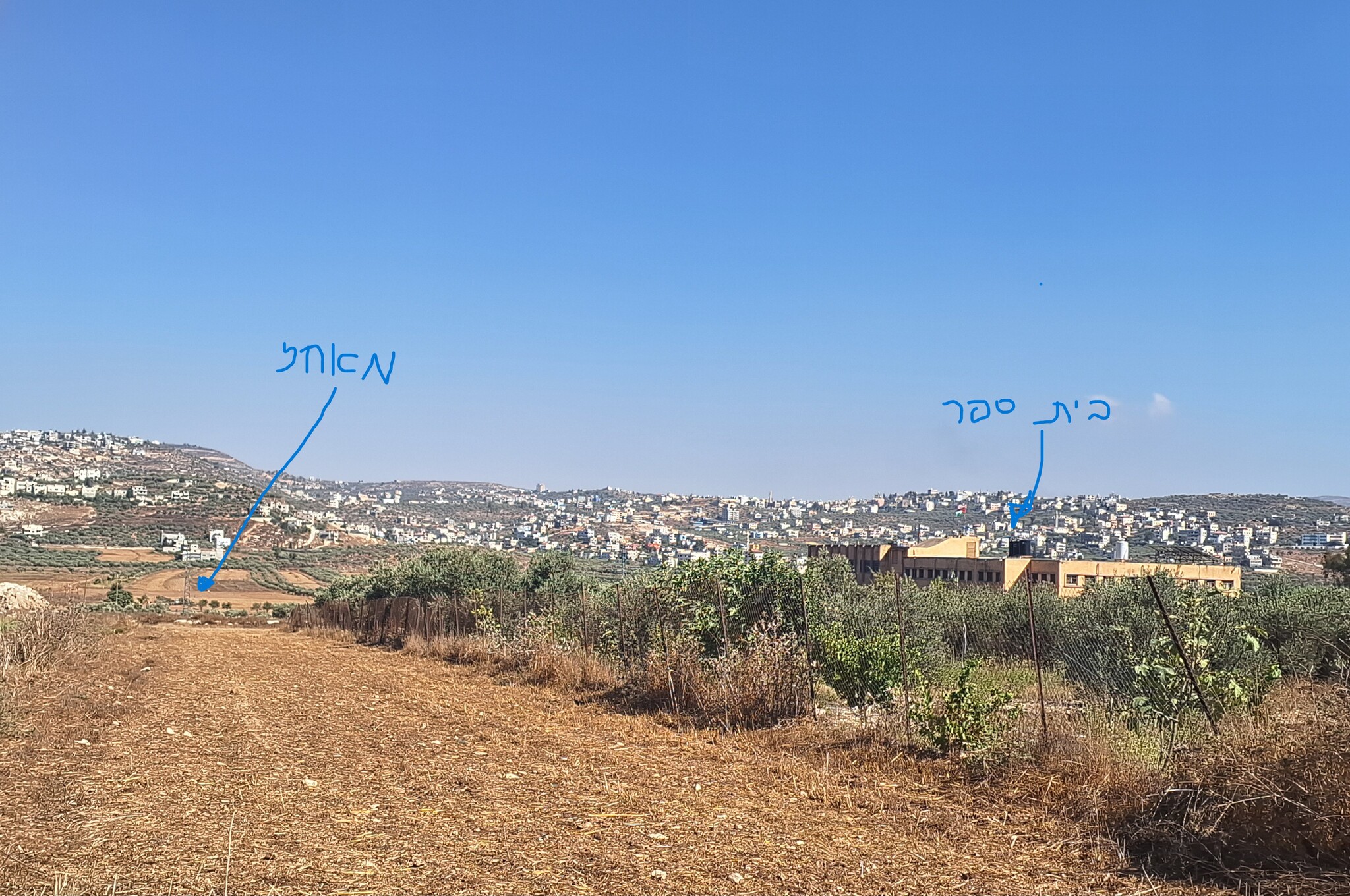 Ronit Dahan-RamatiAug-24-2026Huwara: The school on the outskirts of town and an outpost hidden among the trees
-
