
Huwwara
Huwwara ,Sunday , 3.4.05, PMObservers: Noa P., Naomi L., )who took notes).A rain drenched watch, terrible cold and the observance of regulations as if the subjects of these regulations were not human beings, and as if one couldn’t show more understanding and be more flexible. The soldiers will, not doubt be highly praised by their commanders.13.30 –, few people in the passages, all passing through the carousels, there are no humanitarian queues. There is no x-ray van which means that the checking will be done on the floor. A woman soldier with a dog arrives, in order to have the dog sniff around the area of the checkpoint and in the cars leaving Nablus. In the passage intended for those entering Nablus there is an electrical cable which blocks about half of the passage area. Although it is covered by a plastic hose for protection, it touches the bodies of those passing in groups of more than two, and this brings about a feeling of discomfort in us. An old woman, hardly able to walk, leaning on a cane on one side and on a young man on the other, panting heavily, stops near us to get her breath back. The Brigade Commander said: “just 150 meters”, while we measured about 400. For her it is more than a kilometer.A bus full of celebrators which arrives from Bethlehem wishes to enter in order to go to a wedding of a man from Bethlehem with a girl from Nablus. A group of dignitaries, among which is the priest, descend from the bus and implore the soldier to let them enter so as to enable them to pray in the church and celebrate. Although the passage is immediately accorded, something in their pleas and their body language makes us uneasy. The mother of the groom tells us that all the way they were afraid they would not be allowed to enter, and now that they entered they fear they would not be allowed to leave. She asks us to approach the bus to give us sweetmeats in honor of the occasion, but at that moment a torrent of rain begins which causes her to flee to the bus and us to seek protection under the shed of the roadblock. Everybody gets wet. A little girl stands in the rain and her father calls her to make her seek shelter under the shed. This is the first time we hear these words in another context, another language. It makes us shiver.Woman burdened with packages, herbs, clothes and all kinds of tools and utensils are asked to reveal the contents of the bags to the soldiers. “Did you see what we found yesterday? What, didn’t you watch the news?”, asks one of the soldiers. “After what has been found yesterday, you still are against the checkpoints?”. The previous Thursday bullets and cartridges were found in the bus. The driver was held for examination and since then his family has been looking for him and has no information as to what happened to him. A young man who arrives at the checkpoint asks the soldiers and us for any information regarding the driver. It’s from him that we learn about the incident. We said that we had no doubt that there are bullets and cartridges in Nablus, the question is where one looks for them and where one finds them. But we had the feeling we were wasting our words. 14.00 – Changing of the guards at the Hawarra checkpoint and everybody waits for the soldiers to stop giggling and to exchange hugs and experiences. The women’s queue is stopped for 15 minutes. About 60 people, women and children, are waiting in the cold.14.15 The queue becomes longer and longer, and the commander E’ says to us “the changing of the guards has not yet taken place”. Some of the people are already waiting for over 30 minutes. “There are hardly 30 people there” a soldier says. From where he stands he has no means of knowing how many people are waiting in the queue, he only sees the first row of people being pressed to the iron gates.14.20 A humanitarian queue is opened and the pressure is suddenly released. Women, children and old people stream out and hurry into the rain.The student which the Security Services (Shabak) wanted to enlist is again considered as wanted, and is held as a detainee. We meet him every Sunday there, “I am being detained here every day”‘ he says. After 15 minutes and a phone call to the Shabak he is released, this time smoothly.14.40 Winter has returned to Hawarra. It is extremely cold, the rain comes down in torrents, and we ask E’ to man the empty post so as to shorten, as much as possible, the waiting time of the people. “This is not necessary”‘ he says. Until they reach the taxis the people are soaked through and through.The humanitarian queue is closed, bars obstruct the passage. Everybody huddles under the roof of the checkpoint, which is of not much use as the strong wind pushes the rain into the shed. 14.51 A woman with a small girl and a screaming baby in her arms hands E’ an identity card and implores him in Arabic to let them pass. “Go back to the queue and wait until I call you”‘ he says in Hebrew which she does not understand, and making an unmistakable sign with her hand she returns to the carousels. She is fortunate in that the men show solidarity and let her push to the beginning of the queue.A representative of the Matak, walks around hands in his pockets and doesn’t do a thing! “Don’t tell me what to do, OK?” he reacts angrily when we ask him to do something to hasten up the passage of the people. He didn’t do a thing all the time, and when he was collected at 16.00 into the white jeep his absence was not felt. 15:00 Terrible rain, accompanied by hail and freezing cold. Because some of the people wait under the shed, the checking has stopped completely. Small children, shivering and freezing are hoarded between the concrete walls. The soldiers get wet too, step out from the check posts and enter the shed. Some of the men have had enough, and they push forward marching quickly. 15.15 Only two soldiers are checking, both freezing. Standing in the passageways, the electrical switches are not within their reach and the whole process of checking is further slowed down. From the farther carousels one hears cries and babies weeping. One father holding a baby, just a few months old, who passed about 15 minutes ago, waits for his wife who is stuck somewhere in the queue. He takes his coat off and winds it around the baby, who is covered in a woolen blanket. He himself remains clad in a thin shirt.The humanitarian queue is again closed.We contacted B’ (R’ is unavailable) and asked, considering the bad weather, to open a permanent humanitarian queue and to speed up the checking. He promised to find out. 15.43 – a group of men passed through the first row of carousels, and stands in front of the other group. E’ seems not to approve of this, and he directs the gun at the men, at eye level, from a distance of about 2 cms , all the while threatening that if they won’t go back none will pass. They don’t move from the place their have attained justly, even at the cost of a gun barrel which passes from one forehead to another. E’ announces that the “checkpoint is closed”. Ten minutes pass and nobody moves. Only after the Palestinians marched three steps backwards the checking process was resumed.Meanwhile there is no answer from the phones of the battalion commander, the deputy battalion commander and the spokesperson. A girl soldier from the Brigade Commander’s chambers directs us to the “spokeperson only” but there we get nothing but a recorded message.16.00 – about 200 persons are crowded next to the carousels. In a conversation between the deputy battalion commander and myself, after describing the events, he says that the ‘one by one’ – stems from a certain consideration” and we beg that the fact that there are hundreds of people waiting, in rain and cold, should also be a consideration of sorts. He promises to act to alleviate the situation.In the meantime there is again no humanitarian queue and whoever tries to pass from the side is sent back.16.15 The humanitarian queue is reopened. All the posts are manned and the pressure begins weaken. The in the weather too there seems to be a lull.16.30 Most of the people waiting have passed. Frozen to the core and wet we leave, our hearts heavy. At the Yitzhar Huarra junction, about five minutes drive away, there is a surprise checkpoint (which is already permanent) and a queue of 12 cars. Further on there is another checkpoint, this time manned by the police and the Yassam 8 cars.Perhaps somebody will be lucky today too and he will find a few bullets and cartridges to save his soul.
Huwwara
See all reports for this place-
The Huwwara checkpoint is an internal checkpoint south of the city of Nablus, at the intersection of Roads 60 and 5077 (between the settlements of Bracha and Itamar). This checkpoint was one of the four permanent checkpoints that closed on Nablus (Beit Furik and Awarta checkpoints to the east and the Beit Iba checkpoint to the west). It was a pedestrian-only barrier. As MachsomWatch volunteers, we watched therre since 2001 two shifts a day - morning and noon, the thousands of Palestinians leaving Nablus and waiting for hours in queues to reach anywhere else in the West Bank, from the other side of the checkpoint the destination could only be reached by public transport. In early June 2009, as part of the easing of Palestinian traffic in the West Bank, the checkpoint was opened to vehicular traffic. The passage was free, with occasional military presence in the guard tower. Also, there were vehicle inspections from time to time. Since the massacre on 7.10.2023, the checkpoint has been closed to Palestinians.
On February 26, 2023, about 400 settlers attacked the town's residents for 5 hours and set fire to property, such as houses and cars. Disturbances occurred in response to a shooting of two Jewish residents of Har Bracha by a Palestinian Terrorist. The soldiers stationed in the town did not prevent the arson and rescued Palestinian families from their homes only after they were set on fire. No one was punished and Finance Minister Smotrich stated that "the State of Israel should wipe out Hawara." Left and center organizations organized solidarity demonstrations and support actions for the residents of Hawara.Hawara continued to be in the headlines in all the months that followed: more pogroms by the settlers, attacks by Palestinians and a massive presence of the army in the town. It amounted to a de facto curfew of commerce and life in the center of the city. On October 5, 2023, MK Zvi established a Sukkah in the center of Hawara and hundreds of settlers backed the army blocked the main road and held prayers in the heart of the town all night and the next day. On Saturday, October 7, 23 The "Swords of Iron" war began with an attack by Hamas on settlements surrounding Gaza in the face of a poor presence of the IDF. Much criticism has been made of the withdrawal of military forces from the area surrounding Gaza and their placement in the West Bank, and in the Hawara and Samaria region in particular, as a shield for the settlers who were taking over and rioting.
On November 12, 2023, the first section of the Hawara bypass road intended for Israeli traffic only was opened. In this way, the settlers can bypass the road that goes through the center of Hawara, which is the main artery for traffic from the Nablus area to Ramallah and the south of the West Bank. For the construction of the road, the Civil Administration expropriated 406 dunams of private land belonging to Palestinians from the nearby villages. The settlers are not satisfied with this at the moment, and demand to also travel through Hawara itself in order to demonstrate presence and control.(updated November 2023)
.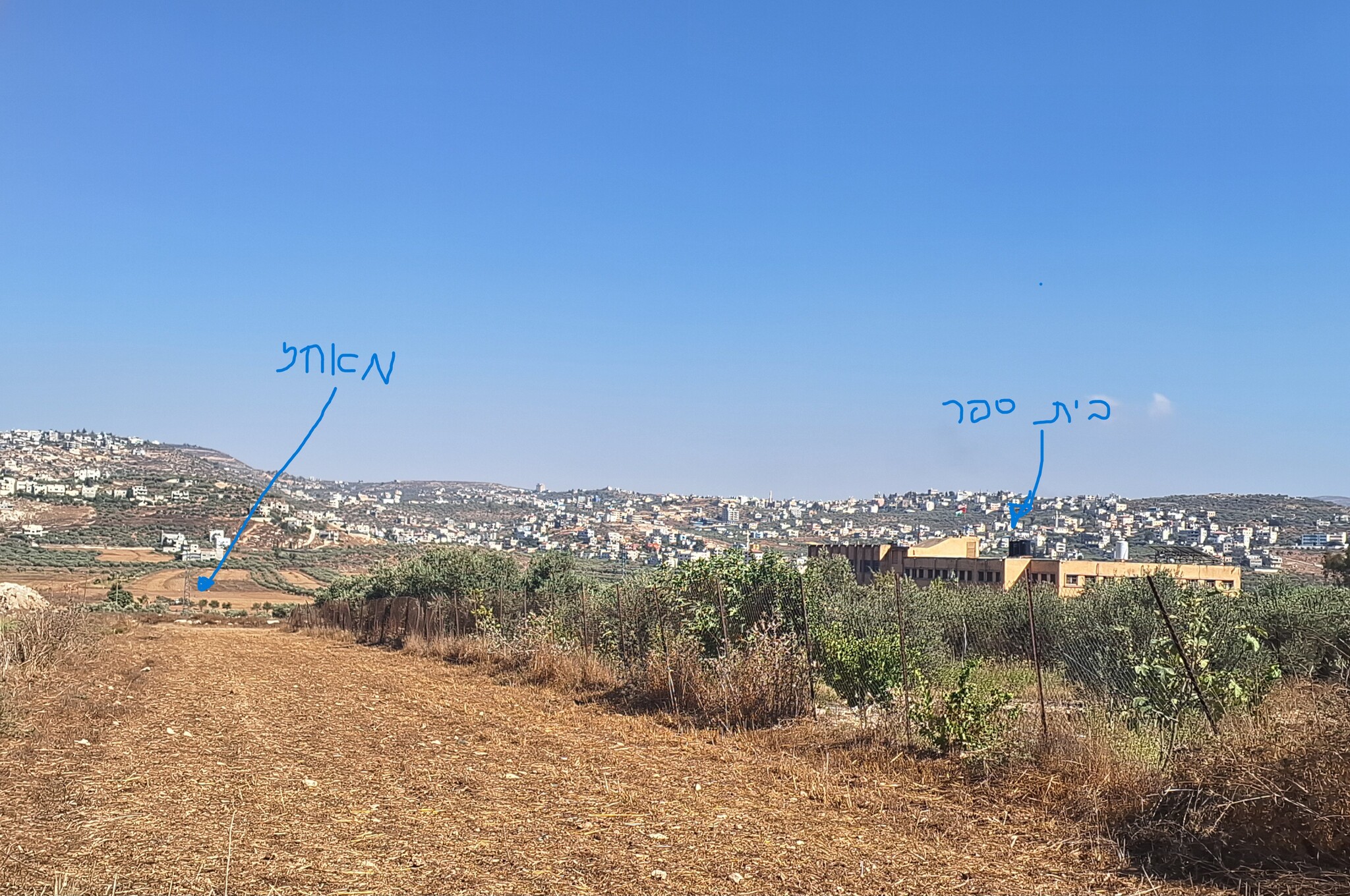 Ronit Dahan-RamatiAug-24-2026Huwara: The school on the outskirts of town and an outpost hidden among the trees
-
