
Huwwara AM
HUWWARA, Thursday 12 August 2004 AMObservers: Michal S. – photographing, Osnat A. (reporting from Huwwara North ); Rina T, Nava A (reporting from Huwwara South)Guest: Dorit A hard day at both checkpoints. The soldiers totally ignored the existence of anyone except themselves. We were invisible and the Palestinians were treated like cattle…the entire structure of the checkpoints had changed and we had the feeling that we have succeeded in inventing something which is not new – pens for human beings. The entire situation recalls cowsheds where farmers urge the cattle to go in for milking; and the tone of voice, too, is the same, and, to our shame, sometimes the words themselves……We were visited by women settlers, who distributed figs and coffee to the soldiers, and stood and checked what we were doing and told the soldiers: “Don’t be afraid of them. Do what you have to do.” Huwwara South The just-introduced revolving gates presented a real problem for anyone trying to go through with a large bag or a panful of cheese or sabras [the edible fruit of a local cactus].Release of detainees was very slow [detainees are typically young men aged from 16 to 30 who have no passage permits. The checkpoint soldiers phone their ID details to the General Security Services (GSS) which cross-checks them against a central list of security suspects and then phones the results back to the checkpoint. This cumbersome procedure, which often takes a long time, can take even longer if the checkpoint soldiers wait to accumulate a batch of ID cards before they contact the GSS, or if they wait to get back a batch from the GSS rather than releasing individuals as clearance comes through for each. During this time, the detainees are virtually prisoners at the checkpoints since the soldiers retain their ID cards until receiving GSS clearance ]. The communications network to the GSS was not operating and ID cards had to be sent to the northern side (the soldiers collected a few before transferring them) and there too there was a delayd. We contacted the District Co-ordinating Office (DCO) [the army section that handles civilian matters; it usually has representatives at the checkpoints, ostensibly to alleviate the lot of the Palestinians] who told us the soldiers were permitted to detain for up to four hours. Between 10.30 and 11.30 the number of detainees rose to 30, nobody had been released since 09.00. There were many detainees throughout the watch. Huwwara NorthWe arrived at 07.00 at a terrible checkpoint. Not that they were pleasant in the past; but now, the almost completed structure proclaimed: we are here to stay, and to harass more than in the past. Why more? The structure, with its galvanized tin roof (there are no walls) was divided by concrete barriers into long narrow lanes leading to a series of revolving gates which serve both to separate the soldiers from the line and to channel people as the soldiers see fit. The lanes are too narrow for comfort, but the gates are even worse. People being led by others, those carrying large bags, heavier people or those carrying children – all have to squeeze through, hang on to the revolving spikes and hope for the best.The military (and political) authorities have apparently decided that checkpoints are essential, but when the army plans a structure, surely they use some criteria of measurement, or even a construction engineer. Someone sat and planned this malice, this cruelty for its own sake, this lack of consideration, this inhumanity. After standing in the right line, after waiting and glimpsing from afar the soldiers’ hand gestures beckoning them on, and after going through the gate, only then were they checked. The soldiers ordered them: “Open! Open! Everything out!”. And if the Palestinian had several bags, or a suitcase or a parcel that the soldier didn’t feel like checking – he was ordered to step out of line and go back to be checked by the roadside where he had to empty out the contents onto the ground. And if he had the impudence to arrive with a baby carriage – he had to lift it over the fence and collect it on the other side – as happened today.The number of detainees ranged from 16 to 20 all the time. Two men detained at 07.30 were released only at 13.30. One had no permit and the other was a taxi driver who said the Israeli police had taken his papers. He had been caught not for trying to cross but because he was waiting in the line of taxis. At 11.20 we contacted the operations sergeant at the DCO who said a four-hour detention was allowed. We contacted the Israel army’s “humanitarian” hotline who said they’d deal with it; then we called the DCO again and they, too, now said they’d deal with it…we left at 12.00 hoping for the best. They were released at 13.30.A 13-year-old boy and his friends were arrested. The commander, D. told the child to sit in the detainees’ area. We talked to A., the DCO representative, who released the boy. The lad returned after some time because his friend had asked him to bring him something to eat. D. saw him and asked why he was outside. The child tried to explain that the other officer had released him. D. was angry, handcuffed him and put him in the punishment cell. The detainees then encouraged him to escape and we scolded them. They knew the soldiers would not hesitate to shoot. But the boy was persuaded and ran, but he soon came back. D. shackled him and placed him in the sun beside the watch tower while we prayed that nobody would beat up the silly child. D. interrogated him as to who had helped him escape (the soldiers told him we had done it)and then nobly allowed us to give him water to drink. We told him we didn’t need his permission. There was not much we could do to help.D. crouched on the outside of the fence and sprawled on the ground for a few minutes, observing the taxi area. Then suddenly, he burst forward , his rifle aimed at the taxis and their drivers who drove off in a panic. An hour later he did it again, hiding behind a vehicle on its way into Nablus and then bursting forward. Again the taxis were driven off at speed. One of the drivers was caught when his vehicle stalled. He was sent to the detainees’ area despite his pleading.At 10.20 several ID cards were finally ready for release. A soldier on his way to release the detainees was called back and told not to do it, but 15 minutes later he did release them. One of the soldiers kept shoving his hand into bags and cases, including women’s belongings, adding another humiliation to the process. A. worked well and quietly, so well that sometimes the other soldiers left him there and disappeared to have a cold drink or to telephone.D. checked a magnetic card [this testifies to a some degreee of security clearance and is essential to the granting of any other permit that the DCO might be asked to give] that a soldier had brought over to him. He pulled it out of its plastic casing and pushed it in with the ID. The holder will discover the damage only when it’s too late.
Huwwara
See all reports for this place-
The Huwwara checkpoint is an internal checkpoint south of the city of Nablus, at the intersection of Roads 60 and 5077 (between the settlements of Bracha and Itamar). This checkpoint was one of the four permanent checkpoints that closed on Nablus (Beit Furik and Awarta checkpoints to the east and the Beit Iba checkpoint to the west). It was a pedestrian-only barrier. As MachsomWatch volunteers, we watched therre since 2001 two shifts a day - morning and noon, the thousands of Palestinians leaving Nablus and waiting for hours in queues to reach anywhere else in the West Bank, from the other side of the checkpoint the destination could only be reached by public transport. In early June 2009, as part of the easing of Palestinian traffic in the West Bank, the checkpoint was opened to vehicular traffic. The passage was free, with occasional military presence in the guard tower. Also, there were vehicle inspections from time to time. Since the massacre on 7.10.2023, the checkpoint has been closed to Palestinians.
On February 26, 2023, about 400 settlers attacked the town's residents for 5 hours and set fire to property, such as houses and cars. Disturbances occurred in response to a shooting of two Jewish residents of Har Bracha by a Palestinian Terrorist. The soldiers stationed in the town did not prevent the arson and rescued Palestinian families from their homes only after they were set on fire. No one was punished and Finance Minister Smotrich stated that "the State of Israel should wipe out Hawara." Left and center organizations organized solidarity demonstrations and support actions for the residents of Hawara.Hawara continued to be in the headlines in all the months that followed: more pogroms by the settlers, attacks by Palestinians and a massive presence of the army in the town. It amounted to a de facto curfew of commerce and life in the center of the city. On October 5, 2023, MK Zvi established a Sukkah in the center of Hawara and hundreds of settlers backed the army blocked the main road and held prayers in the heart of the town all night and the next day. On Saturday, October 7, 23 The "Swords of Iron" war began with an attack by Hamas on settlements surrounding Gaza in the face of a poor presence of the IDF. Much criticism has been made of the withdrawal of military forces from the area surrounding Gaza and their placement in the West Bank, and in the Hawara and Samaria region in particular, as a shield for the settlers who were taking over and rioting.
On November 12, 2023, the first section of the Hawara bypass road intended for Israeli traffic only was opened. In this way, the settlers can bypass the road that goes through the center of Hawara, which is the main artery for traffic from the Nablus area to Ramallah and the south of the West Bank. For the construction of the road, the Civil Administration expropriated 406 dunams of private land belonging to Palestinians from the nearby villages. The settlers are not satisfied with this at the moment, and demand to also travel through Hawara itself in order to demonstrate presence and control.(updated November 2023)
.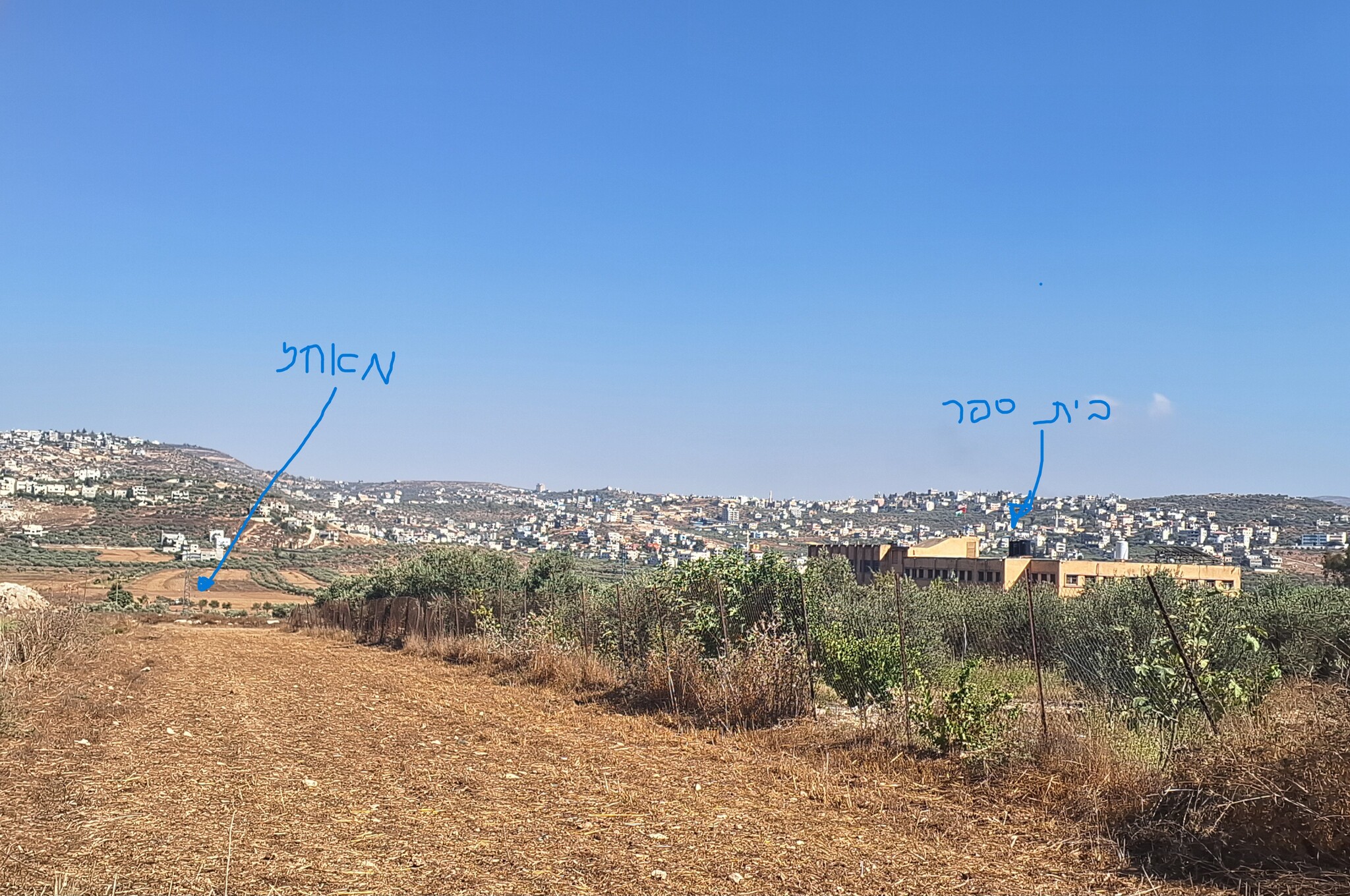 Ronit Dahan-RamatiAug-24-2026Huwara: The school on the outskirts of town and an outpost hidden among the trees
-
