
Huwwara AM
HUWWARA, Thursday 8 July 2004 AM Observers: Gili L., Michal S., Rina T., Tammy T., Osnat A. (reporting) colour= red>When we arrived there were five detainees at the southern checkpoint and five at the north. The numbers remained more or less constant throughout the watch and all were held for more than an hour and a half [in this time their ID card details were relayed by phone to the General Security Services (GSS, or, from the Hebrew acronym, Shabak or Shin Bet) where they were cross-checked against a list of security suspects. The answers were sent back to the checkpoint and then the detainees were either allowed through or sent back; in some cases, not necessarily this morning’s , detainees may be held and moved for further questioning. Throughout this period the detainees are virtual prisoners at the checkpoint since the soldiers hold their ID cards until the answers are given. This can take a considerable length of time, up to four hours is not that out of the ordinary ].At 07:45 a high school pupil arrived with a letter inviting him to an enrolment meeting at school at 09:00. He was detained for lack of a passage permit. His father, a teacher, told the District Co-ordinating Office (DCO) representative [ the DCO is the army section that handles civilian matters and usually has representatives at the checkpoints, ostensibly to alleviate the lot of the Palestinians] that the boy had only yesterday received a permit and an invitation from the school and he showed the soldiers all the documentation. The DCO representative wanted to let the lad through, but 2nd Lieut. D., the checkpoint commander, decided to detain him: “What’s going on here? Is this the first time he’s ever crossed a checkpoint!”.Several minutes later a family arrived: mother, father and an 18-month-old son sleeping in his father’s arms. D. drew the soldier K.’s attention to the fact that the father had no permit. The soldier agreed. “ Of course not! Otherwise, why would he be carrying the baby? It probably belongs to some other woman! ” he said , pointing to a group of women alongside! The family wanted to return home to Ramallah following urgent emergency surgery on the child, and they showed the stitches as well as producing a letter from the hospital. True, the father did not have a permit (when could he have got it? Before the ambulance arrived? Or while the child was undergoing surgery?). So D. decided to detain him and let the mother and child go home. The father, whose plea was translated by the DCO representative, said the mother didn’t know the way alone. “Then let her learn it!” came the answer from D.08:28: We talked to Captain Y., D.’s superior officer, and he said he’d check. Several minutes later D. got a telephone call.08:35: D. talked to the schoolboy and his father and asked the same questions all over again. The decision – the boy couldn’t go through until the GSS gave security clearance. 08:45: Father and son were released. The boy was late for his meeting. But what matter– it wasn’t D.’s appointment with an Israeli university that was in jeopardy . The family with the infant were still waiting in the detainees’ area, and went through only at 09:30.At 08:45, Border Policemen arrived and positioned themselves between the two sides of the checkpoint close to the northern side. They stopped women and men of all ages in random fashion, after they’d gone through and checked them all over again. An unannounced checkpoint inside a checkpoint – what creativity! To their credit, their checks were rapid. R., from the Border Police, told us they were sending details to the GSS, like the soldiers. D., when we asked why it took the Border Police only a few minutes and the soldiers hours, said that the Border Police didn’t check everyone, only one out of each group, and they also worked through different channels.R. said that on a normal day they checked four out of every six people and got replies after two or three minutes, “unless you check at what age he started eating cornflakes.” We remained puzzled about the discrepancy in the checking time between the army and the Border Police.
Huwwara
See all reports for this place-
The Huwwara checkpoint is an internal checkpoint south of the city of Nablus, at the intersection of Roads 60 and 5077 (between the settlements of Bracha and Itamar). This checkpoint was one of the four permanent checkpoints that closed on Nablus (Beit Furik and Awarta checkpoints to the east and the Beit Iba checkpoint to the west). It was a pedestrian-only barrier. As MachsomWatch volunteers, we watched therre since 2001 two shifts a day - morning and noon, the thousands of Palestinians leaving Nablus and waiting for hours in queues to reach anywhere else in the West Bank, from the other side of the checkpoint the destination could only be reached by public transport. In early June 2009, as part of the easing of Palestinian traffic in the West Bank, the checkpoint was opened to vehicular traffic. The passage was free, with occasional military presence in the guard tower. Also, there were vehicle inspections from time to time. Since the massacre on 7.10.2023, the checkpoint has been closed to Palestinians.
On February 26, 2023, about 400 settlers attacked the town's residents for 5 hours and set fire to property, such as houses and cars. Disturbances occurred in response to a shooting of two Jewish residents of Har Bracha by a Palestinian Terrorist. The soldiers stationed in the town did not prevent the arson and rescued Palestinian families from their homes only after they were set on fire. No one was punished and Finance Minister Smotrich stated that "the State of Israel should wipe out Hawara." Left and center organizations organized solidarity demonstrations and support actions for the residents of Hawara.Hawara continued to be in the headlines in all the months that followed: more pogroms by the settlers, attacks by Palestinians and a massive presence of the army in the town. It amounted to a de facto curfew of commerce and life in the center of the city. On October 5, 2023, MK Zvi established a Sukkah in the center of Hawara and hundreds of settlers backed the army blocked the main road and held prayers in the heart of the town all night and the next day. On Saturday, October 7, 23 The "Swords of Iron" war began with an attack by Hamas on settlements surrounding Gaza in the face of a poor presence of the IDF. Much criticism has been made of the withdrawal of military forces from the area surrounding Gaza and their placement in the West Bank, and in the Hawara and Samaria region in particular, as a shield for the settlers who were taking over and rioting.
On November 12, 2023, the first section of the Hawara bypass road intended for Israeli traffic only was opened. In this way, the settlers can bypass the road that goes through the center of Hawara, which is the main artery for traffic from the Nablus area to Ramallah and the south of the West Bank. For the construction of the road, the Civil Administration expropriated 406 dunams of private land belonging to Palestinians from the nearby villages. The settlers are not satisfied with this at the moment, and demand to also travel through Hawara itself in order to demonstrate presence and control.(updated November 2023)
.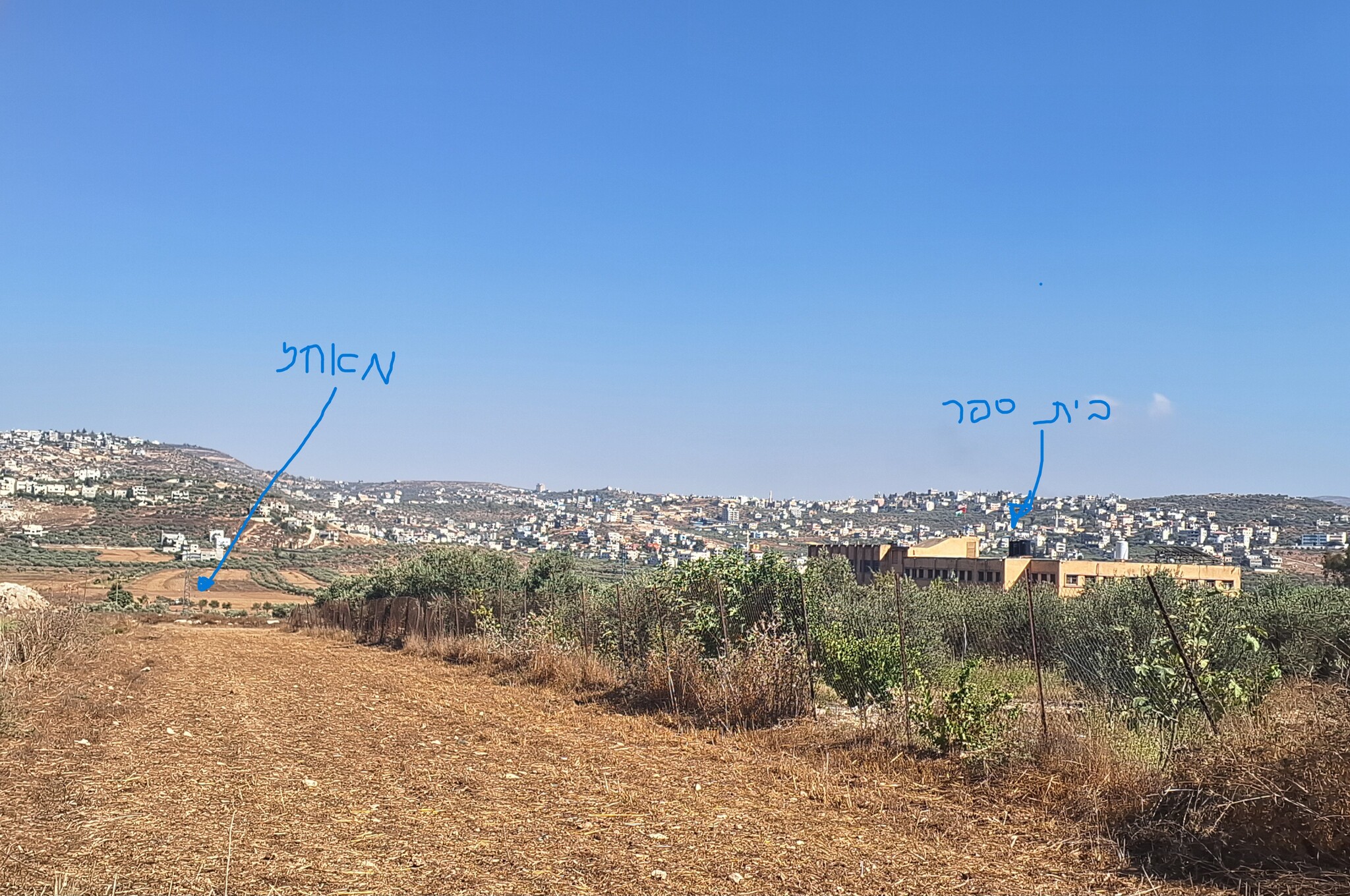 Ronit Dahan-RamatiAug-24-2026Huwara: The school on the outskirts of town and an outpost hidden among the trees
-
