
Huwwara & Beit Furik
Beit Furik and Hawwara, Thursday, 28.4.05, PMObservers: Sarah K., Gilad (guest)14:15 On our way to the checkpoints we meet many road-blocks. We find out that the settlers organized a big assembly in Homesh. The police and the army are there to keep the roads open for them. The road-blocks are located at the turn leading to Beit Iba checkpoint, Shavey Shomron and Dir Sharf.14:30 A long line of more than 30 vehicles wait at Shavey Shomron. Settlers are directed to park their cars in the settlement and ride a bus to Homesh.A policeman explains that he must detain Palestinian cars because a road jam was created on the way north. He releases them gradually.14:45 On our way from Beit Iba to Huwwara we pass Homesh. Hundreds of cars park along the road. “Thanks” to the assembly in Homesh we meet no road-blocks at Jit and Huawara junctions. 15:15 Beit Furik – only a few people reach the checkpoint. A computer helps the soldiers to check them quickly. One car is waiting to get out of Nablus. After 10 min wait it is checked and sent on. The commander answers our questions politely, reporting a quiet day with no special events. After half an hour we leave the checkpoint and turn for a short chat to taxi drivers parking on the road to the village of Beit Furik. They say that Thursday afternoon is always quiet. People are at home preparing their rest day.16:00 HuwwaraPeople enter Nablus without check. However, vehicles are checked. Sometimes people are not allowed out of Nablus although they were not checked on their way in. 2 palestinians holding Israeli IDs are detained because they entered Nablus without permission. They claim they did not know the rule forbidding them to do so. There is a sign in the checkpoint announcing this rule, but it is left on the floor nonprominent. 7 soldiers are at the checkpoint. 3 are MP including 2 female soldiers. They check passing people. A soldier hold constantly a gun directed toward the passing people. 2 soldiers stays close to the magnetic gates. They check big luggage. This creates a real bottleneck. It is not clear why people carrying luggage are not checked separately. All along the soldiers at the checking point cannot control the line behind the second farthest carousel. The soldier at the magnetic gate keeps calling them asking to push the button and release the carousels. The checkpoint commander keeps a quiet atmosphere at the checkpoint. He insists that we stay behind the checking point betonades whenever we start turning to different point at the checkpoint.16:00 A line of about 30 people wait behind the carousels. Women have a separate line and are quickly checked. A line of 6 vehicles in both directions: in and out of Nablus. One man is detained. He lives in East Jerusalem and holds an Israeli ID. The commander claims it is forged since the “menorah”, symbol of the state of Israel, is imprinted upside down. The police was informed and is supposed to come and check this man. He presents a membership card of the Wakf.16:15 an old woman faint close to the checking point. The soldiers bring immediately water and direct the woman to a passing ambulance.16:25 Vehicles are checked very slowly. 8 wait in the line. 2 female soldiers leave the checking point and only one soldier stays.16:30 The commander sends back one female soldier. A driver of a UN car comes forward out of the line. He is detained for a few minutes then is allowed to enter Nablus. A taxi is detained. The driver has entered Nablus in the morning without permission. He says that he entered Nablus and got out without problems the day before. The commander sends him to park his car and pass the checkpoint on foot, he and his family that wait in the car. 16:45 A long line of more than 70 men and 15 women was created due to the “bottleneck” at the magnetic gates. The commander directs elder men to a separate line and the load is reduced after a short while. A constant line of 5-6 cars wait on the two sides of the checkpoint.17:00 We call the Humanistic Center of the army. They check the issue of the taxi driver and support the commander’s decision. After more than an hour the driver decides to give up for now. Again, a long line of crowded men is created.17:10 The commander intervenes, start checking separately people without luggage and the load is reduced. We call the police station of Ariel to see why nobody comes to check the Israeli Palestinian from East Jerusalem. They say that they are “on their way”. The commander too keeps calling the police. He suggests the man should be released but is not permitted to do so.18:00 End of the shift for the MP soldiers. It takes them a few minutes to organize and leave the checkpoint. Meanwhile a line of 8 vehicles is created at the entrance to Nablus.18:10 Another Palestinian with an Israeli ID is detained on his way out of Nablus. We call again the police but this time they are impatient and tell us to let the soldiers take care. The soldiers do but the police is still busy.18:30 We leave the checkpoint on our way to collect the shift from Beit Iba. We take the phone number of the Palestinian waiting for the police. We call him at 19:30. He informs us that the police did not arrive till 19:10 and the commander decided to let them go.
Beit Iba
See all reports for this place-
A perimeter checkpoint west of the city of Nablus. Operated from 2001 to 2009 as one of the four permanent checkpoints closing on Nablus: Beit Furik and Awarta to the east and Hawara to the south. A pedestrian-only checkpoint, where MachsomWatch volunteers were present daily for several hours in the morning and afternoon to document the thousands of Palestinians waiting for hours in long queues with no shelter in the heat or rain, to leave the district city for anywhere else in the West Bank. From March 2009, as part of the easing of the Palestinian movement in the West Bank, it was abolished, without a trace, and without any adverse change in the security situation.
 Jun-4-2014Beit-Iba checkpoint 22.04.04
-
Huwwara
See all reports for this place-
The Huwwara checkpoint is an internal checkpoint south of the city of Nablus, at the intersection of Roads 60 and 5077 (between the settlements of Bracha and Itamar). This checkpoint was one of the four permanent checkpoints that closed on Nablus (Beit Furik and Awarta checkpoints to the east and the Beit Iba checkpoint to the west). It was a pedestrian-only barrier. As MachsomWatch volunteers, we watched therre since 2001 two shifts a day - morning and noon, the thousands of Palestinians leaving Nablus and waiting for hours in queues to reach anywhere else in the West Bank, from the other side of the checkpoint the destination could only be reached by public transport. In early June 2009, as part of the easing of Palestinian traffic in the West Bank, the checkpoint was opened to vehicular traffic. The passage was free, with occasional military presence in the guard tower. Also, there were vehicle inspections from time to time. Since the massacre on 7.10.2023, the checkpoint has been closed to Palestinians.
On February 26, 2023, about 400 settlers attacked the town's residents for 5 hours and set fire to property, such as houses and cars. Disturbances occurred in response to a shooting of two Jewish residents of Har Bracha by a Palestinian Terrorist. The soldiers stationed in the town did not prevent the arson and rescued Palestinian families from their homes only after they were set on fire. No one was punished and Finance Minister Smotrich stated that "the State of Israel should wipe out Hawara." Left and center organizations organized solidarity demonstrations and support actions for the residents of Hawara.Hawara continued to be in the headlines in all the months that followed: more pogroms by the settlers, attacks by Palestinians and a massive presence of the army in the town. It amounted to a de facto curfew of commerce and life in the center of the city. On October 5, 2023, MK Zvi established a Sukkah in the center of Hawara and hundreds of settlers backed the army blocked the main road and held prayers in the heart of the town all night and the next day. On Saturday, October 7, 23 The "Swords of Iron" war began with an attack by Hamas on settlements surrounding Gaza in the face of a poor presence of the IDF. Much criticism has been made of the withdrawal of military forces from the area surrounding Gaza and their placement in the West Bank, and in the Hawara and Samaria region in particular, as a shield for the settlers who were taking over and rioting.
On November 12, 2023, the first section of the Hawara bypass road intended for Israeli traffic only was opened. In this way, the settlers can bypass the road that goes through the center of Hawara, which is the main artery for traffic from the Nablus area to Ramallah and the south of the West Bank. For the construction of the road, the Civil Administration expropriated 406 dunams of private land belonging to Palestinians from the nearby villages. The settlers are not satisfied with this at the moment, and demand to also travel through Hawara itself in order to demonstrate presence and control.(updated November 2023)
.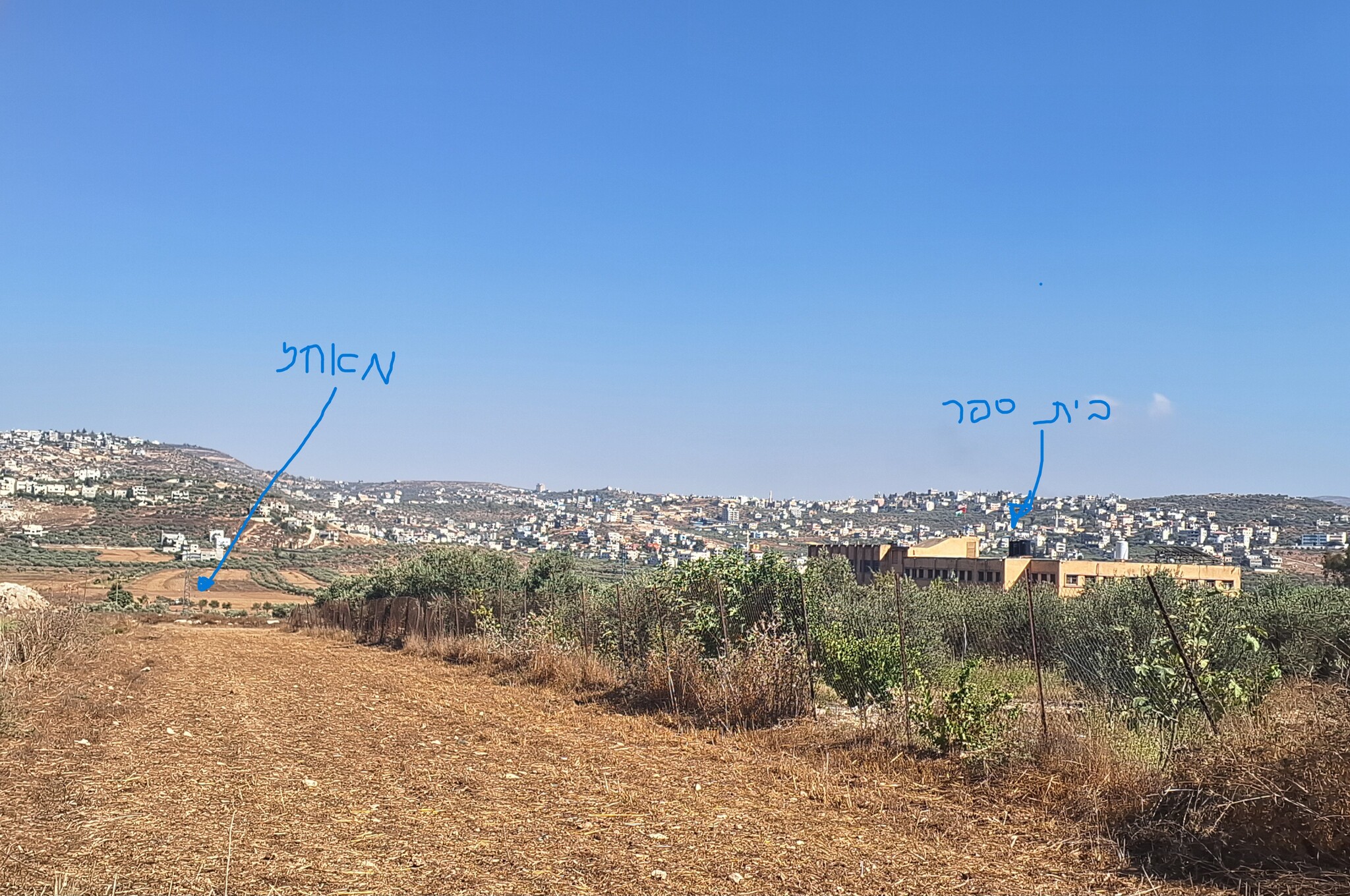 Ronit Dahan-RamatiAug-24-2026Huwara: The school on the outskirts of town and an outpost hidden among the trees
-
