
Huwwara, Beit Furik AM
HUWWARA, BEIT FURIK, Sunday 11 July 2004 AMObservers: Hanna L., Dina A. (reporting) and a guest, Jessica, a freelance writer for Bilt der Frau colour = red> Summary1. An unbearable shift – today we were approached mainly by “medical cases” – young men with proper medical papers, but no permits. We weren’t able to assist anybody – appointments were missed, check-ups and x-rays didn’t get done, stitches weren’t taken out. Nothing of life and death, everything of life. 2. Many cases of young and older women who wanted to go through accompanied by a son or a husband. The men were not allowed to pass and the women, regardless of their age or condition, were given a “feminist” lecture by soldiers of under 20 about going alone to the hospital. 3. Due to difficulties in Huwwara South we didn’t have enough time to monitor Huwwara North properly, and that side is usually even more difficult. 4. There was no shade and no water. The water containers had gone. We distributed bottles of water everywhere.07:45 — There was a Border Police checkpoint on Road no. 5, between Kafr Qassem and Rosh Ha’ayin. This is the first time we (and also N., our driver) have encountered a checkpoint on an Israeli road into the Occupied Territories; it created a huge traffic jam that held us up by 25 minutes.08:20 — Another checkpoint, this time manned by soldiers , next to the exit towards Elkana and Oranit (parallel to the permanent checkpoint for outgoing traffic from the territories). The soldiers seem tired and harassed despite the early morning hour.08:35 — Tapuah Junction There was a line of 31 vehicles, moving slowly but steadily.08:45 — Huwwara South It was already hot when we arrived and there was a line of 100 people. The soldiers were harsh and tough towards the Palestinians, and joked amongst themselves. There were nine detainees in the concrete “cage”. There was no shade and no water.As we walked down the line we were swamped with approaches – people arrived from all over as soon as they saw us, asking for attention and help even before they got to the soldiers. It was heartbreaking. Amongst the detainees were three young men with proper medical notes, but without permits .There was also a young woman in her 20s with a referral for a laser operation to remove kidney stones. She was on the verge of dehydration, as she’d been fasting since the previous night, and had now been waiting for over an hour in the blazing sun for her husband, who was not allowed to accompany her. We started to nag the District Co-ordinating Office (DCO) [the army section that handles civilian matters] , Physicians for Human Rights, D.B.[who co-ordinates medical services in the Occupied Territories], the hospital in Nablus, the woman’s doctor and the army’s “humanitarian” hotline . There, A. told me (after the habitual, patronizing query as to why it was at all necessary for a family member to accompany the woman) that next time “they” should know that together with the medical referral they had better make a special request for someone to go with them. We found a line in one of the medical papers in Arabic, specifying that patients undergoing this operation must be accompanied. But the checkpoint commander didn’t know Arabic. We went to the other side of the checkpoint, got the commander there, A., to give a translation and then returned – and still nothing had moved. By 11:00 the young husband called us to tell us that the General Security Services had not given him security clearance after checking his ID card details and he and his wife were going home — after all those hours. At 18:00 I received a phone call at home from the husband, who was talking from the hospital: he told me that they had decided to walk to another checkpoint and there they’d managed to get into an ambulance travelling to Nablus; they’d arrived at the hospital at the very last minute , but just in time for his wife to have the operation. Everything had gone well and we were the first ones to be informed.We were approached from all sides by people with medical references, but we couldn’t do anything. There were folk needing a sinusitis operation, removal of stitches, new wound dressings, an x-ray for a broken shoulder, help for a swollen ear, a gum operation etc. etc. An elderly grandmother, who was allowed through, begged and pleaded in Arabic that her grandson be given permission to come with her……again and again she beseeched them, but there was nothing doing. At 10:00 we came across a young woman with her two children and her mother – both women had Israeli ID cards with Nablus written there as their official place of residence; and it was to Nablus that they wanted to go. But the soldiers had refused them permission. . A phone call to the DCO brought the information that as Israelis who benefit from the Israeli Social Security law, they needed a special permit to enter Nablus. The young woman lost control, screamed, grabbed her mother and children and simply stormed through, leaving the soldiers quite at a loss ; they called their colleagues at Huwwara North to alert them to the imminent arrival of the woman and her family. What follows here is based on hearsay, since we left for Beit Furik and only on our way back did we learn that a huge row had developed in the area between the northern and southern sections of Huwwara checkpoint. A., the commander of Huwwara North had taken control , called for a DCO representative to come, and defused the tension, but not before the older woman had got hurt. By the time we returned, both women and the children were already sitting under the meagre shade of a military tower between the two sides of the checkpoint. A police officer was taking testimony from the older woman about the assault on her by a soldier. The soldier denied the woman’s charge , but DCO commander A., who made it a point to report to us “officially”, told us that a doctor had already been called in, had bandaged her leg and had given his testimony to the police. An Israeli ambulance had been called and the woman had been offered attention at an Israeli hospital but this she’d refused because she would either have had to pay or to sign an undertaking for future payment. Subsequently we learned that the older woman now lives in Shu’afat, and her daughter has been living in Belgium for the past four years. She’d come for a visit and both wanted to go see their big family in Nablus. They couldn’t grasp why they were denied entry to Nablus. The entire checkpoint operation seemed ludicrous to them – and, outraged, they’d simply decided to walk across. There was no calming the young woman who told me again and again: “They talked to me as if I were a dog!” Commander R. recommended a return home while the army handled their special request which, he said, could take several hours. But the two women refused : the trip to Nablus had already cost NIS100 and they could not afford to go back and then return. It was agreed that they could wait in the shade until receiving a permit for today. We bought water and some food for the children from vendors at the checkpoint..10:40 — Beit Furik There was no shade and no water, the soldiers were tough and harsh. Trucks were delayed for no apparent reason, “because now we check people, and everybody waits a little, there’s nothing to be done about it.” One truck driver claimed he’d been waiting for over an hour.There were seven detainees in the concrete “cage”, among them a young man who needed a check-up on a bandaged knee. The soldier ordered all the detainees to crouch down, and that included the man with the injured knee, who couldn’t manage — “So what?” was the soldier’s reaction. 11:45 — Tapuah junctionThere were 36 vehicles on line. In the outgoing lane our car, too, was stopped and our documents inspected.
Huwwara
See all reports for this place-
The Huwwara checkpoint is an internal checkpoint south of the city of Nablus, at the intersection of Roads 60 and 5077 (between the settlements of Bracha and Itamar). This checkpoint was one of the four permanent checkpoints that closed on Nablus (Beit Furik and Awarta checkpoints to the east and the Beit Iba checkpoint to the west). It was a pedestrian-only barrier. As MachsomWatch volunteers, we watched therre since 2001 two shifts a day - morning and noon, the thousands of Palestinians leaving Nablus and waiting for hours in queues to reach anywhere else in the West Bank, from the other side of the checkpoint the destination could only be reached by public transport. In early June 2009, as part of the easing of Palestinian traffic in the West Bank, the checkpoint was opened to vehicular traffic. The passage was free, with occasional military presence in the guard tower. Also, there were vehicle inspections from time to time. Since the massacre on 7.10.2023, the checkpoint has been closed to Palestinians.
On February 26, 2023, about 400 settlers attacked the town's residents for 5 hours and set fire to property, such as houses and cars. Disturbances occurred in response to a shooting of two Jewish residents of Har Bracha by a Palestinian Terrorist. The soldiers stationed in the town did not prevent the arson and rescued Palestinian families from their homes only after they were set on fire. No one was punished and Finance Minister Smotrich stated that "the State of Israel should wipe out Hawara." Left and center organizations organized solidarity demonstrations and support actions for the residents of Hawara.Hawara continued to be in the headlines in all the months that followed: more pogroms by the settlers, attacks by Palestinians and a massive presence of the army in the town. It amounted to a de facto curfew of commerce and life in the center of the city. On October 5, 2023, MK Zvi established a Sukkah in the center of Hawara and hundreds of settlers backed the army blocked the main road and held prayers in the heart of the town all night and the next day. On Saturday, October 7, 23 The "Swords of Iron" war began with an attack by Hamas on settlements surrounding Gaza in the face of a poor presence of the IDF. Much criticism has been made of the withdrawal of military forces from the area surrounding Gaza and their placement in the West Bank, and in the Hawara and Samaria region in particular, as a shield for the settlers who were taking over and rioting.
On November 12, 2023, the first section of the Hawara bypass road intended for Israeli traffic only was opened. In this way, the settlers can bypass the road that goes through the center of Hawara, which is the main artery for traffic from the Nablus area to Ramallah and the south of the West Bank. For the construction of the road, the Civil Administration expropriated 406 dunams of private land belonging to Palestinians from the nearby villages. The settlers are not satisfied with this at the moment, and demand to also travel through Hawara itself in order to demonstrate presence and control.(updated November 2023)
.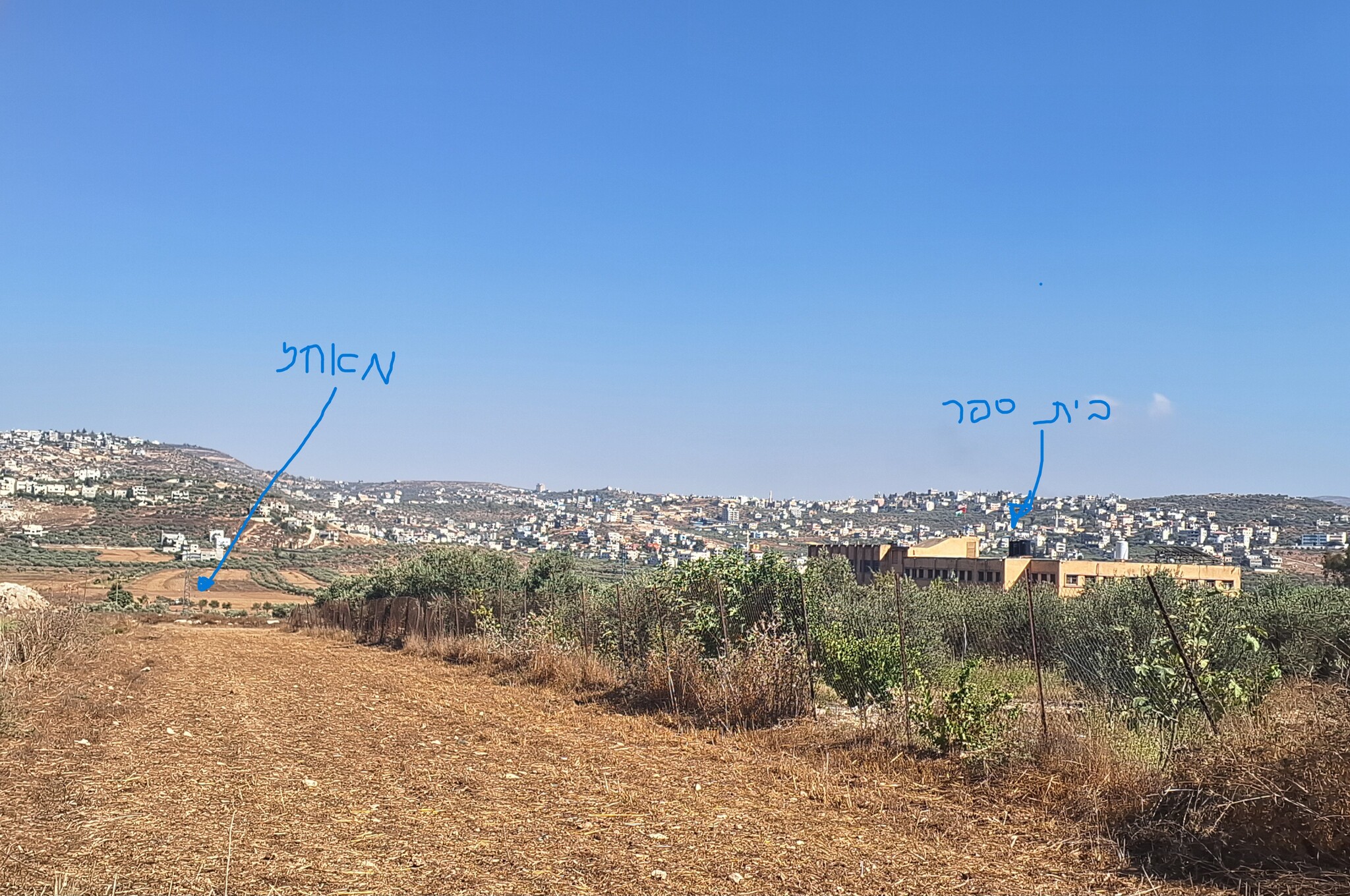 Ronit Dahan-RamatiAug-24-2026Huwara: The school on the outskirts of town and an outpost hidden among the trees
-
