
Huwwara, Beit Furik AM
HUWWARA and BEIT FURIK, Thursday 5 August 2004 AMObservers: Huwwara North: Michal S. (camera), Nili L. ( reporting); Huwwara South: Rina T., Asnat A (reporting); Beit Furik: all the above; Visitors: – Tami C. and an Israel TV Channel 1 crew (filming a documentary) colour =red>Huwwara SouthAs soon as we arrived we were greeted by U., the checkpoint commander, who said (with a perfectly serious expression): “Good morning! I’m U., the bad checkpoint commander from the newspaper article!” (on the previous Friday, Yediot Aharonot, one of Israel’s leading evening newspapers, had run a feature article on this soldier in its widely-read weekend supplement) At the end of the day, as the reporter had noted , “U. is no fool.” U. had seen himself as the world outside of his army unit sees him. Perhaps he’d read and been overwhelmed by the article. Perhaps friends or his parents had influenced him. What really matters is that it seems people around him are seeing the effects of these army duties on the psyche of their children / friends / family members. They don’t like it, and neither does he – perhaps he’s really understood…The checkpoint operated with no physical or verbal violence. The soldiers were courteous. They did stick to procedures as they are required to , somehow managing… but without being hostile. They even tried to help (within the limits of the rules, of course.) Where appropriate, they involved external bodies such as the District Co-ordinating Office (DCO) [the army section that handles civilian matters and generally has representatives at the checkpoints ostensibly to alleviate the lot of the Palestinians] and the police [to help provide security clearance for people who wanted to go through the checkpoint although they had no permits] . This was the first time that I’d met a checkpoint crew in the Nablus area that actively tried to help. It was also the first time, terrible though it seems, that I’d come across a crew all of whose members simply did their jobs humanely – without abusing the power they’d been given.Overall, there were only few people trying to pass through the checkpoint, and no real pressure throughout the time we were there. People were instructed to stand in three lines: “older men”, “youngsters” and women. Many of the “youngsters” (including some 34-year-old youngsters…) were detained , but did eventually go through. When the detainees strayed out of the detention area, soldiers instruct them to get back in. On one occasion a soldier said to a young man, “Get back into the ‘jora'” – an Arabic term meaning “sewage hole”, which is the soldiers’ slang for the detention area. That was the only incident of verbal violence we witnessed. A young couple arrived, holding a baby. The man had no permit, but the woman was allowed through with the baby, and they were (politely!) told that the man must be detained for security clearance – which should not take long. The woman refused to leave without her husband , and he said that she wouldn’t manage on her own. Several times she approached the soldiers and our group, trying to get the man released, and each time she was told it couldn’t be done until he was cleared. The soldiers tried to convince her to go ahead, and not keep her baby waiting in the hot sun, but she refused. They even found an older woman who was on her way to the same hospital to which the young family was going, and politely suggested to her that they could go together and let the man join them a little later. U. asked her, quite sincerely, “Why are you doing this to your baby?” but she refused to leave. Meanwhile , the man approached from the detainee area carrying his crying baby. The DCO representative arrived, checked his papers and released him. The same officer then proceeded to check three Jordanian women who worked in Nablus, and let them pass too.At 09:30, when the DCO representative was no longer there, we called the army’s “humanitarian” hotline about a Jordanian citizen, a pregnant woman, who needed some medical tests done in Nablus. The hotline representative, A., said he’d try to help, and called back after a few minutes to check if she could go to the DCO office to obtain a security pass (that would have taken a few hours…) I explained to him that this woman was in advanced stages of her pregnancy, and would need to use a lavatory quite frequently… (there’s not one to be found in a radius of a few kilometers from here…) A. managed to get her cleared within 15 minutes, and later called back to ensure all was well.07:00 — Huwwara North CheckpointThere was just a trickle of people going through and all was relatively quiet. Two detainees were awaiting GSS clearance. Construction was under way to provide shade from the sun. Soldiers’ positions and the detainees’ area were already covered. Building materials, including pieces of wood and metal, were strewn all over the place and presented a bit of a hazard despite attempts to move them aside. A make-shift iron gate closed off the detainees’ waiting area, and throughout the day we heard soldiers telling the detainees to wait inside without passing this barrier.The X-ray truck used last week to check bags and suitcases had vanished. It had removed the need for the degrading ritual of emptying plastic bags, hand-bags and suitcases on the floor for all to see. The feeling was that at least it had helped protect the privacy of the people being checked. When we asked about it, one of the soldiers said the truck been here yesterday, but he had no idea if it was supposed to arrive at any point today.08:00A TV crew from Israel Television’s Channel 1 arrived. Chaim Yavin, veteran anchorman and reporter was preparing a documentary including Tami C. and her daughter – a “second generation to the Palmach” [the underground mainstream Jewish commando units from the days of the British Mandate whose members formed the backbone of the Israeli Army when the state came into being in May 1948]. We noticed some change of attitude among the soldiers checking security passes. Rifles – typically pointed by the soldiers at the Palestinians leaving Nablus as they checked their papers and belongings- were suddenly not visible. As the TV crew left at 08:40, the rifles were back in their familiar position – pointing towards the bodies and heads of men, women, children and elderly people. Meanwhile , one of those detained at 07:00 was released, and two hours later, four new detainees arrived. One was accompanied by his father and presented a referral from a psychiatrist to go to a clinic in Jericho; they ended up waiting 40 minutes for clearance. Another detainee was a person we’d seen many time already. He is a psychologist and has a work permit, but not the official passage permit. The soldier claimed that he didn’t even have a permit to enter Nablus in the first place, and he wondered how it happened that he was now trying to leave Nablus. The soldier said (half-seriously and half in joke) that he didn’t care if the man waited 13 hours. At the end he was cleared for passage after one hour.At 09:00, there were more people detained, but they were released after a relatively short wait. One man without a pass was told by the soldier: “Get out of here – go home!” The soldier than added:- “He should get the hell out of here! Had I known better Arabic I’d have cursed him till he cried!”10:00 –There were two new detainees – a man and his daughter. The man claimed his daughter had a medical problem with her hair, but we couldn’t understand what was the matter. The DCO representative talked to him and told us that he was on the list of people prevented from passing for security reasons. On top of this, the DCO man said, they had seen a doctor yesterday and there was nothing wrong with the girl. They were released after an hour and allowed to pass. Two additional detainees, a man and his young son, were also released after about an hour.At 11:00 a truly extraordinary thing happened: a soldier offered water to the detainees. He filled a water bottle and handed it to them.The presence of our camera and notepads provokes aggressive behaviour towards us by one of the soldiers, S. It began with sly remarks and then became more violent. Thus, he told one of the detainees who asked to talk to the officer in charge, “You cannot talk to any officer – only to them” and he pointed at us and added : “Write that in your notepad.” Later he approached us again and said: “You should know that because of you these detainees suffer here.” Then he turned to the detainees and said: “Turn around or I’ll kick you in the head!” and, turning to me again : “Go on—write that down!” I felt he was distressed, but was trying to tell us that he wasn’t afraid of us. I approached the checkpoint commander and told him what had happened. At first he defended the soldier and asked us to leave the checkpoint, but later he agreed to listen and eventually talked to the soldier himself . During that conversation the soldier said: “They keep looking at me.” The commander told him to ignore us…Beit Furik12:00 — On the way home we passed through Beit Furik. There were three detainees, and very little traffic. The soldiers had little to do.
Huwwara
See all reports for this place-
The Huwwara checkpoint is an internal checkpoint south of the city of Nablus, at the intersection of Roads 60 and 5077 (between the settlements of Bracha and Itamar). This checkpoint was one of the four permanent checkpoints that closed on Nablus (Beit Furik and Awarta checkpoints to the east and the Beit Iba checkpoint to the west). It was a pedestrian-only barrier. As MachsomWatch volunteers, we watched therre since 2001 two shifts a day - morning and noon, the thousands of Palestinians leaving Nablus and waiting for hours in queues to reach anywhere else in the West Bank, from the other side of the checkpoint the destination could only be reached by public transport. In early June 2009, as part of the easing of Palestinian traffic in the West Bank, the checkpoint was opened to vehicular traffic. The passage was free, with occasional military presence in the guard tower. Also, there were vehicle inspections from time to time. Since the massacre on 7.10.2023, the checkpoint has been closed to Palestinians.
On February 26, 2023, about 400 settlers attacked the town's residents for 5 hours and set fire to property, such as houses and cars. Disturbances occurred in response to a shooting of two Jewish residents of Har Bracha by a Palestinian Terrorist. The soldiers stationed in the town did not prevent the arson and rescued Palestinian families from their homes only after they were set on fire. No one was punished and Finance Minister Smotrich stated that "the State of Israel should wipe out Hawara." Left and center organizations organized solidarity demonstrations and support actions for the residents of Hawara.Hawara continued to be in the headlines in all the months that followed: more pogroms by the settlers, attacks by Palestinians and a massive presence of the army in the town. It amounted to a de facto curfew of commerce and life in the center of the city. On October 5, 2023, MK Zvi established a Sukkah in the center of Hawara and hundreds of settlers backed the army blocked the main road and held prayers in the heart of the town all night and the next day. On Saturday, October 7, 23 The "Swords of Iron" war began with an attack by Hamas on settlements surrounding Gaza in the face of a poor presence of the IDF. Much criticism has been made of the withdrawal of military forces from the area surrounding Gaza and their placement in the West Bank, and in the Hawara and Samaria region in particular, as a shield for the settlers who were taking over and rioting.
On November 12, 2023, the first section of the Hawara bypass road intended for Israeli traffic only was opened. In this way, the settlers can bypass the road that goes through the center of Hawara, which is the main artery for traffic from the Nablus area to Ramallah and the south of the West Bank. For the construction of the road, the Civil Administration expropriated 406 dunams of private land belonging to Palestinians from the nearby villages. The settlers are not satisfied with this at the moment, and demand to also travel through Hawara itself in order to demonstrate presence and control.(updated November 2023)
.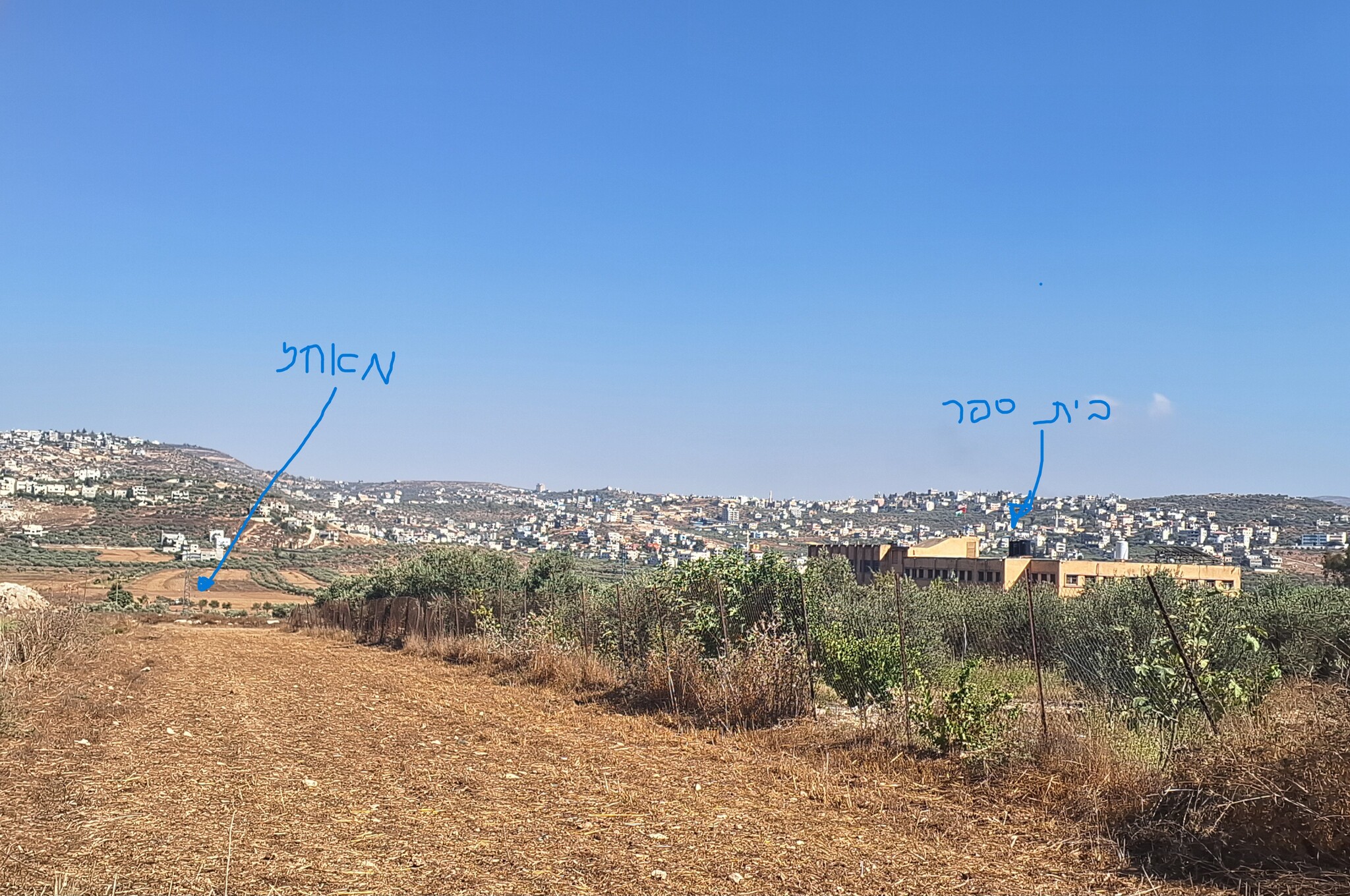 Ronit Dahan-RamatiAug-24-2026Huwara: The school on the outskirts of town and an outpost hidden among the trees
-
