
Huwwara, Beit Furik AM
HUWWARA, BEIT FURIK, Wednesday 4 August 2004 AMObservers: Michal P., Orit B., Shalva C., Yehudit V., Hanna A., Iris R., Tal A., Miri K., Tushka K., and Klil Z. (reporting) The watch was marked by the arrest of our driver, who was new Machsomwatch.08.30 – Huwwara North There was only a short line, traffic was flowing, and there were 11 detainees who’d been waiting for between one and two hours [detainees are typically men aged between 16 and 30 or 35 who lack passage permits; the ID details are relayed by phone from the checkpoint to the General Security Services (GSS) where they are cross-checked against a central list of security suspects; the results are then phoned back to the checkpoint; this cumbersome process can take a long time and the wait can be made even longer if the checkpoint soldiers first accumulate a batch of ID cards before relaying them to the GSS, or if they wait for a similar batch to come back from checking before they release individuals; throughout this time, the detainees are virtually held prisoner at the checkpoint because the soldiers retain their ID cards until the results of the check are through]. One of the innovations was a massive concrete structure with very thick walls: the northern part is a room for the controlled explosion of devices and explosive belts; the southern part is a cell with an iron door. The soldiers explained that it was meant only for exceptional cases of unruly and uncontrollable conduct. However, one of the soldiers did shove a frightened young man in and closed the door. When I asked why, he shouted: “Don’t interfere!” Several minutes later he released the young man , saying : “Your car can suddenly start ? All of a sudden you’ve got a battery?”Another innovation: a mobile scanning device loaded onto a large vehicle, so that people going through the checkpoint don’t have to empty out the contents of their bags and cases on the tables. The vehicle’s radio was playing loud music to entertain the soldiers while they worked. At 09.00, six detainees were released. One was a van driver who’d parked alongside the taxis although vans aren’t allowed to park so close to the checkpoint. But parking at a distance made it hard for him to ply his trade (transporting passengers). He told us his wife had asked him to bring rice and bread home for the family. His keys were confiscated for half an hour and he was released thanks to Shalva’s intercession.Four ambulances were checked rapidly and went through. An empty armoured vehicle was standing by the watch-tower, only one checking position was operating and the soldier was working fast; he often let women through without checking their ID cards . He shouted at one woman, dressed elegantly in pink: “Pink panther, come on!” To me, he said: “You’re pampering the terrorists today!” At 10.00 another six detainees were released and the soldiers joked about the cold drinks we’d distributed to the people waiting. A little later, a soldier noticed some movement on the hill and summoned his comrades. They looked through the rifle sights but saw nobody there.At 10.30 we learned that our driver, M-T, who’s a cousin of our regular driver, N., had been detained at a nearby checkpoint. We didn’t understand why, but on the way back he told us that he’d passed the checkpoint and stopped when a soldier waved a hand at him, and then he’d found himself detained for two hours with his keys confiscated. Shalva and Michal called the District Co-ordinating Office (DCO), Knesset Member Roman Bronfman and others [the DCO is the army section that handles civilian matters; it usually has representatives at the checkpoints, ostensibly to alleviate the lot of the Palestinians]. The DCO officer at Huwwara North, A., also helped, though at first the commander there refused to talk to us. The soldiers claimed M-T had “run riot”, adding later that he’d been “cheeky”. They summoned the [Israeli] police and when Shalva and Klil arrived, he was being questioned by two policemen. They too were angry that he’d argued with them and they examined his ID card , checked the vehicle and threatened him with a ticket. In the end they sent him on his way.Hanna, on the north side, saw 50 detainees at 11.00. All their ID details had passed muster and they were released after several minutes.Huwwara South — observers: Shalva C. and Hanna A. (reporting)A shelter had been built for the detainees, of whom there were two. One, due to be married tomorrow, was accompanied by his mother and fiancée en route to Nablus for final arrangements. The other was with his father en route to hospital. Twenty minutes after our arrival they were allowed through. We noticed a clear division of responsibility – the soldiers let through all those who didn’t seem questionable. When they weren’t sure, they sent people to Sergeant A. for clarification. He worked rapidly, between cars and pedestrians, and dealt with the soldier’s questions. We noted the following cases of him exercising his “discretion”A man with a peaked cap went through after A. had asked him to remove the cap in case there was something hidden there. A young man presented a permit, apparently to visit a hospital ; A. asked him how much money he had on him: the man took out his wallet and showed him; A. said it wasn’t enough for hospital and didn’t let him through. Ten minutes later he changed his mind. A psychologist from an organization in Nablus that treats children came over to us because he’d been barred from proceeding ; when A. saw this he took away his ID card.At 10:25 there were five detainees at Huwwara South, one of them was a diabetic, another had a referral to the neurological clinic at the hospital.A soldier kicked a Palestinian who kept trying to go through. Shalva went over to A. to call his attention to what had happened , but he burst out furiously at us. It turns out he was angry at an article that had appeared a week ago in one of Israel’s mass circulation evening papers that was highly critical of the behaviour of some soldiers at the checkpoints. He charged that we let Palestinians through behind the backs of the soldiers.Beit Furik – observers:Michal P., Yehudit V. (reporting)There were no detainees waiting here and the few pedestrians went through without delay. Lieut. N., who is familiar to us, speaks Arabic but adhered to regulations and was inflexible. An old woman with a Jordanian passport wanted to go into Nablus. N. refused, but the checkpoint commander let her through. One young man was detained for a very short while (15 minutes) and released after having been checked by the commander. Another was also released after an immediate check. Lieut. A, the commander, was courteous and welcoming When Michal and Yehudit talked about our views, he and another soldier listened, but one of the two women soldiers interrupted and shouted: “You should be killed.”_______________________________________
Huwwara
See all reports for this place-
The Huwwara checkpoint is an internal checkpoint south of the city of Nablus, at the intersection of Roads 60 and 5077 (between the settlements of Bracha and Itamar). This checkpoint was one of the four permanent checkpoints that closed on Nablus (Beit Furik and Awarta checkpoints to the east and the Beit Iba checkpoint to the west). It was a pedestrian-only barrier. As MachsomWatch volunteers, we watched therre since 2001 two shifts a day - morning and noon, the thousands of Palestinians leaving Nablus and waiting for hours in queues to reach anywhere else in the West Bank, from the other side of the checkpoint the destination could only be reached by public transport. In early June 2009, as part of the easing of Palestinian traffic in the West Bank, the checkpoint was opened to vehicular traffic. The passage was free, with occasional military presence in the guard tower. Also, there were vehicle inspections from time to time. Since the massacre on 7.10.2023, the checkpoint has been closed to Palestinians.
On February 26, 2023, about 400 settlers attacked the town's residents for 5 hours and set fire to property, such as houses and cars. Disturbances occurred in response to a shooting of two Jewish residents of Har Bracha by a Palestinian Terrorist. The soldiers stationed in the town did not prevent the arson and rescued Palestinian families from their homes only after they were set on fire. No one was punished and Finance Minister Smotrich stated that "the State of Israel should wipe out Hawara." Left and center organizations organized solidarity demonstrations and support actions for the residents of Hawara.Hawara continued to be in the headlines in all the months that followed: more pogroms by the settlers, attacks by Palestinians and a massive presence of the army in the town. It amounted to a de facto curfew of commerce and life in the center of the city. On October 5, 2023, MK Zvi established a Sukkah in the center of Hawara and hundreds of settlers backed the army blocked the main road and held prayers in the heart of the town all night and the next day. On Saturday, October 7, 23 The "Swords of Iron" war began with an attack by Hamas on settlements surrounding Gaza in the face of a poor presence of the IDF. Much criticism has been made of the withdrawal of military forces from the area surrounding Gaza and their placement in the West Bank, and in the Hawara and Samaria region in particular, as a shield for the settlers who were taking over and rioting.
On November 12, 2023, the first section of the Hawara bypass road intended for Israeli traffic only was opened. In this way, the settlers can bypass the road that goes through the center of Hawara, which is the main artery for traffic from the Nablus area to Ramallah and the south of the West Bank. For the construction of the road, the Civil Administration expropriated 406 dunams of private land belonging to Palestinians from the nearby villages. The settlers are not satisfied with this at the moment, and demand to also travel through Hawara itself in order to demonstrate presence and control.(updated November 2023)
.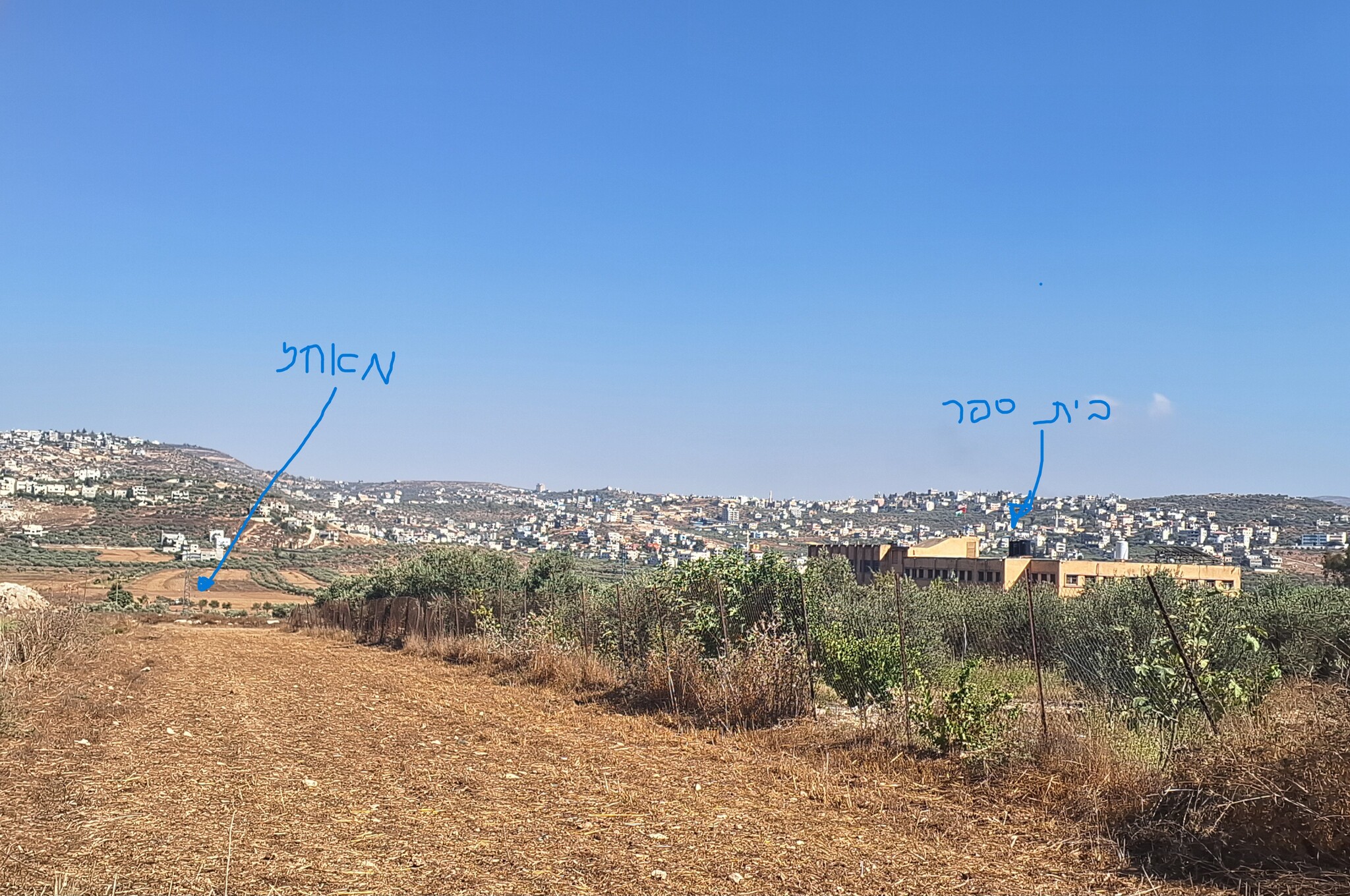 Ronit Dahan-RamatiAug-24-2026Huwara: The school on the outskirts of town and an outpost hidden among the trees
-
