
Huwwara, Beit Furik AM
HUWWARA, BEIT FURIK, Monday 16 August 2004 AM Observers: Suzi M., Shira G., Tal H., Ina M. (reporting) Nablus was under closure (probably because of recent events) – entry into the town was allowed at Huwwara South (with the usual restrictions), but no one was allowed to leave.The Beit Furik checkpoint was officially closed, although a few special exceptions were made. As routine activity was close to non-existent , we had time to look at the physical changes (more and more construction…) and talk to soldiers..Huwwara SouthWe arrived before 11:00 and found that because of the closure there was a nearly empty checkpoint. There were about 17 detainees in the “pen” [detainees are, typically, men aged from 16 to 30 who have no passage permits. The checkpoint soldiers phone their ID details to the General Security Services (GSS) which cross-checks them against a central list of security suspects and then phones the results back to the checkpoint. This cumbersome procedure, which often takes a long time, can take even longer if the checkpoint soldiers wait to accumulate a batch of ID cards before they contact the GSS, or if they wait to get back a batch from the GSS rather than releasing individuals as clearance comes through for each. During this time, the detainees are virtually prisoners at the checkpoints since the soldiers retain their ID cards until clearance arrives]. Only a very few individuals were waiting to cross through the checkpoint. We took the opportunity of acquainting ourselves with the latest innovations, especially the turnstiles which are so constructed that it is absolutely impossible to go through them carrying a baby or any luggage. A woman with a very large, heavy sack couldn’t negotiate the turnstile , and asked the soldier (whom we know from this checkpoint, and who speaks fluent Arabic) if she could walk round the side. We moved the plastic barrier in order to enable her to go through, and the soldier then insisted that we replace it after her (“It’s not my job…..”)We approached the checking post, and the soldiers asked “Who’s your [Machsomwatch!] commander?” We used the time to inspect the changes closely and note them down. The woman soldier there threatened that if Shira photographed the position, “I’ll break her camera”. Another soldier ordered us to stand away from the platform between the position and the detainees’ “pen”, claiming it was a “sterile area”.At Huwwara North, one soldier whistled at us, the other was resting. A few minutes later, soldiers from the southern checkpoint closed it and moved up to reinforce Huwarra North, bringing “their” detainees with them. A “seamline” security guard emerged, we didn’t notice from where, introduced himself to the soldiers and was immediately drawn in and fully updated as one of the guys [“seamline” volunteers are usually men – and women , too in a few cases – often considerably older than even the reservists, who undertake periods of unpaid service at the checkpoints along the borders between Israel and the Palestinian Authority – Huwwara is not, however , on the seamline]. A few metres away, a metal fence had been set up in the sun (carried by one person who was in the line), behind which about 25 people waited to go through. We asked the soldiers to let them wait in the shade, and were promised that they would be checked and let through shortly. The checkpoint commander announced through a megaphone, in Arabic (more or less correctly, for a change), that they would be allowed in [to Nablus], but not back, and made sure that they understood him. They were then summoned to the checking post in two lines, men and women, one by one.Beit Furik The checkpoint was closed in both directions. Nevertheless there were about 15 detainees held there by about 10 soldiers. When we got there, a water tanker was filling the (leaking) tank by the checkpoint; a small truck was waiting on the road, with some sheep in the rear and three adults and a nine-month-old baby in the cabin, all wanting to get back to their home in Salem. Having attracted the commander’s attention, the couple and the baby went through, the third adult, a relative, was detained. Some women wanted to enter Nablus, but were not allowed to do so : the soldiers said they were “escapers”. We kept hearing reports of people trying to evade the checkpoint by making their way through the fields, and once a soldier was sent to catch one of them (“We’ll catch and screw him!” )Some of the soldiers wanted to talk to us and we had a lively discussion – about history, about the [ Arab-Israel] conflict, and the [Israeli]occupation [of Palestine]. Among other things, they elaborated on why soldiers don’t like Machsomwatch: they feel we’re against them…The commander (a university graduate) surprised us by talking about historical narratives and extremism, and expressing a relatively liberal and moral worldview, relative to checkpoint realities, that is. The atmosphere was far less overbearing and hostile than at Huwwara , although most of the soldiers present were obviously not partners in an attempt to be humane. One of the soldiers (especially belligerent), who had apparently just woken up, screamed at the detainees to “stop pretending”. His mates joined him and called us “Jewish Arab women” and “murderers”, and demanded: “Get out of my checkpoint”. We were witness to some really heavy pressure by the soldiers on their commander, who ended up using his own judgement consistently, and on two others who tried to hold a serious discussion with us.It felt to us as though they needed to display both meanness and a desire for “action”, providing us with yet another reminder of the impossibility of staying really humane for any length of time under social pressure that encourages, promotes and dictates “pleasurable abuse”.
Huwwara
See all reports for this place-
The Huwwara checkpoint is an internal checkpoint south of the city of Nablus, at the intersection of Roads 60 and 5077 (between the settlements of Bracha and Itamar). This checkpoint was one of the four permanent checkpoints that closed on Nablus (Beit Furik and Awarta checkpoints to the east and the Beit Iba checkpoint to the west). It was a pedestrian-only barrier. As MachsomWatch volunteers, we watched therre since 2001 two shifts a day - morning and noon, the thousands of Palestinians leaving Nablus and waiting for hours in queues to reach anywhere else in the West Bank, from the other side of the checkpoint the destination could only be reached by public transport. In early June 2009, as part of the easing of Palestinian traffic in the West Bank, the checkpoint was opened to vehicular traffic. The passage was free, with occasional military presence in the guard tower. Also, there were vehicle inspections from time to time. Since the massacre on 7.10.2023, the checkpoint has been closed to Palestinians.
On February 26, 2023, about 400 settlers attacked the town's residents for 5 hours and set fire to property, such as houses and cars. Disturbances occurred in response to a shooting of two Jewish residents of Har Bracha by a Palestinian Terrorist. The soldiers stationed in the town did not prevent the arson and rescued Palestinian families from their homes only after they were set on fire. No one was punished and Finance Minister Smotrich stated that "the State of Israel should wipe out Hawara." Left and center organizations organized solidarity demonstrations and support actions for the residents of Hawara.Hawara continued to be in the headlines in all the months that followed: more pogroms by the settlers, attacks by Palestinians and a massive presence of the army in the town. It amounted to a de facto curfew of commerce and life in the center of the city. On October 5, 2023, MK Zvi established a Sukkah in the center of Hawara and hundreds of settlers backed the army blocked the main road and held prayers in the heart of the town all night and the next day. On Saturday, October 7, 23 The "Swords of Iron" war began with an attack by Hamas on settlements surrounding Gaza in the face of a poor presence of the IDF. Much criticism has been made of the withdrawal of military forces from the area surrounding Gaza and their placement in the West Bank, and in the Hawara and Samaria region in particular, as a shield for the settlers who were taking over and rioting.
On November 12, 2023, the first section of the Hawara bypass road intended for Israeli traffic only was opened. In this way, the settlers can bypass the road that goes through the center of Hawara, which is the main artery for traffic from the Nablus area to Ramallah and the south of the West Bank. For the construction of the road, the Civil Administration expropriated 406 dunams of private land belonging to Palestinians from the nearby villages. The settlers are not satisfied with this at the moment, and demand to also travel through Hawara itself in order to demonstrate presence and control.(updated November 2023)
.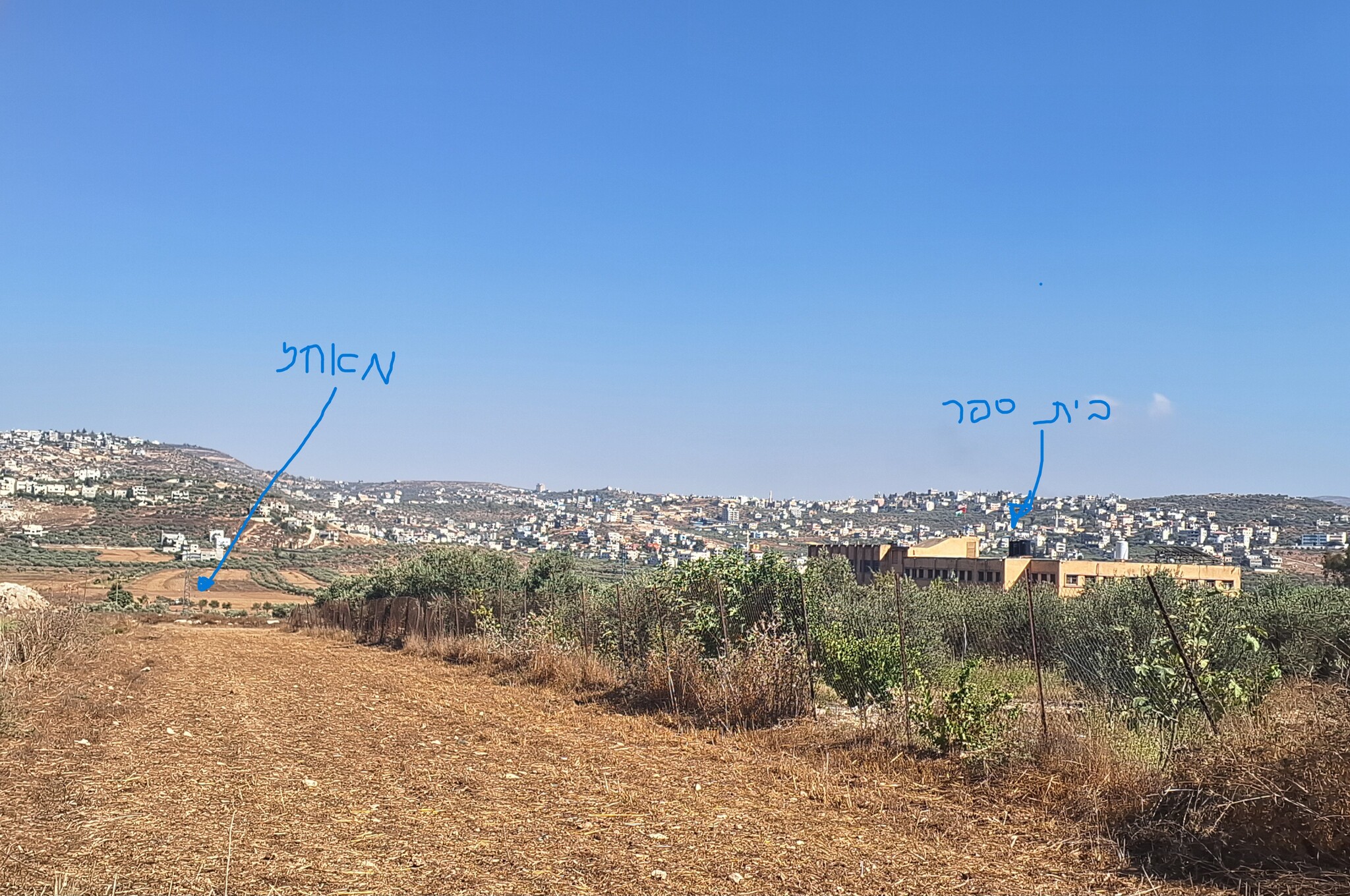 Ronit Dahan-RamatiAug-24-2026Huwara: The school on the outskirts of town and an outpost hidden among the trees
-
