
Huwwara North and South
HUWWARA, Monday 13 December 2004 PM Observers: Maia K., Clil Z., Roni K. (reporting) Guests: Yo G. (photographer), Norman A. ( a writer from Germany) colour=red>The watch at both Huwwara North and Huwwara South checkpoints lasted from 13:30-17:45 ; since we were only a few people, we went back and forth between the two.Summary There was a relaxed atmosphere at the checkpoints until 16:00 approximately. Until then, the lines were short, people passed through quickly, there were only a few detainees, and the checkpoint commanders had time to talk with us. During the second half of the shift, which we spent at Huwwara North in the dark, the lines were long, were managed with annoying slowness and detainees sometimes numbered in the dozens. 13:20 – Tapuah junction: no pressure; about seven vehicles waiting to be checked. Huwwara South 13:30-14:00 – There was a relaxed atmosphere at the checkpoint and lines were short. When the pressure built up a bit, the soldiers improvised. For instance, they created a women’s line outside the main lanes and everyone went through quickly. When we arrived, we were surprised to see a new water faucet.In the detention shed were two men. [Detainees are, typically, men aged from 16 to 30 or 35 who have no passage permits; recently, young women, too, have been detained. There has also recently been a downward shift in the ages affected – now from 14 to 30 — but this can vary. The detainees’ ID details are phoned through to the General Security Services (GSS, also known as the Shabak or the Shin Bet, the Hebrew acronym for the GSS) for checking against a central list of security suspects and the answers are then relayed back to the checkpoints. This cumbersome process can take considerable time, and that can be prolonged even more if the soldiers wait to accumulate a batch of ID cards before passing them on to the GSS , or if they behave in a similarly tardy manner at the end of the process, waiting until they have a batch of GSS clearances before they release individual detainees. Meanwhile, the detainees are virtually prisoners at the checkpoint where the soldiers retain the ID cards until the entire process is completed] One of the two , very anxious, was on his way to the hospital in Nablus to bring some medical apparatus to his brother who was hospitalized there. Following clarification, he pass through after half an hour. We heard from the soldiers here, for the first time, that explosive materiel had been found at the checkpoint yesterday, on the back of a truck. This story and reports of new warnings were repeated throughout the whole shift.14:30-15:40 The change in shifts, brought no alteration in the general situation . At one point, we heard an infant crying in the women’s line, when we told the soldiers they speeded up the line. An outstanding incident: a tow-truck with Israeli license plates had been detained on the road next to the checkpoint. The two drivers, from East Jerusalem, employed by an Israeli towing company, had been sent – of all places – to the Yitzhar settlement, where the residents attacked their truck and broken the headlights. The two then made the mistake of coming to the checkpoint to lodge a complaint, but the soldiers didn’t consider this their problem. We ourselves thought it definitely was and one of our members who happened to pass by called the police. Half an hour later, a patrol car arrived and the drivers submitted their complaint and were sent to the Ariel police station to press charges. We left Huwwara South while things were still quite calm Huwwara North 14:00-14:30During this period , things were relatively calm. When we arrived, we immediately noticed that a table had been placed next to the x-ray luggage scanner so that packages no longer simply fell on the ground as for so long in the past . Military police were among the many soldiers at the inspection posts. At 16:00, a large crowd arrived at the checkpoint, but just at that point, several of the inspection stations stood unmanned, which caused crowding and much discomfort. But the lines were still rather short then and, when there was crowding in the women’s’ line, the soldiers, at our request, opened a special line and the women went through quickly. The commander, A. , had introduced himself when we arrived and we heard from him that earlier in the day a woman suspected of being a suicide bomber had been apprehended (see below). 15:40-17:40This time there were long lines of dozens of people. The situation was particularly bad in the line of older men, where there was a lot of crowding in the turnstiles [these are not simple turnstiles such as one finds in a subway station, but high , revolving gates made of steel bars: each segment is barely large enough to admit one average-sized person; there is virtually no room to spare for anything that person may be carrying , whether a child or a parcel; passage for pregnant women or for the elderly is extremely difficult and frightening]. Some elderly men were trying to pass by the sides on their own, so that another side line was created; however, the soldiers there sent them back to the main line. We were amazed, and then we were told that a warning had been received relating to an elderly man. We could do nothing but accept this. In any case, the situation did not improve, and the progress in the lines was terribly slow. In fact, at a certain stage we saw that only a few of the inspection stations were manned, there was a lack of women checkers, and then it turned out that a crowded and long line of women had also been created. We again tried to persuade the soldiers to open a special line, but then we were told that there had also been a special warning received about women! And also that there was no sense in opening, for example, a line just for women over 50….At this point, in the face of so many warnings and rumours, we began to be suspicious (the information about explosive material which was seized yesterday on the back of a truck, the story about someone suspected of being a female suicide bomber earlier the same day, a warning about an elderly man, and also about a woman of a certain age)…A special women’s’ line was finally organized. This was at about 17:15, really in the dark and with no other choice – since what can you do at a checkpoint which is still crowded at night?Detainees At first, there were no detainees in the shed. When we returned, at about 15:40, there were already five , two from the University of Bir Zeit near Ramallah. We were told later on that they were “on the GSS black list” and they remained in the shed for several hours, until the end of the shift. The number of detainees increased all the time and, by 17:00, there were already 20-30. Some were men who’d left the lines and tried to pass through on the side when they could no longer tolerate the long wait and the crowding and shoving.
Huwwara
See all reports for this place-
The Huwwara checkpoint is an internal checkpoint south of the city of Nablus, at the intersection of Roads 60 and 5077 (between the settlements of Bracha and Itamar). This checkpoint was one of the four permanent checkpoints that closed on Nablus (Beit Furik and Awarta checkpoints to the east and the Beit Iba checkpoint to the west). It was a pedestrian-only barrier. As MachsomWatch volunteers, we watched therre since 2001 two shifts a day - morning and noon, the thousands of Palestinians leaving Nablus and waiting for hours in queues to reach anywhere else in the West Bank, from the other side of the checkpoint the destination could only be reached by public transport. In early June 2009, as part of the easing of Palestinian traffic in the West Bank, the checkpoint was opened to vehicular traffic. The passage was free, with occasional military presence in the guard tower. Also, there were vehicle inspections from time to time. Since the massacre on 7.10.2023, the checkpoint has been closed to Palestinians.
On February 26, 2023, about 400 settlers attacked the town's residents for 5 hours and set fire to property, such as houses and cars. Disturbances occurred in response to a shooting of two Jewish residents of Har Bracha by a Palestinian Terrorist. The soldiers stationed in the town did not prevent the arson and rescued Palestinian families from their homes only after they were set on fire. No one was punished and Finance Minister Smotrich stated that "the State of Israel should wipe out Hawara." Left and center organizations organized solidarity demonstrations and support actions for the residents of Hawara.Hawara continued to be in the headlines in all the months that followed: more pogroms by the settlers, attacks by Palestinians and a massive presence of the army in the town. It amounted to a de facto curfew of commerce and life in the center of the city. On October 5, 2023, MK Zvi established a Sukkah in the center of Hawara and hundreds of settlers backed the army blocked the main road and held prayers in the heart of the town all night and the next day. On Saturday, October 7, 23 The "Swords of Iron" war began with an attack by Hamas on settlements surrounding Gaza in the face of a poor presence of the IDF. Much criticism has been made of the withdrawal of military forces from the area surrounding Gaza and their placement in the West Bank, and in the Hawara and Samaria region in particular, as a shield for the settlers who were taking over and rioting.
On November 12, 2023, the first section of the Hawara bypass road intended for Israeli traffic only was opened. In this way, the settlers can bypass the road that goes through the center of Hawara, which is the main artery for traffic from the Nablus area to Ramallah and the south of the West Bank. For the construction of the road, the Civil Administration expropriated 406 dunams of private land belonging to Palestinians from the nearby villages. The settlers are not satisfied with this at the moment, and demand to also travel through Hawara itself in order to demonstrate presence and control.(updated November 2023)
.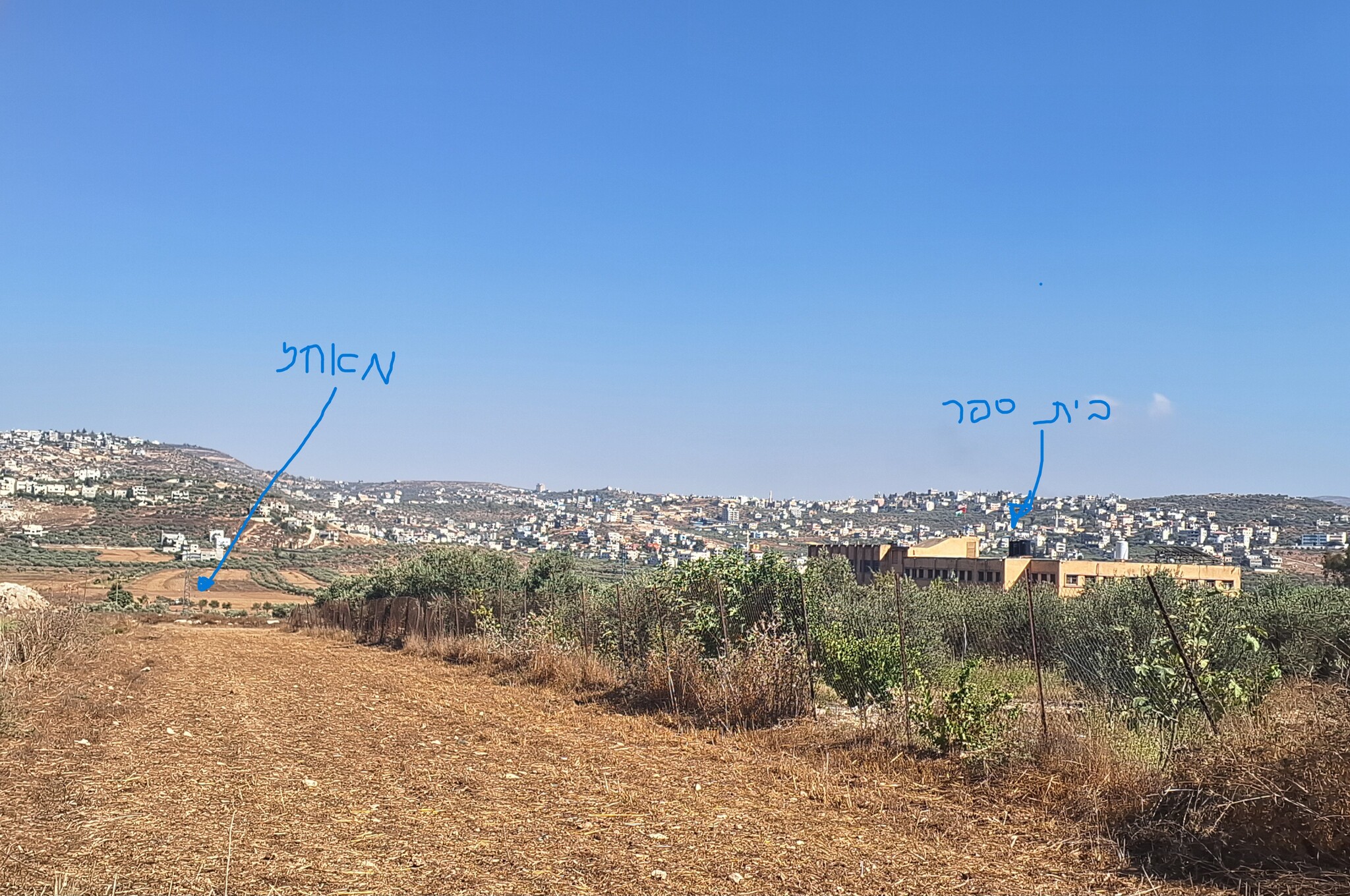 Ronit Dahan-RamatiAug-24-2026Huwara: The school on the outskirts of town and an outpost hidden among the trees
-
