
Huwwara PM
HUWWARA, Sunday 11 July 2004 PMObservers: Ruth P., Arza A. (reporting on the northern checkpoint); Judith V., Sara K. (reporting on the southern checkpoint) colour= red>Huwwara North There was a long and crowded line of people, with many women and young children.People carrying large packages were sent to a special line since checking them takes longer.In one case, a soldier replacing another who’d finished his shift rechecked packages; he said that he’d not been told that they’d already been checked. This was a really unnecessary hardship for the Palestinians. A representative of the District Co-ordinating Office (DCO) [ the army section that handles civilian matters] was present at the checkpoint during our shift and helped the soldiers to check .There were a few detainees waiting in an area surrounded by concrete blocks where they had shade and some benches [the detainees are mostly Palestinian men aged from 16 to 30, almost always without permits, although some with permits are also detained. Their ID cards are taken from them and the details sent by phone to the General Security Services (GSS or, from the Hebrew acronym, the Shabak or Shin Bet) which cross-checks them against a central list of security suspects. This check can take a considerable time. The results are relayed back to the checkpoint and only when the checkpoint soldiers get notification of a detainee’s security status do they return his card to him. Thus, throughout the check, detainees are virtually prisoners at the checkpoint]. One of the detainees was a bridegroom carrying wedding presents.Today, the detainees were released at a reasonable pace.There was no water available for the detainees. We gave them bottles of water that we’d brought with us.Ruth supplied hats to young children with no head covering.Cars were strictly checked, but the traffic flowed well. Huwwara South At 14:45 there were more than 30 men waiting on the line; today, there was only one line for young and older men. Ten women waited in a different line and were checked quickly . But the checking of the men was far slower and more thorough, so that each waited about half-an-hour. The whole area was still without shade and most people had to wait under the burning sun.In an area that was fenced off by concrete blocks , there were seven detainees; they claimed they’d already been waiting for several hours.The checkpoint commander and the soldier in charge of the detainees were quite hostile to us and when we tried to get them to behave a little more pleasantly to the Palestinians they simply rejected our request. Only later did the commander turn to us, discuss the situation and give us some information about the questions we posed. According to him, the man who’d bombed a bus stop in Tel Aviv that morning had been from Nablus [a 19-year-old woman soldier was killed in that blast].At 15:00, five detainees were released and told they must get proper permits [this is no small task for a young Palestinian man and can cost more than a day’s work in time-consuming bureaucracy with no guarantee that the permit will eventually be forthcoming, which is why many men will try their luck at getting through the checkpoints without documentation]. Four foreign citizens were not allowed to pass: one was American and three were members of the same family: one of whom had a Jordanian passport; the other two were a Nablus-born, German-resident mother and her German-born son. They had come to visit the sick 80-year-old matriarch of the family. We called the DCO to ask for help. After 30 minutes Corporal A. arrived and made several phone calls to try to solve the problem. Eventually, he allowed the Jordanian passport-holder to go through because the man said he intended applying for a Palestinian ID. The German citizens were refused permission to go through. The American citizen had a Palestinian ID and with the help of his father , he too went through. We called the parliamentary assistant of Knesset Member Roman Bronfman and urged that some solution be found for the predicament of foreign citizens. No one at any frontier crossing or at Ben Gurion airport tells them that they need a special permit to enter the Occupied Territories. We asked Corporal A. to help two detainees – a man with a bad headache, and his friend — but he said that they must wait. We had the feeling that he did not want to change decisions made by the checkpoint commander, Sgt. U. At 15:30, the last two detainees (for the moment ) were released. The commander urged soldiers to check the women quickly , but it doesn’t really achieve much since families are separated in the lines and the women and children have to wait for their menfolk to finish being checked. 16:00 — There was a sudden surge forward in the men’s line. The commander halted all activity and tried to push the men back . There was no response and it took half-an-hour and the efforts of two more soldiers and even some of the men themselves to convince all the Palestinians that they must indeed move back. .It was at least an hour before the number of men waiting in the line dropped from over 70 to about 20.17:30 — There were eight detainees wait, two of whom had been there for three hours. There was no line of cars.When Captain I. from the DCO arrived, we asked him for help with the detainees but he refused, saying that he’d been insulted by a woman from Machsomwatch who’d called him a Nazi and a fascist. We apologized and explained that the woman did not represent our attitude; but he answered that by talking to him we were holding up his checking of the Palestinians and thus harming rather than aiding them!
Huwwara
See all reports for this place-
The Huwwara checkpoint is an internal checkpoint south of the city of Nablus, at the intersection of Roads 60 and 5077 (between the settlements of Bracha and Itamar). This checkpoint was one of the four permanent checkpoints that closed on Nablus (Beit Furik and Awarta checkpoints to the east and the Beit Iba checkpoint to the west). It was a pedestrian-only barrier. As MachsomWatch volunteers, we watched therre since 2001 two shifts a day - morning and noon, the thousands of Palestinians leaving Nablus and waiting for hours in queues to reach anywhere else in the West Bank, from the other side of the checkpoint the destination could only be reached by public transport. In early June 2009, as part of the easing of Palestinian traffic in the West Bank, the checkpoint was opened to vehicular traffic. The passage was free, with occasional military presence in the guard tower. Also, there were vehicle inspections from time to time. Since the massacre on 7.10.2023, the checkpoint has been closed to Palestinians.
On February 26, 2023, about 400 settlers attacked the town's residents for 5 hours and set fire to property, such as houses and cars. Disturbances occurred in response to a shooting of two Jewish residents of Har Bracha by a Palestinian Terrorist. The soldiers stationed in the town did not prevent the arson and rescued Palestinian families from their homes only after they were set on fire. No one was punished and Finance Minister Smotrich stated that "the State of Israel should wipe out Hawara." Left and center organizations organized solidarity demonstrations and support actions for the residents of Hawara.Hawara continued to be in the headlines in all the months that followed: more pogroms by the settlers, attacks by Palestinians and a massive presence of the army in the town. It amounted to a de facto curfew of commerce and life in the center of the city. On October 5, 2023, MK Zvi established a Sukkah in the center of Hawara and hundreds of settlers backed the army blocked the main road and held prayers in the heart of the town all night and the next day. On Saturday, October 7, 23 The "Swords of Iron" war began with an attack by Hamas on settlements surrounding Gaza in the face of a poor presence of the IDF. Much criticism has been made of the withdrawal of military forces from the area surrounding Gaza and their placement in the West Bank, and in the Hawara and Samaria region in particular, as a shield for the settlers who were taking over and rioting.
On November 12, 2023, the first section of the Hawara bypass road intended for Israeli traffic only was opened. In this way, the settlers can bypass the road that goes through the center of Hawara, which is the main artery for traffic from the Nablus area to Ramallah and the south of the West Bank. For the construction of the road, the Civil Administration expropriated 406 dunams of private land belonging to Palestinians from the nearby villages. The settlers are not satisfied with this at the moment, and demand to also travel through Hawara itself in order to demonstrate presence and control.(updated November 2023)
.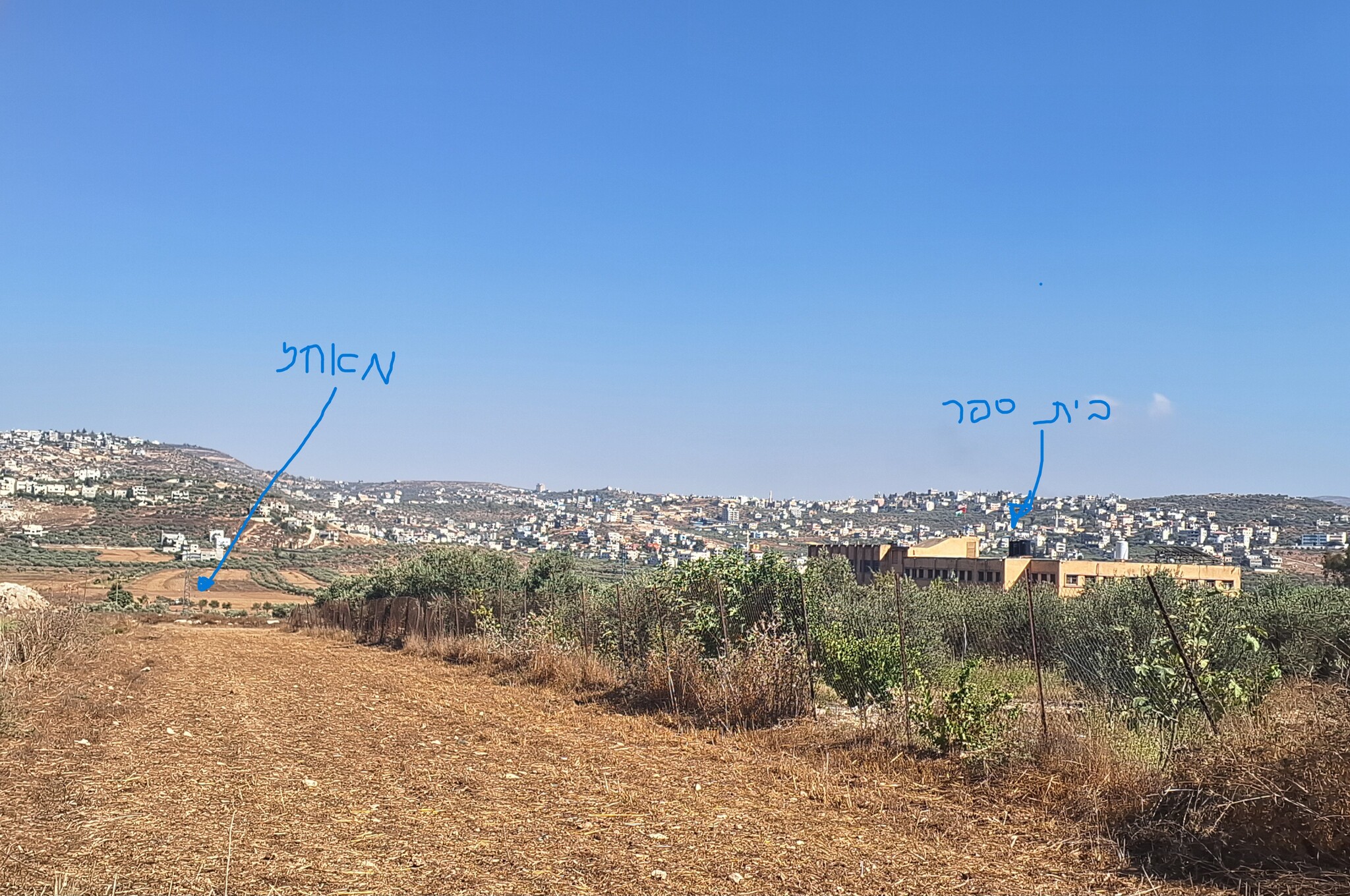 Ronit Dahan-RamatiAug-24-2026Huwara: The school on the outskirts of town and an outpost hidden among the trees
-
