
Huwwara,BeitFurik AM
HUWWARA, BEIT FURIK, BEIT IBA, Thursday 24 June 2004 AM Observers: Aharona M., Yael B-S., Micky P., Ofra C., Dina A., Yudit A-D. (reporting) colour = red>There was only light traffic through all the checkpoints, as the Israel army was operating in Nablus, and the town was under curfew. Passage was generally quick, and at most points there was a representative of the District Co-ordinating Office (DCO) [the army section that handles civilian matters].Huwwara South (Ofra and Yudit)08:15 – There were about 20 people standing in line, and 15 detainees. The DCO representative was attentive to the Palestinians, and spoke to them respectfully rather than with his gun. His questions were to the point, he was flexible, and he let them pass even without a permit. We were able to talk to him, and he handled every case we referred to him, and usually let them pass — including those who’d been turned down by the checkpoint commander.One of the soldiers shouted and waved his weapon around, threatening and occasionally closing the checkpoint briefly whenever a Palestinian stepped out of line or spoke up. This same soldier insisted on “arranging” the line of people waiting and made the detainees sit on the ground.10:40 – Another two or three detainees joined the 15 who’d been waiting all morning. No progress had been made. The DCO was trying, but apparently the General Security Services (GSS) was overloaded. The DCO officer apologized for the delay; it was not in his hands [the GSS — also known by its Hebrew acronym as the Shabak or Shin Bet — cross-checks the detainees’ details, which are phoned in by the checkpoint soldiers, against its central list of security suspects; until security clearance comes back to the checkpoint from the GSS, the soldiers hold the detainees’ ID cards, thus keeping them virtually imprisoned until that point; the check often takes up to four hours or more].Huwwara North (Dina, Yael)08:20 – This site is being rebuilt ; there are concrete mixers, large cement blocks and a crane .Things were quiet here. People passed through quickly; there was no shouting or waving of rifles. The checkpoint commander and his soldiers behaved humanely.Here, too, there was a DCO representative who was flexible. When we spoke to him about a young boy who had arrived from a hospital in Nablus without a permit, he let him go through.Beit Furik (Micky, Ninette, Aharona)08:25 – There were very few people here because of the curfew. The soldiers were relatively polite; they spoke normally, not threateningly. A young man who wanted to take his sick father through was denied entry. The soldiers refused to check his documents with the GSS, claiming that if they were to check everyone, the line would stretch on interminably. We contacted the army’s “humanitarian” hotline where they were sympathetic, but powerless to intervene. We persisted, and finally the man was checked out and allowed to go through with his father.11:00 – There was an unannounced road-block on Route 60, near the gas station between the Jit junction and Beit Iba. A bus let the passengers off. We continued on. Beit Iba (brief stop)11:10 – Towards Nablus: there were very few people headed this way and they went through quickly. The soldiers were reasonable.From Nablus: There was no metal detector . They’d laid down a new concrete floor with designated waiting lanes. In the centre was a shaded area where about 50 people were waiting in a semi-circle.Some of the soldiers were rude, loud and bothersome. We had some restraining influence on their attitudes.A family with children arrived. A soldier shouted at the father for lying, and he claimed that the soldier was mixing him up with someone else. When we intervened, the soldier agreed to check again and admitted that there’d been a misunderstanding. The family went through.There were about 10 detainees whom we left to the care of the second shift.
Beit Iba
See all reports for this place-
A perimeter checkpoint west of the city of Nablus. Operated from 2001 to 2009 as one of the four permanent checkpoints closing on Nablus: Beit Furik and Awarta to the east and Hawara to the south. A pedestrian-only checkpoint, where MachsomWatch volunteers were present daily for several hours in the morning and afternoon to document the thousands of Palestinians waiting for hours in long queues with no shelter in the heat or rain, to leave the district city for anywhere else in the West Bank. From March 2009, as part of the easing of the Palestinian movement in the West Bank, it was abolished, without a trace, and without any adverse change in the security situation.
 Jun-4-2014Beit-Iba checkpoint 22.04.04
-
Huwwara
See all reports for this place-
The Huwwara checkpoint is an internal checkpoint south of the city of Nablus, at the intersection of Roads 60 and 5077 (between the settlements of Bracha and Itamar). This checkpoint was one of the four permanent checkpoints that closed on Nablus (Beit Furik and Awarta checkpoints to the east and the Beit Iba checkpoint to the west). It was a pedestrian-only barrier. As MachsomWatch volunteers, we watched therre since 2001 two shifts a day - morning and noon, the thousands of Palestinians leaving Nablus and waiting for hours in queues to reach anywhere else in the West Bank, from the other side of the checkpoint the destination could only be reached by public transport. In early June 2009, as part of the easing of Palestinian traffic in the West Bank, the checkpoint was opened to vehicular traffic. The passage was free, with occasional military presence in the guard tower. Also, there were vehicle inspections from time to time. Since the massacre on 7.10.2023, the checkpoint has been closed to Palestinians.
On February 26, 2023, about 400 settlers attacked the town's residents for 5 hours and set fire to property, such as houses and cars. Disturbances occurred in response to a shooting of two Jewish residents of Har Bracha by a Palestinian Terrorist. The soldiers stationed in the town did not prevent the arson and rescued Palestinian families from their homes only after they were set on fire. No one was punished and Finance Minister Smotrich stated that "the State of Israel should wipe out Hawara." Left and center organizations organized solidarity demonstrations and support actions for the residents of Hawara.Hawara continued to be in the headlines in all the months that followed: more pogroms by the settlers, attacks by Palestinians and a massive presence of the army in the town. It amounted to a de facto curfew of commerce and life in the center of the city. On October 5, 2023, MK Zvi established a Sukkah in the center of Hawara and hundreds of settlers backed the army blocked the main road and held prayers in the heart of the town all night and the next day. On Saturday, October 7, 23 The "Swords of Iron" war began with an attack by Hamas on settlements surrounding Gaza in the face of a poor presence of the IDF. Much criticism has been made of the withdrawal of military forces from the area surrounding Gaza and their placement in the West Bank, and in the Hawara and Samaria region in particular, as a shield for the settlers who were taking over and rioting.
On November 12, 2023, the first section of the Hawara bypass road intended for Israeli traffic only was opened. In this way, the settlers can bypass the road that goes through the center of Hawara, which is the main artery for traffic from the Nablus area to Ramallah and the south of the West Bank. For the construction of the road, the Civil Administration expropriated 406 dunams of private land belonging to Palestinians from the nearby villages. The settlers are not satisfied with this at the moment, and demand to also travel through Hawara itself in order to demonstrate presence and control.(updated November 2023)
.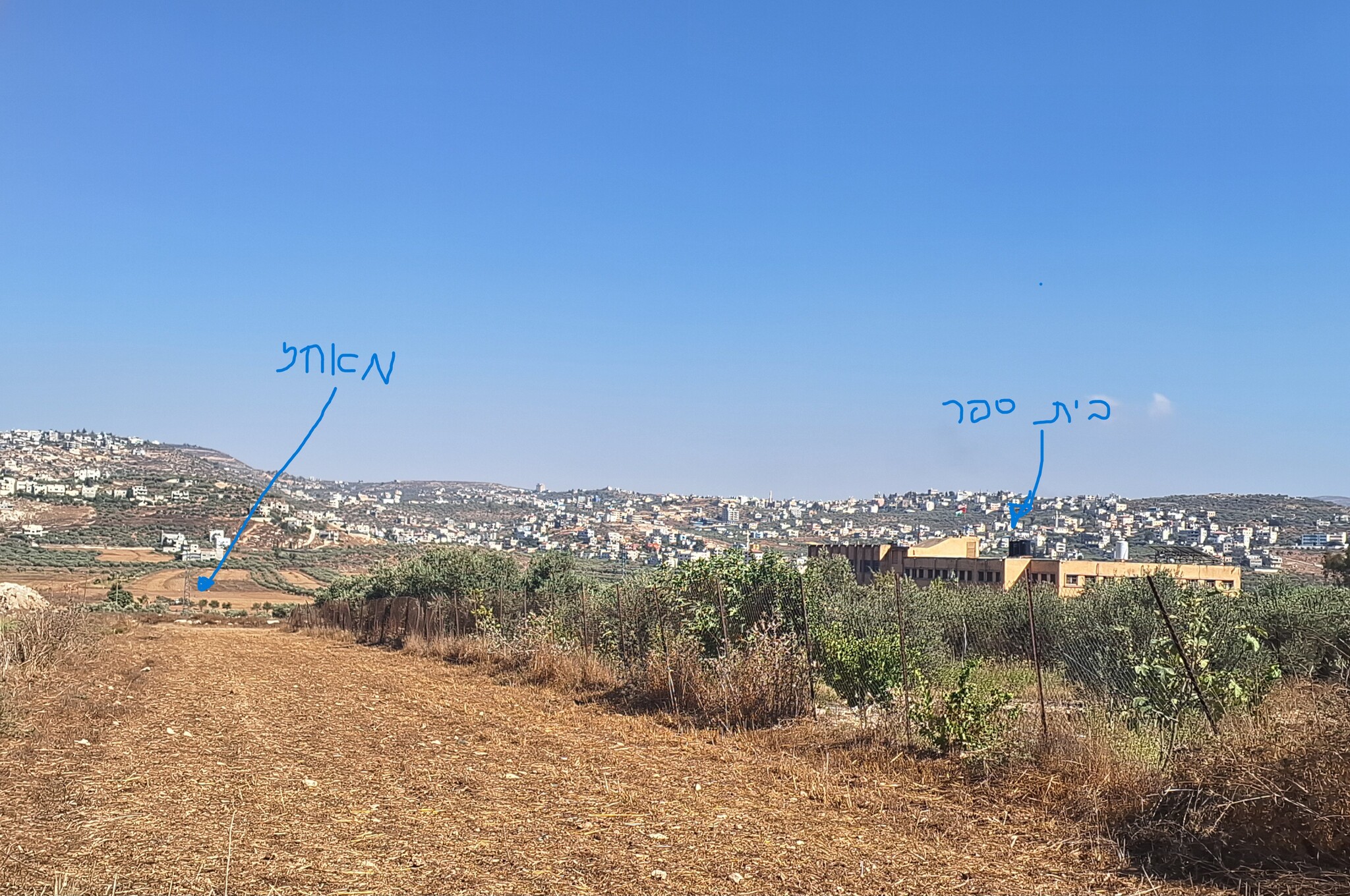 Ronit Dahan-RamatiAug-24-2026Huwara: The school on the outskirts of town and an outpost hidden among the trees
-
