
Huwwara,Irtah, Jubara, Beit Furik PM
HUWWARA, IRTAH, JUBARA, BEIT FURIK, Tuesday 27 July 2004 PM Observers: Raheli B., Natali M., Ada R. , Petahya A., two guests, and Vered K. (reporting) colour=red>13:25 — Irtah ( Gate 700)There was a long queue of about 17 trucks at the entrance. The drivers said that they’d already been waiting an hour and a half. The soldiers told us that the traffic jam was caused by “building work” – it turned out that a crane working near the entrance had blocked the road from 10.00. Why can’t work like this be done at night or at a time which doesn’t hold up so many people for such a long time? These people lost a day’s work.14:00 — JubaraThere was a long queue of cars at the entrance and exit between Tulkarm and Nablus / Qalqiliya . Cars and people were again being checked in both directions [after a short period in which checks were almost done away with here]. We tried to find out why this was so and what the new restrictions on movement were – only to be met with a hostile response from the soldier who claimed that the congestion was normal for that time of the day, that we were interfering and endangering the situation , and he wouldn’t help us locate whoever was in charge . We didn’t stay any longer for lack of time. But perhaps we need to take Jubara checkpoint more seriously again. Jit JunctionIsraeli police were stopping cars and handing out traffic reports – we are not sure that they have the authority to do this in areas B and C of the Palestinian Authority.On the way back at 17:15, there were about 30 cars were waiting in both directions. Another line, too, at an unannounced roadblock at the T junction near Funduq village. At Sarra checkpoint the gate at the bottom was open but there was no traffic on the road – the checkpoint was empty. 14:45 — Huwwara SouthAbout 60 men, women and children were waiting in line (amongst them was a woman with a child in her arms who looked as if he was about to faint, quite dehydrated from the heat – just after 16:00, I saw them as they went through to Nablus having also having had to make it past Huwwara North too.There were some nine detainees , baking under the broiling hot sun [as they waited for the General Security Services (GSS or, from the Hebrew acronym, the Shabak or Shin Bet) to cross-check their ID card details against lists of security suspects]; they virtually refused to accept water from us, taking it as an insult; “I don’t want water, I want to get out of this place and go home – we’ve already been waiting for three hours.” A woman from Ramallah, in the early stages of pregnancy, who claimed she’d been waiting four hours for her husband to be released, asked us to help her: she does not want to go on without him. Ada’s requests to the commander of both north and south checkpoints didn’t achieve anything, although he promised to help, particularly since the soldier in question was the one who’d behaved so appallingly in Huwwara North last week. 15:00 –North HuwarraThere were three queues all of which moved relatively well in front of two soldiers with rifles aimed and a female soldier who held a rifle in one hand and a glove puppet on the other to amuse the children, or perhaps to minimize the trauma of pointing the loaded rifle…A pregnant woman, feeling unwell from standing in the sun, asked us to try to get the process speeded up – she had entered with an Israeli ID card somehow or other (she claimed she had gone through the checkpoint) and now they weren’t letting her leave . And it was so hot, and she had no shade. But it was apparently more important to the army to carry out a painting job, slowly painting the metal framework that stood ready there…..And meanwhile, no effort was being made by the army to put up any canvas or shade, so that 19 men and this woman were left waiting in the hot sun without enough places to sit down, with no toilets and no water, apart from the crate of drinks which we distributed between the two checkpoints.Amongst those detained was an absurd and totally Kafkaesque case: A boy had been hurt in a road accident involving a military vehicle in Huwarra village that morning, and the army had sent him in an ambulance to be attended to in Nablus, after which he’d returned. Since it was found that he had no significant injuries, they took him aside for questioning, as if he’d entered Nabulus of his own choice, just for the fun of it ….. And then he was submitted to three hours of waiting in the sweltering sun together with the other detainees ; and there was his father who’d come, alarmed, to pick him up, and was now waiting for him, desperate, irritable and dehydrated. Another boy told us that his father had died, but he did not have a death certificate to show them which he apparently needed to obtain permission to cross. Our appeals to the soldiers did not help. Ada phoned Y. at 15:55, and, although it wasn’t clear whether it was because of her call or not, a soldier arrived soon with a pile of ID cards, thus allowing most of the detainees, including the boy who’d had the accident, to proceed on their way. Another detainee, an American citizen, of Syrian extraction now asked us to help. He had come to Nablus to find a bride and now and his new wife were being detained. His wife was allowed to pass with no difficulty, and other American citizens who’d gone through the checkpoint b before him had experienced no difficulties. But not him! He wanted to put in a formal complaint. It turned out that his passport had been taken to be checked either by the GSS or by the Ministry of the Interior, and meanwhile he’d been waiting three hours and to our dismay, even at 17:45 when we contacted him by phone, he was still there (despite Ada’s unending and hours-long attempts to get through the bureaucratic nightmare whether by contacting Israeli or US officials who all proved elusive in the extreme ). It was not until 19:30 that a U S consular official managed to get the couple released (it took him just seven minutes to do the job); he said he would report the incident to the US authorities.Meanwhile, at 16:30 we left for Beit Furik, following a report of some violence there. We left six people still detained at Huwwara North, and another 20 at Huwwara South. A new detainee, dressed in a smart, clean suit, earned some special attention and extra humiliation from one of the soldiers when he hesitated to sit down on the dirty ground and spoil his clothes. And also as we were leaving: complaints from taxi drivers that the soldiers had confiscated keys from three of them because they’d not moved their cars when told to do so: the drivers said they’d not been present when the soldiers ordered the cars moved — so, whether or not the soldiers were within their rights in this matter — and there is ample evidence that they are definitely not — the “punishment” of taxi drivers still continues. Beit FurikWhen we arrived there were no signs of there having been any violence and the detainees sitting there, who claimed to have been there for over two hours, knew nothing about it. Still, there was a long queue of about 100, was moving only very slowly towards the checkpoint, and it looks as if we should spend more time here.The soldiers were determined to “educate” one detainee who, he claimed, went through the checkpoint every day. (He is an accountant with a Nablus hi-tech company, speaks English but no Hebrew, and he explained to us that every resident in the area has been assigned to one particular checkpoint through which he may travel, and through no other.) There is nothing to compare with the Big Brother of the Israeli occupation! According to the soldiers, he was caught trying to bypass the checkpoint, just some 20 metres away, and had been detained for over two hours there. We spoke to N., the commander, who wanted to know why we had not brought biscuits for the soldiers, and why, according to him, we identified more with the Palestinians and believed them more than we identified with or believed the soldiers, and him in particular. But after a quarter of an hour of nagging , albeit without tempers being lost, the man was freed, with the soldier shouting after him: “If I catch you again trying to bypass the checkpoint, you will be sent to jail, do you hear?” We reminded the soldier that the man didn’t understand Hebrew and this is the reply we got: “He’ll soon learn! Don’t worry!” While we were there, two large, closed, white cars arrived: in one was a machine for detecting explosives – bags and other belongings were placed on a conveyor belt moving through the vehicle, and the contents were checked for explosives. The soldier operating the device showed an enthusiasm and a pleasant manner so at odds with the place as he greeted people: “Good day to you, please place your bag there.” He said that he and his colleagues were from the border-crossing unit – the military police.
Huwwara
See all reports for this place-
The Huwwara checkpoint is an internal checkpoint south of the city of Nablus, at the intersection of Roads 60 and 5077 (between the settlements of Bracha and Itamar). This checkpoint was one of the four permanent checkpoints that closed on Nablus (Beit Furik and Awarta checkpoints to the east and the Beit Iba checkpoint to the west). It was a pedestrian-only barrier. As MachsomWatch volunteers, we watched therre since 2001 two shifts a day - morning and noon, the thousands of Palestinians leaving Nablus and waiting for hours in queues to reach anywhere else in the West Bank, from the other side of the checkpoint the destination could only be reached by public transport. In early June 2009, as part of the easing of Palestinian traffic in the West Bank, the checkpoint was opened to vehicular traffic. The passage was free, with occasional military presence in the guard tower. Also, there were vehicle inspections from time to time. Since the massacre on 7.10.2023, the checkpoint has been closed to Palestinians.
On February 26, 2023, about 400 settlers attacked the town's residents for 5 hours and set fire to property, such as houses and cars. Disturbances occurred in response to a shooting of two Jewish residents of Har Bracha by a Palestinian Terrorist. The soldiers stationed in the town did not prevent the arson and rescued Palestinian families from their homes only after they were set on fire. No one was punished and Finance Minister Smotrich stated that "the State of Israel should wipe out Hawara." Left and center organizations organized solidarity demonstrations and support actions for the residents of Hawara.Hawara continued to be in the headlines in all the months that followed: more pogroms by the settlers, attacks by Palestinians and a massive presence of the army in the town. It amounted to a de facto curfew of commerce and life in the center of the city. On October 5, 2023, MK Zvi established a Sukkah in the center of Hawara and hundreds of settlers backed the army blocked the main road and held prayers in the heart of the town all night and the next day. On Saturday, October 7, 23 The "Swords of Iron" war began with an attack by Hamas on settlements surrounding Gaza in the face of a poor presence of the IDF. Much criticism has been made of the withdrawal of military forces from the area surrounding Gaza and their placement in the West Bank, and in the Hawara and Samaria region in particular, as a shield for the settlers who were taking over and rioting.
On November 12, 2023, the first section of the Hawara bypass road intended for Israeli traffic only was opened. In this way, the settlers can bypass the road that goes through the center of Hawara, which is the main artery for traffic from the Nablus area to Ramallah and the south of the West Bank. For the construction of the road, the Civil Administration expropriated 406 dunams of private land belonging to Palestinians from the nearby villages. The settlers are not satisfied with this at the moment, and demand to also travel through Hawara itself in order to demonstrate presence and control.(updated November 2023)
.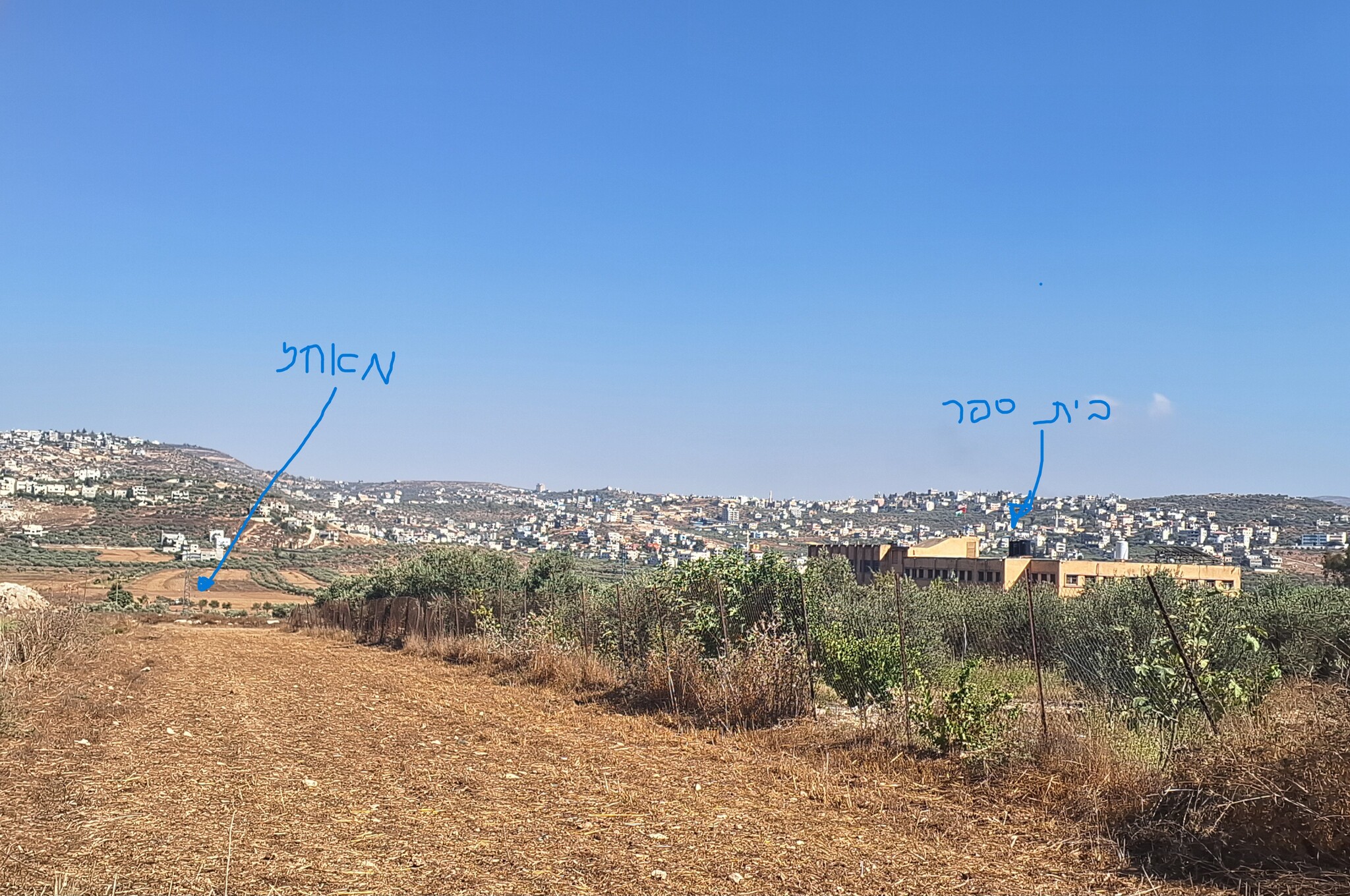 Ronit Dahan-RamatiAug-24-2026Huwara: The school on the outskirts of town and an outpost hidden among the trees
-
