
Jordan Valley: A Great Fear Has Fallen Over the Valley
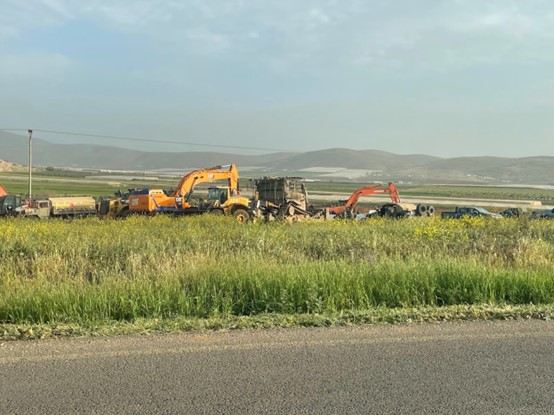
This is how the morning begins. The instruments of destruction will come — there are no closed gates for them. They will continue to Judaize Palestinian fields and expel those living along the path they have marked — those who have not yet left. Twelve families from Khirbet Yerza have already gone. In other words, Yerza is no more. But there is a road.
In al-Farisiya, there is no land left for grazing. B. keeps his flock close to the homes. On dry ground, he distributes grass he brought from elsewhere. A. still tries to graze, but then the army comes looking for him and he runs. A story that repeats itself.
The children and women continue with their routine. Lessons on Zoom, spending hours with us playing games and chatting. Ramadan. Everyone is fasting and counting the days. One week remains.
We were called to help bring calm to Hamam al-Maleh. Only M. and his mother remain there, after they — and another man — were attacked this week. Both were hospitalized. M. has returned home. The other man will not return. He is elderly and injured.
That same night, activists from the “Blue Tent – Our Land” group were also present. They were attacked with clubs inside the room where they were staying. Their vehicle was smashed from all sides. The local tractor was stolen, along with several sheep.
We stayed with them until the midday rest (during Ramadan), then returned to al-Farisiya.
The presence of our cars is more significant than our presence. When an Israeli vehicle is seen, they do not enter.
In al-Farisiya there is a strong Israeli presence, so for now they arrive without clubs.
At noon we moved on to Samra, where preparations were underway for the brigade commander’s visit. He delivered a cruel message in gentle words, a kind of “killing me softly”: leave now, or you will be removed later. Your choice.
And, by virtue of being the sovereign (Smotrich, apparently, has not informed him otherwise), he said the settlers’ tent looming over them would be removed. The tent is still there.
The settlers have lowered the level of violence — a night and a half passed quietly. But while we were sitting there under the “Tree of Love,” settlers arrived at the tent. Uri, the director from his illegal outpost, came personally to inform the Palestinians, one by one, that they must leave.
Although the land they are on — and far beyond it — is registered in their names in the land registry, they are permitted to remain only on the lower area. They are forbidden to move beyond it in any direction.
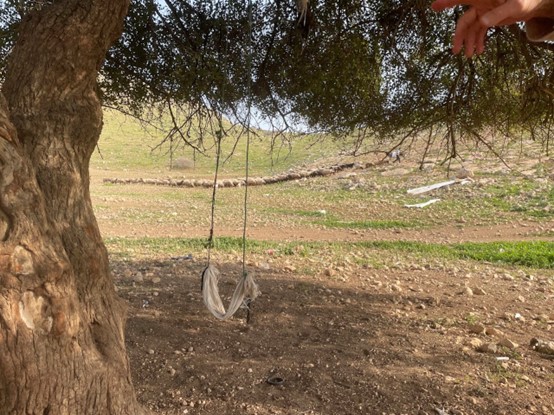
At the entrance to Samra stands a Christ’s thorn jujube tree that serves as a center for children’s play and gathering. Here they cook in the dirt, play, and enjoy themselves. For us, it is also a lookout point toward the blue tent. Our bag of games and coloring supplies allows all of us moments of shared joy.
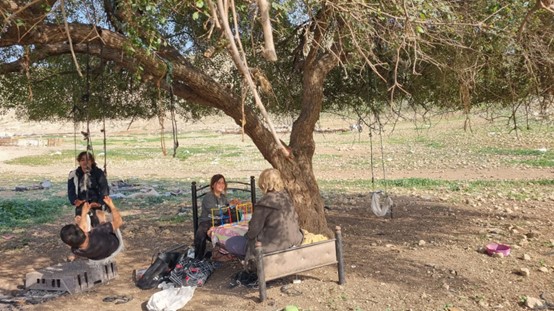
Toward evening, the night volunteers replace us, and we are invited to the iftar meal in Makhoul — the meal that breaks the fast.
The next day brings horrifying accounts of what happened overnight in Humsah. A large group of settlers arrived at the far edge of the community. They bound everyone, beat them with clubs — including two volunteers from an international group in the area. They burned, destroyed, and obstructed ambulances from entering. The police were slow to arrive.
A great fear has fallen over the valley.
Location Description
Al-Farisiya / 'Ein a-sakut
See all reports for this place-
Al-Farisiya / 'Ein a-sakutA community of shepherds in the Jordan Valley opposite the settlement of "Rotem". Making a living from grazing sheep, the residents are exposed to harassment, abuse and theft from settlers who come to them from outposts and settlements in the area, and their grazing area is shrinking due to settler takeovers, fire zones and declared nature reserves.Machsom Watch companies participate in shepherd escort activities and provide a 24/7 protective presence, and there is continuous and warm contact with the community.
-
Hamam al-Maleh
See all reports for this placeJordan Valley
See all reports for this place-
Jordan Valley The Jordan Valley is the eastern strip of the West Bank. Its area consists of almost a third of the West Bank area. About 10,000 settlers live there, about 65,000 Palestinian residents in the villages and towns. In addition, about 15,000 are scattered in small shepherd communities. These communities are living in severe distress because of two types of harassment: the military declaring some of their living areas, as fire zones, evicting them for long hours from their residence to the scorching heat of the summer and the bitter cold of the winter. The other type is abuse by rioters who cling to the grazing areas of the shepherd communities, and the declared fire areas (without being deported). The many groundwaters in the Jordan Valley belong to Mekorot and are not available to Palestinians living in the Jordan Valley. The Palestinians bring water to their needs in high-cost followers.
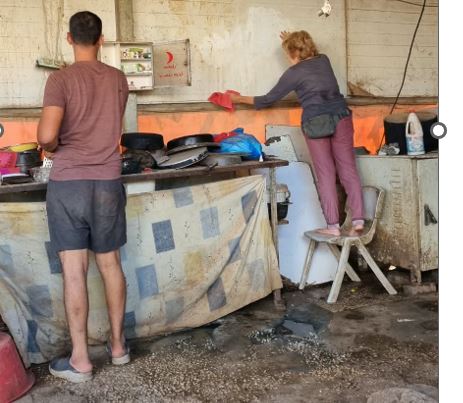 Bosmat HetzroniSep-24-2026Khalet Makhul – An unnecessary cleanup operation...
-
