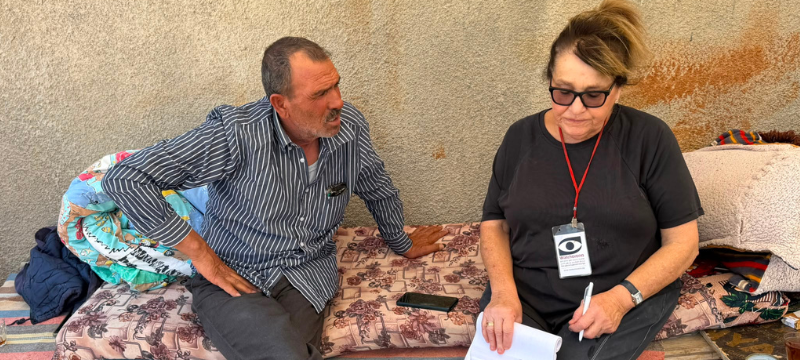
Jurish: “Sending the children to school is now frightening” – settlers violence and the spreading of outposts in the region
We entered via Road 55. This time the entrance to Nabi Elias village was open. We drove along the road leading to Emanuel and Deir Istia (Road 5066) that joins Road 5 at Giti Junction. The entrance to Deir Istia is blocked, the iron gate closed.
On our way to Jurish we saw that the construction of the stone gate of the road repaved and expanded has been completed. Last time we were here we saw it being worked on. At its head now reads the inscription “Welcome to Jurish”.
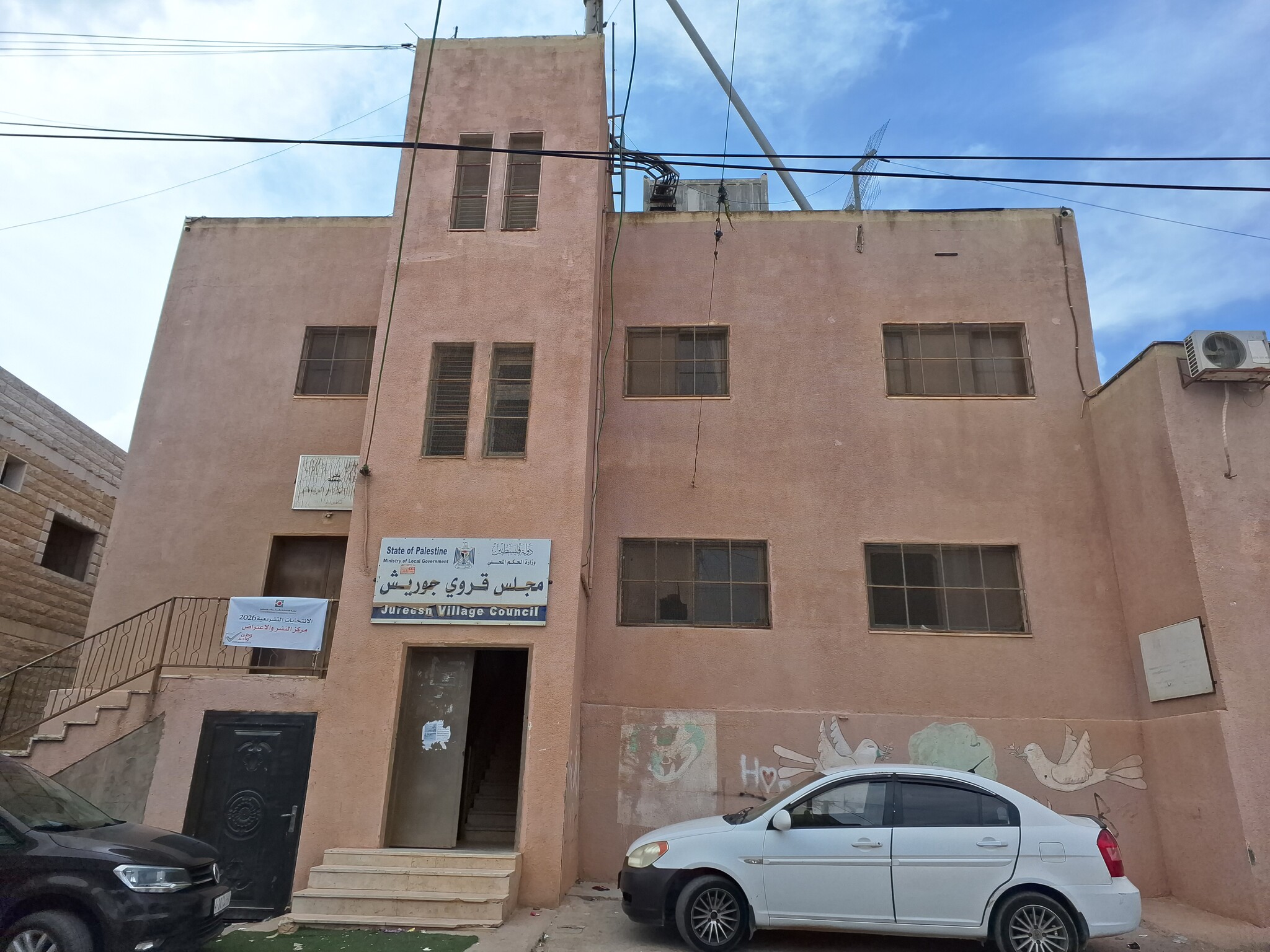
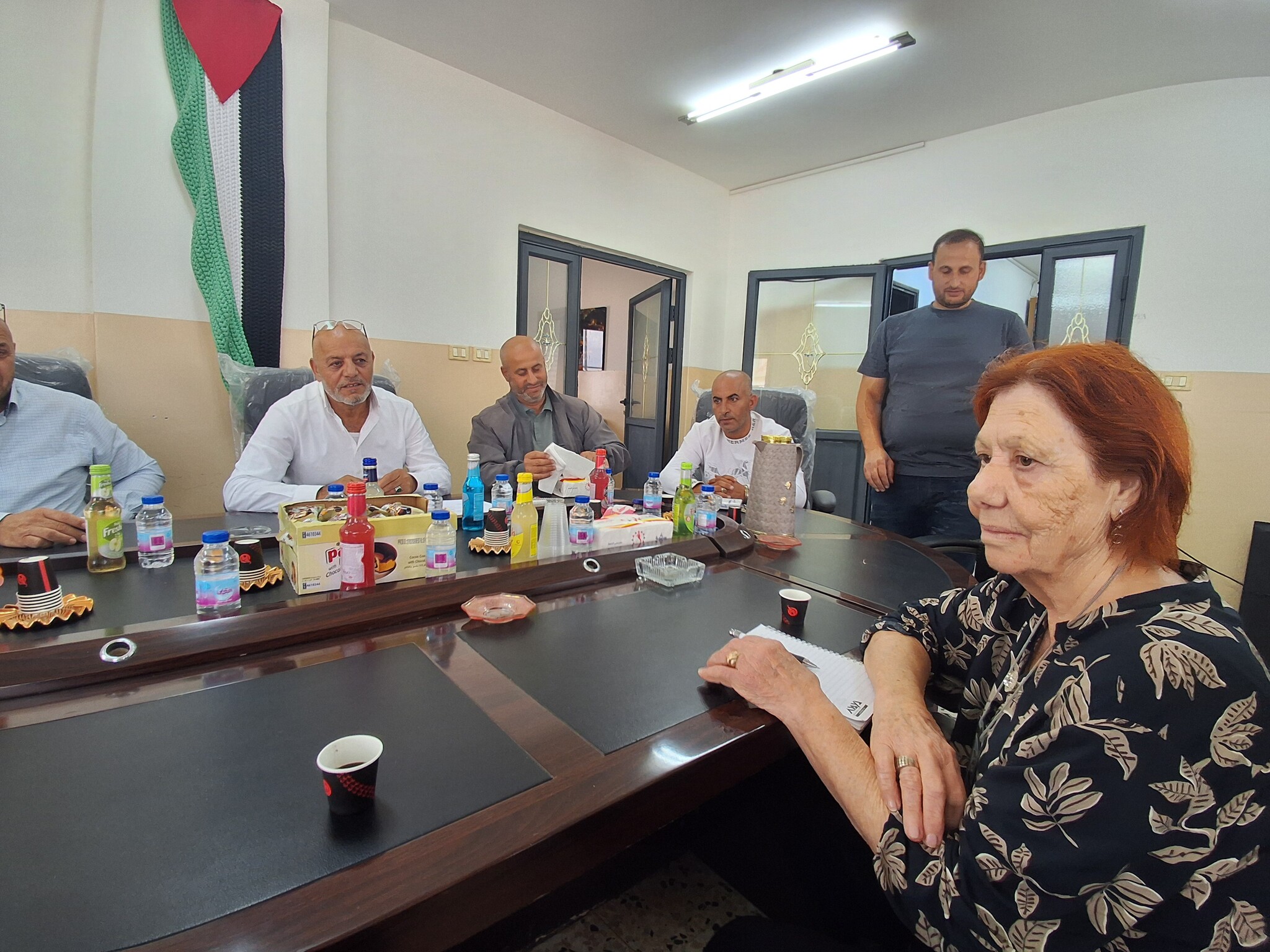
Jurish is situated east of Qusra village. It too has suffered, like all the villages surrounded by Jewish settlements. We met with the head of the local council and others in a nice meeting hall. They told us that they are attacked all the time. The eastern part of the village, named Aqraba Skull has especially suffered from settlers assaults. The last one took place 24 hours ago. On Monday, September 28th, settlers came into the center of the village, met a schoolchildren’s minibus, stopped it and pepper sprayed the children.
The people said this was done in coordination with the soldiers. They are very concerned for their children now. So such so, that they do not even let them come out of the house, even to go shopping.
An elderly man came in, leaning on a cane, and said that his olive trees were cut down and he was pepper-sprayed. He had come from his olive tree grove. He was extremely sad, telling us about it. The head of local council said that the assailants are mostly younger boys or men, maximum aged 20. The villagers are afraid to send the children to school. The son of the head of the council studies at Qablan village. The school there is been attacked several times.
There are new settlements across the ravine from the first houses in Jurish. The checkpoints too right now pose a serious obstacle. One of the people present said that he went to Aman for a few hours and returned home before his wife who had gone to Nablus that day.
The economic situation in the village is dire, to the point that people cannot afford to send the children to high school, which costs money.
We spoke of the upcoming elections in Israel, the attempts to illegitimize the Arab parties, whether there was any hope for change. One of the people present was interested in Sylvia’s wellbeing, when he realized we are members of the same organization. He must have been helped by her in the past.
On the way there and back we noticed – from Road 505 around Aqraba and Usarin – road signs and roads leading to new settlements such as “Maoz Yehuda” and “Rechav’am” south of the road. On the other side of the road, somewhat east of Evyatar is a sign heralding an outpost/colony named “Harbinger of Peace”, no less…
We took a small turn at Beta which was quiet. Many businesses are shut down. At the center is a roundabout with the map of the entire Palestine in stone, topped by an inscription which was black-sprayed.
Huwara was quiet. We drove to observe the outpost erected east of the high school, on the north-eastern side of Huwara, near the western side of Awarta. It seems to be expanding. A Temple flag waves over it. Apparently, more tents have been added and the land flattened, olive trees uprooted, a path broken.
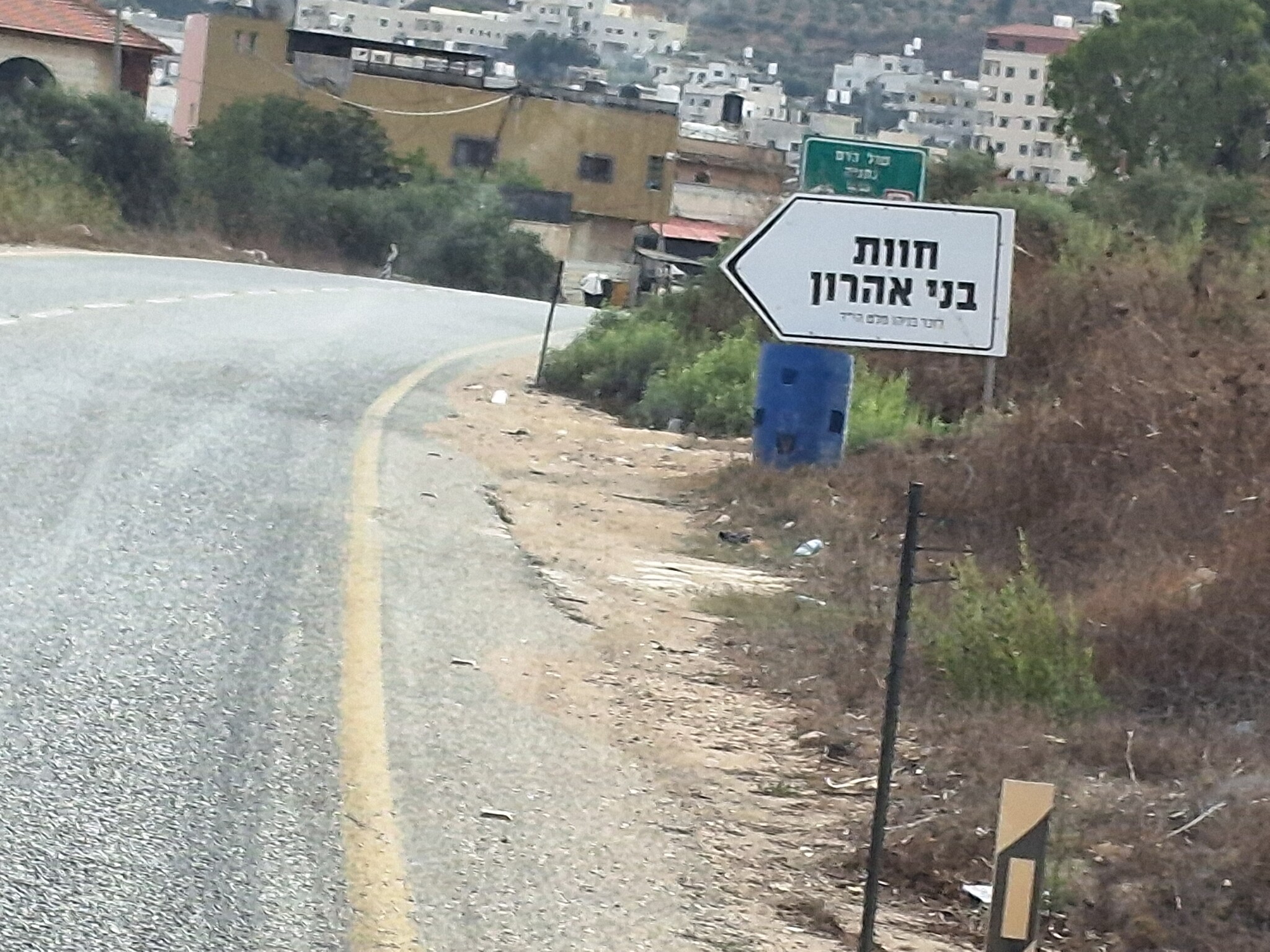
On Road 555, between Burin and Huwara, the entrance already carries the sign – “Bnei Aharon Farm” – and blue plastic buckets. One of the signs has small letters saying “In the memory of Bnayahu Malt May the Lord Avenge Him”. This was the security official killed in a “hike” to Till village a few weeks ago. On our way there, a settler came facing us on an ATV, of the kind given out to outposts by Smutrich.
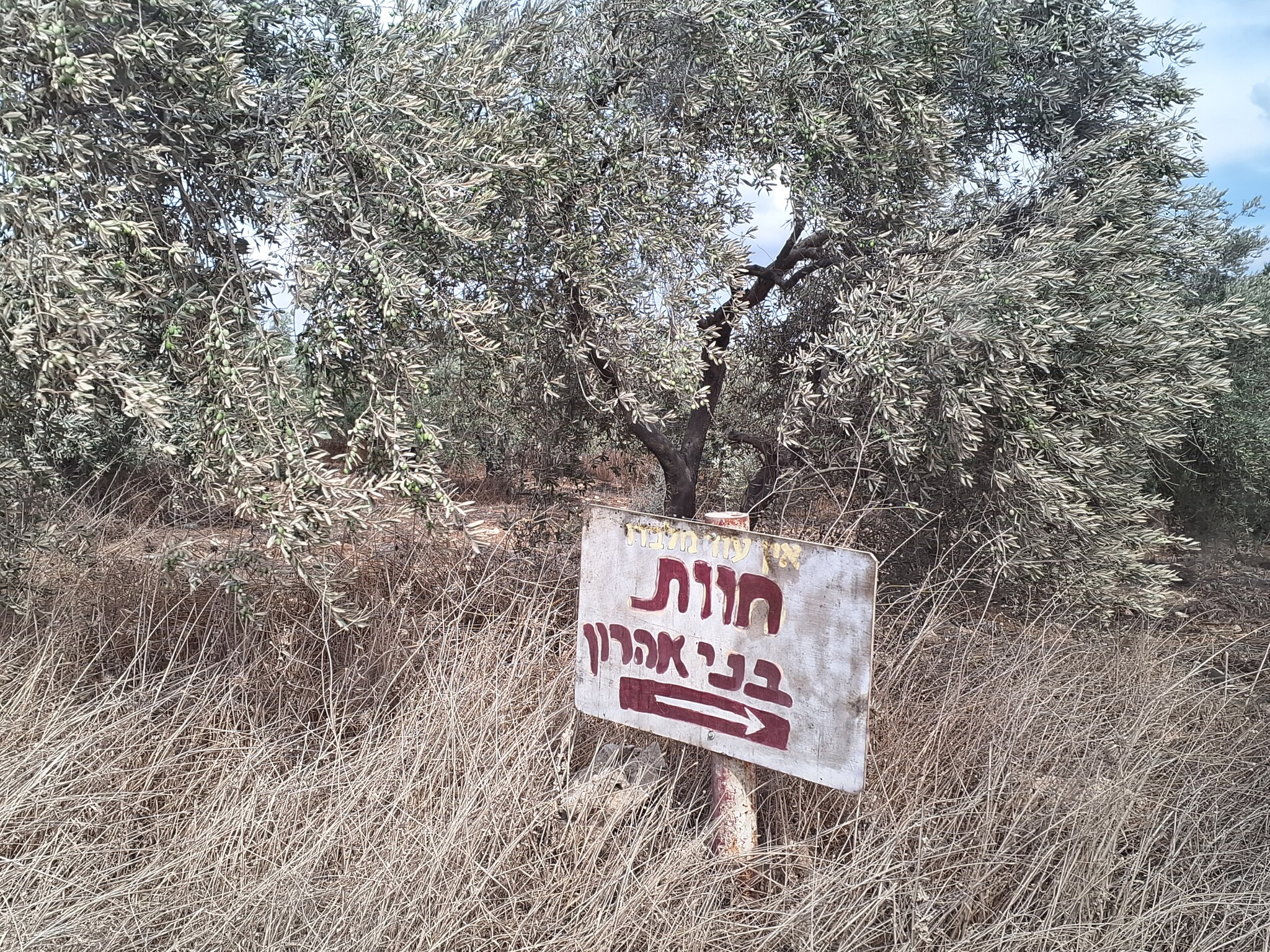
Awarta and Beit Furik checkpoints were open, no soldiers on the ground, just watching from above in the watchtower.
D. in Burin village was hosting a school principal from Madama who sat with an elderly woman from London, the representative of a foundation which donates money. The conversation was around settlers attacks. D. said she went to her olive trees, and a settler immediately showed up with soldiers and they chased her away.
On our way at the roundabout entrance to Huwara, a settler was making the rounds in an ATV on the roundabout itself. On the way via Road 60 we saw a sign saying “Tell Bnayahu”, which must be another outpost planned to commemorate Bnayahu Malt. The signs invite one to travel the area on the holidays and see the settlement coup. Below the signs one can see “Details at the Religious Zionism website”. There are many political signs heralding the upcoming elections.
On the roadside of Road 55 near Eimatin there are expansion works and piping laid nearby.
Location Description
Burin (Yitzhar)
See all reports for this place-
Burin (Yitzhar)
This is a Palestinian village in the Nablus governorate, a little south of Nablus, on the main road passing through the West Bank. The settlements: Yitzhar and Har Bracha, settled in locations that surrounded the village, placed fences so it is cut off the main road.
There are around 4000 inhabitants. Most of them are engaged in agriculture and pasture, although many graduates of the two secondary schools continue to study at the university. Academic positions are hardly available, they find work as builderd, or leave for the Gulf countries.
The village lands were appropriated several times for the establishment of Israeli settlements and military bases, and as a result, Burin's land and water resources dwindled. lSince 1982, more than 2,000 dunams of village land have been declared "state land" and then transferred to Har Bracha settlement.
Over the past few years and more so since 2017, the villagers have been terrorized by the residents of Yitzhar and Har Bracha, the Givat Ronen outpost and others. Despite the close proximity of soldiers to an IDF base close to one of the village's schools, residents are suffering from numerous stone-throwing events, vehicle and fire arson, also reported in the press.
In 2023, the prevention of the olive harvest in the village plot was more violent than ever. Soldiers and settlers walked with drawn weapons between the houses of the village and demanded that people stop harvesting in the village itself and in the private plots outside the village. The settlers from Yitzhar and Giv'at Roned raided the olive groves and stole crops. 300 olive trees belonging to the residents of Burin, near Yitzhar, were uprooted. The loss of livelihood from the olives causes long-term economic damage to the farmers' families, bringing them to the point of starvation.
(updated for November 2023)
-
Huwwara
See all reports for this place-
The Huwwara checkpoint is an internal checkpoint south of the city of Nablus, at the intersection of Roads 60 and 5077 (between the settlements of Bracha and Itamar). This checkpoint was one of the four permanent checkpoints that closed on Nablus (Beit Furik and Awarta checkpoints to the east and the Beit Iba checkpoint to the west). It was a pedestrian-only barrier. As MachsomWatch volunteers, we watched therre since 2001 two shifts a day - morning and noon, the thousands of Palestinians leaving Nablus and waiting for hours in queues to reach anywhere else in the West Bank, from the other side of the checkpoint the destination could only be reached by public transport. In early June 2009, as part of the easing of Palestinian traffic in the West Bank, the checkpoint was opened to vehicular traffic. The passage was free, with occasional military presence in the guard tower. Also, there were vehicle inspections from time to time. Since the massacre on 7.10.2023, the checkpoint has been closed to Palestinians.
On February 26, 2023, about 400 settlers attacked the town's residents for 5 hours and set fire to property, such as houses and cars. Disturbances occurred in response to a shooting of two Jewish residents of Har Bracha by a Palestinian Terrorist. The soldiers stationed in the town did not prevent the arson and rescued Palestinian families from their homes only after they were set on fire. No one was punished and Finance Minister Smotrich stated that "the State of Israel should wipe out Hawara." Left and center organizations organized solidarity demonstrations and support actions for the residents of Hawara.Hawara continued to be in the headlines in all the months that followed: more pogroms by the settlers, attacks by Palestinians and a massive presence of the army in the town. It amounted to a de facto curfew of commerce and life in the center of the city. On October 5, 2023, MK Zvi established a Sukkah in the center of Hawara and hundreds of settlers backed the army blocked the main road and held prayers in the heart of the town all night and the next day. On Saturday, October 7, 23 The "Swords of Iron" war began with an attack by Hamas on settlements surrounding Gaza in the face of a poor presence of the IDF. Much criticism has been made of the withdrawal of military forces from the area surrounding Gaza and their placement in the West Bank, and in the Hawara and Samaria region in particular, as a shield for the settlers who were taking over and rioting.
On November 12, 2023, the first section of the Hawara bypass road intended for Israeli traffic only was opened. In this way, the settlers can bypass the road that goes through the center of Hawara, which is the main artery for traffic from the Nablus area to Ramallah and the south of the West Bank. For the construction of the road, the Civil Administration expropriated 406 dunams of private land belonging to Palestinians from the nearby villages. The settlers are not satisfied with this at the moment, and demand to also travel through Hawara itself in order to demonstrate presence and control.(updated November 2023)
.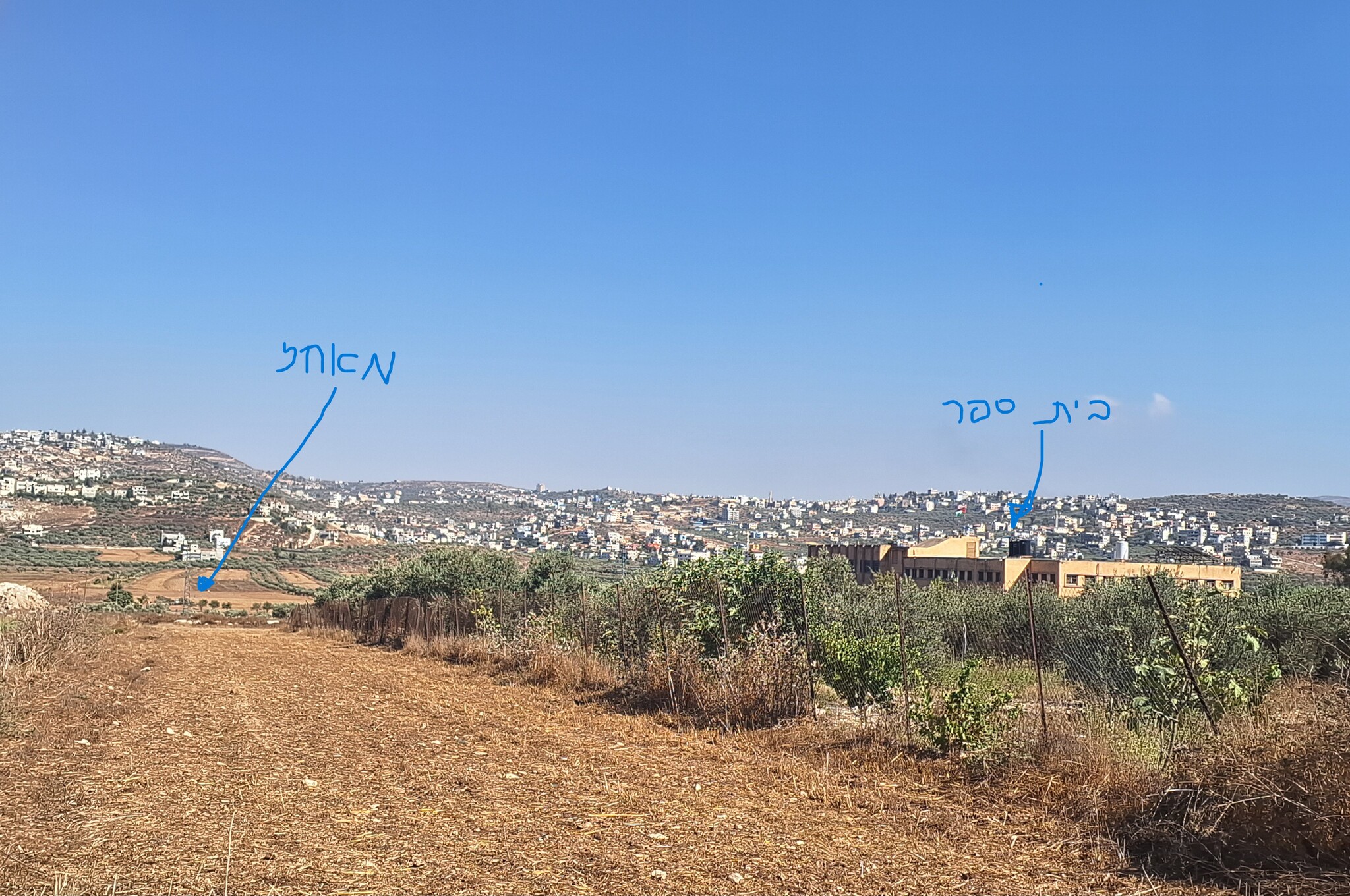 Ronit Dahan-RamatiAug-24-2026Huwara: The school on the outskirts of town and an outpost hidden among the trees
-
Jurish
See all reports for this place-
Jurish
An ancient village, of which 62% of the lands were defined after the 1995 agreements as Area B, while the remaining 38% Area C. Israel confiscated 17 dunams of the village's land for the construction of the Israeli Migdalim settlement, in addition to expropriating land for Road 505. In mid-2016, a road was blocked by the IDF (partly paved by the Palestinian Authority) that connected Jurish to Road 505. This is the shortest way to get to Jurish from the main road, without bypassing another 6.5 km through Qusra.
From 2014 to mid-2016, volunteers from the Watch checkpoint in the village held English, yoga and Hebrew classes for girls.
-