
Khalet a-Daba’: a tiny village and a lot of harassment from settlers


This time the shift was dedicated to a visit to the Dababsa family in Khalet a-Daba’ (The hyena Corner) because it was important to hear and see how they were doing and also to bring them groceries in the middle of Eid al-Adha which we could to thanks to your donations.
Khalet a-Daba’ is a tiny village, one of three which forms triangle on the hills around the settlements Mitzpe Avigayil and Mitzpe Yair: Mufarqara, Sha’ab al Butum and Khalat Al-daba.
We sat with Jaber, this time on a hill in front of the village houses with impressive posters painted on them of which we have sent photographs more than once. I asked him to tell us about the events of the last month.
Jaber tells about frequent events which take place almost every day and every night. During the day, the settlers come with their herds and go up to their fields so that their sheep can eat their barley intended for the food of the Dababsa family’s herd. And also, to break and uproot their trees. 200 trees were vandalized in the last month, says Jaber. The settlers brought three herds which ate the remains of the uprooted and broken trees.
Two weeks ago, when it happened, they called both the police and the Civil Administration. The civil administration ordered the police to destroy a tent symbolizing the hold on the land that the settlers had erected on a hill in front of them. So, they destroyed it but left the remains on the ground and did not take them away, so that at any moment the settlers can come back and put it up again. The Palestinians were told to file a complaint.
In another case, when they were on their land, soldiers came and threatened: “If you don’t leave here, they will shoot you.”
Although they saw the damaged trees, they did nothing to the settlers. Another complaint was filed and the matter is being handled by the lawyer, Neta Amar. Neta asked for all the photos from the event so she could handle the complaint. Jaber speaks quickly in anger and feverishly and it is very difficult to follow and to manage to write everything down despite my repeated requests He smiles and breathes and continues. The settlers continue with what they want to do. He says that yesterday they brought a tractor with a JCB shovel, which digs holes in preparation for planting more trees in a distant plot that we could not see from our place of residence. When they send us photos I will send later
Then he continues and says that 20 settlers arrived and continued the work of planting on the hill which they call Jabel Mashaha.
These are lands of the Dababsa, Hamamda and Amora families.
He explained to us that it is very close the Mughayir el Abid. (The Caves of the Slaves) Another remote place where they also live in caves most of the time and they also suffer a lot from the harassment of the settlers and the army.
And at night? A troop arrives just to patrol to show presence.
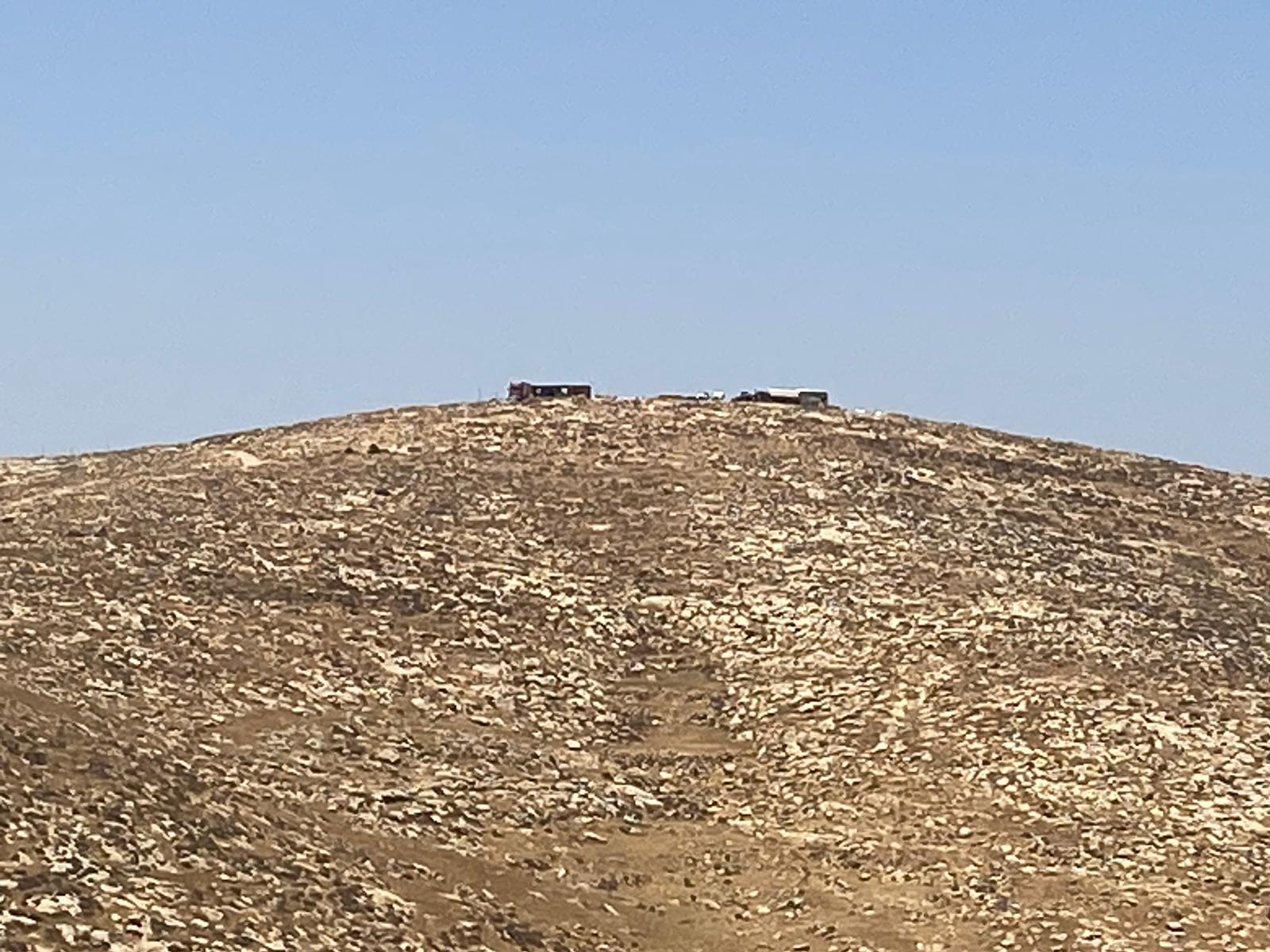
We also see from Khalet a-Daba’ in the distance on the hill the settlement (bus and hut) of the settler Amichai. We also reported about this in the reports from Mufarqara and Sha’ab al Butum.
Jaber says that there are volunteers from England, Ireland, Italy. Their presence mainly gives a feeling of security at night.
They can also take pictures without having their cameras taken from them which is what happens to them and the Israelis.
These are the words of Jaber Dababsa who calls himself Hares al Jabal, the guardian of the mountain.
Location Description
Masafer Yatta*
See all reports for this place
