
Masafer Yatta - evacuation danger

Masafer Yatta: the area where twelve Palestinian settlements are on the verge of demolition. Over a thousand people are facing deportation. We do not include any of the illegal outposts established in the area.
https://www.english.acri.org.il/post/evacuation-of-villagers-in-the-masafer-yatta-area-of-the-south-hebron-hillsMasafar Yatta
https://www.english.acri.org.il/post/acri-statement-regarding-forcible-transfer-of-palestinians-in-masafer-yattaIn light of the news about the impending deportation, we went to meet residents in the communities who are subject to deportation, and to get updated.
At-Tuwani:
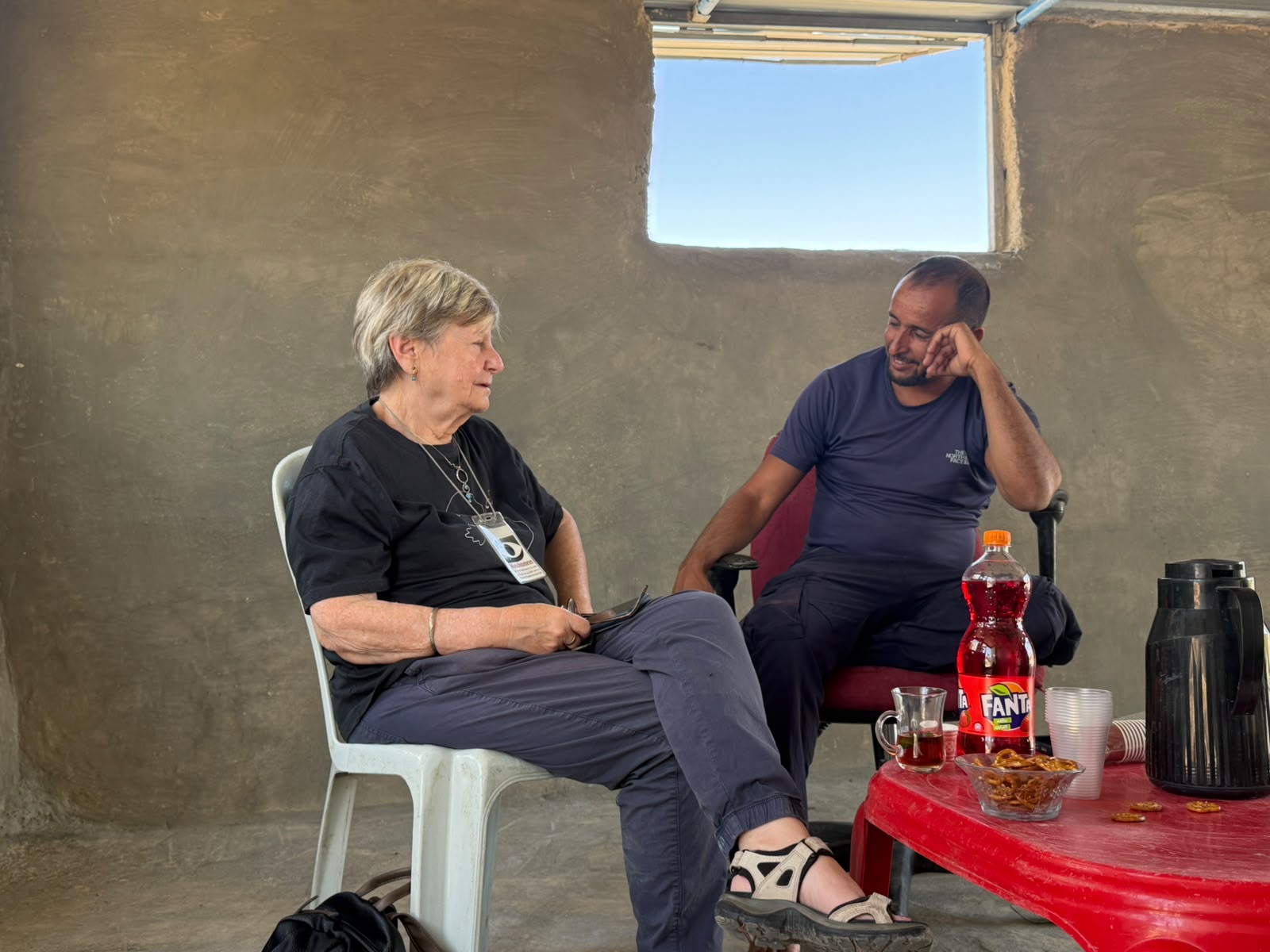
We met Jum’a Rabai and Nasser Adara. We have known Jum’a for nearly twenty years, since the beginning of the reports about the abuses committed by the residents of the Havat Ma’on outpost, on the hill just above At-Tuwani. Jum’a speaks fluent Hebrew and sends regards to Hagit and hopes to see her soon.
At the entrance to At-Tuwani on both sides of the road behind the cement barriers stand soldiers and behind them the Israeli flag. When we returned, neither they nor the flag were there.
Jum’a shows us videos of unidentified people walking in the areas between At-Tuwani and Ma’on farm, which belong to Hafez al-Huraini . (Following his attack by a settler from Ma’on farm several months ago, it was Hafez who was arrested and not the attacking settler). The residents of At-Tuwani are trying to fence off their plots so that the settlers cannot enter. But then the settlers with the help of the army destroy these fences. A kind of war of attrition.
Jum’a stories about the residents’ arrests:
A few days ago, a relative was arrested near the fence between the West Bank and Israel, on the Palestinian side. But he was arrested as an illegal worker, and was apparently taken to a detention center in Gush Etzion. He was tied to a chair for three days, blindfolded, without food or water and without sleep. They did not interrogate or talk to him. After three days he was released just like that, without any investigation or explanation. The villagers had searched for the man – they did not understand where he had gone, but the military authorities said that the man was not with them.
Another story: Four months ago, his son was arrested for days. He also tied and thrown on the floor, without food or drink. When his son was released, he, Jum’a, received a call from someone who identified himself as Itamar Ben-Gvir. Jum’a did not answer the call. After investigation, it turned out that even before the establishment of the government, all the families of the detainees received a phone number which was identified as Ben-Gvir.
One of the residents answered the phone and Ben-Gvir (or whoever was on the other end, human or automatic, announced that soon his son would be released.
Jum’a says that in general there is a worsening of the soldiers’ behaviour towards the residents. They suspect the collaboration between Ben-Gvir and the army.
They live in constant fear. When the children go alone, there is no certainty where they will end up, how they will return, and what will happen to them on the way. There used to be a feeling that there was a law, indeed one law for the Jews and one for the Palestinian residents, but at least there is a law. Now there is no law at all! The settlers allow themselves to do whatever they want.
Jum’a says that he is tired and physically exhausted from the day-to-day war with the problems which the neighbours from Ma’on Farm cause and which has been going on for many years. A real feeling of living in a war zone.
Khalet a-Daba’ and Shu’b al-Butum:
These two villages are included in an area that has been declared a fire area, and are threatened by demolition. We went with Nasser Adara to Khalet a-Daba’. He tells us that, in the meantime, the residents have not received written demolition orders, only oral notifications. We also met Nasser Nawaja’a from Susiya ( an investigator at B’tselem), and Bassel Adara (son of Nasser Adra, who writes in the Hebrew paper, Sihah Mekomit). They returned from the Mitzpe Yair area, and said that once again the flocks of the settlers came into the Palestinian fields, ate the budding wheat which had started to grow, and trampled everything.
Naser Nawaja’a says that there is a dialogue going on with the government offices , in an attempt to convince the Palestinians to evacuate by agreement and not resist. The demolition date was set for September, but demolition orders have not yet been received.
In the distance on the hills, in the Shu’b al-Butum area, we saw vehicles. Our hosts recognized them as the cars of the DCO, and guess they are handing out demolition orders. They say that recently, soldiers have been entering houses (caves, tents, shanties) at night, taking pictures of the ID cards in order to verify who the permanent residents are. Of course, that wakes and scares everyone.
A-Tuwani
See all reports for this place-
A-Tuwani
The locals came to a-Tuwani during the 20th century from the village of Yatta. They settled in abandoned ruins, utilizing the arable land, pastures for grazing sheep and the abundance of natural caves for habitation. The residents who settled in the caves came from families who could not purchase land for houses in the mother villages, as well as shepherds who did not have enough land to graze. They were joined by clan members who quarreled with other families in the mother locality.
Some of the residents today live in concrete buildings built above the caves. In the area of the village are several water cisterns and an ancient water well called 'Ein a-Tuwani. Local residents are forced to buy water in containers and transport them through many road blocks to the village. With the help of international organizations, an electrical system was installed in the village. In the late 90s of the 20tTh century, an elementary school was established in the serving several small villages in the area.
In 2004, MachsomWatch began visiting and reporting from the Khirbet Tuwani cave village, which suffers badly from the settlers of nearby outposts, and especially from the extremist Ma'on outpost. . The settlers contaminate cisterns, poison the flocks and uproot trees.Particularly notable is the harassment of children from the surrounding villages on their way to school in a-Tuwani, so much so that military escort of children is required to separate them from the attackers (this was arranged following an initiative of the organization's members). In the past year, the escort has been without the vital presence of overseas volunteers.
Near a-Tuwani there are several families who have returned to the caves due to the incessant demolitions of the civil administration (as there is a total construction ban in all of area C). Destroyed are not only residential and agricultural buildings, but also water pipes, machinery. Even water cisterns are clogged up. a-Tuwani residents have created an association for non-violent demolition protests, but in the past year the army’s harsh harassment and settler violence have intensified and escalated. The incident of the small generator confiscation, which left a young man paralyzed, is one of many examples - any legitimate protection of property rights leads to violence and even shootings by the army and the civil administration.
Updated April 2022
 Muhammad D.Oct-10-2026Smadar with Najeh in Umm Qusa
-
Mesafer Yatta
See all reports for this place-
This is happening in Fire Area 918 in the South Hebron Hills
On the eve of Remembrance Day (the day before Israel Independence Day), 4th May, 2022, the Israeli High Court decided on the transfer and expulsion of residents from 8 Palestinian communities in the area of Masafar Yata in the South Hebron Hills. Residents of the villages have been living under the threat of demolition, evacuation and expropriation since the IDF issued evacuation orders in 1999 based on the 1980s proclamation of their area of residence as a firing zone for IDF drills. None of the nearby settlements were included in this zone. The Masafer Yata Palestinian villages retain a special lifestyle and ancient agricultural culture. They also posess a clear historical documentation that testifies to a Palestinian settlement in this area, generations before the establishment of Israel, long ago in the caves and at later times outside them.
Evacuating residents from the area means destroying these historic villages and leaving entire families (about 2,000 people, children, adults, and the elderly) homeless. This is contrary to international law.
In June 2022, a firing drill started, and life became harder.
-
Susiya
See all reports for this place-
Susiya The Palestinian area lies between the settlement of Susya and a military base. The residents began to settle in areas outside the villages in the 1830s and lived in caves, tents and sukkot. To this day they maintain a traditional lifestyle and their livelihood is based on agriculture and herding. Until the 1948 war, the farmers cultivated areas that extended to the Arad area. As a result of the war, a significant portion of their land left on the Israeli side was lost. After the 1967 war and the Israeli occupation, military camps were established in the area, fire zones and nature reserves were declared, and the land area was further reduced. The Jewish settlement in Susya began in 1979. Since then, there has been a stubborn struggle to remove the remains of Palestinian residents who refuse to leave their place of birth and move to nearby town Yatta. With the development of a tourist site in Khirbet Susya in the late 1980s (an ancient synagogue), dozens of families living in caves in its vicinity were deported. In the second half of the 1990s, a new form of settlement developed in the area - shepherds' farms of individual settlers. This phenomenon increased the tension between the settlers and the original, Palestinian residents, and led to repeated harassment of the residents of the farms towards the Palestinians. At the same time, demolition of buildings and crop destruction by security forces continued, as well as water and electricity prevention. In the Palestinian Susya, as in a large part of the villages of the southern Hebron Mountains, there is no running water, but the water pipe that supplies water to the Susya Jewish settlement passes through it. Palestinians have to buy expensive water that comes in tankers. Solar electricity is provided by a collector system, installed with donation funds. But the frequent demolitions in the villages do not spare water cisterns or the solar panels and power poles designed to transfer solar electricity between the villages. Updated April 2021, Anat T.
-
